Inside India’s New Tech Frontier: Uttar Pradesh Unveils ₹1,000 Crore War Chest to Dominate Deep-Tech and Innovation
LUCKNOW — In what is being hailed as the most aggressive regional economic pivot in recent Indian history, the Government of Uttar Pradesh has officially unveiled its landmark Uttar Pradesh Startup Policy 2026. Armed with a massive ₹1,000 crore ($120 million) sovereign Fund of Funds, the policy represents a calculated bid by India’s most populous state to break the tech-monopoly of Bengaluru, Gurugram, and Mumbai, shifting the nation's startup gravity northward.
The policy, first reported by the Indian Startup Times, marks a structural shift in how regional governments in India foster high-growth enterprises. Rather than merely offering tax sops, Uttar Pradesh (UP) is positioning itself as a direct equity participant, co-investor, and infrastructure provider for the next generation of deep-tech, artificial intelligence, and space-tech pioneers.
The ₹1,000 Crore Fund: Decentralizing Venture Capital
At the heart of the 2026 policy is the newly established ₹1,000 Crore Fund of Funds. Unlike traditional subsidy-heavy models, this corpus will operate on a co-investment model, partnering with alternative investment funds (AIFs) registered with the Securities and Exchange Board of India (SEBI).
According to senior administrative officials close to the development, the state intends to leverage this fund to crowd-in private capital. For every rupee the state invests, partner venture capital firms are expected to bring in matching or multiplier capital, effectively creating a ₹3,000 to ₹5,000 crore investment runway for early-stage startups within the state over the next five years.
Key Pillars of the UP Startup Policy 2026
- Capital Amplification: A dedicated ₹1,000 crore Fund of Funds to co-invest with institutional venture capitalists.
- Deep-Tech Premium: Specialized grants, IP creation subsidies, and testing infrastructure specifically earmarked for AI, biotech, and robotics.
- The Rise of Tier-2 Hubs: Setting up world-class incubation centers outside the NCR region, focusing on Lucknow, Kanpur, Varanasi, and Prayagraj.
- Sustenance Allowances: Monthly stipends for validated early-stage founders to de-risk the transition from ideation to product-market fit.
Betting Big on Deep-Tech: Moving Past SaaS and E-Commerce
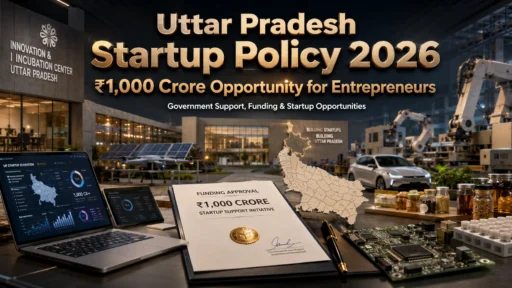
The most notable strategic pivot in the 2026 policy is its explicit bias toward "deep-tech." While the previous policy iterations focused heavily on e-commerce, logistics, and transactional fintech, the new framework prioritizes sectors with high IP barriers: semiconductor design, precision agriculture tech, defense systems, quantum computing, and advanced materials.
To catalyze this, the state is offering a 50% subsidy on patent filing costs (both domestic and international) and creating a specialized "Deep-Tech Sandbox" in partnership with premier academic institutions like IIT Kanpur and MNNIT Allahabad. Startups operating in these domains will also gain access to state-funded advanced labs, supercomputing facilities, and specialized fabrication units without the prohibitive upfront capital expenditures that typically cripple early-stage deep-tech ventures.
"We are no longer interested in just hosting back-offices or customer service operations," a senior policy advisor to the UP Chief Minister stated. "UP wants to own the intellectual property powering the next industrial revolution. This policy is designed to de-risk the research and development phase for deep-tech founders, which is traditionally ignored by commercial VCs."
The Battle of Geographies: Beyond the Noida-Gurugram Monopoly
For the past decade, Uttar Pradesh's startup success was almost entirely concentrated in Noida and Greater Noida—essentially functioning as extensions of the Delhi-National Capital Region (NCR). The Startup Policy 2026 aims to break this geographic asymmetry by funding and constructing ten new state-of-the-art "Innovation Hubs" across the state's interior.
These hubs, planned as public-private partnerships (PPP), will provide co-working spaces, high-speed fiber connectivity, legal clinics, and direct access to state bureaucrats to fast-track regulatory clearances. By targeting cities like Lucknow (AI and medical tech), Kanpur (defense and advanced materials), and Varanasi (handicrafts tech and agri-tech), the state aims to capitalize on the lower operational costs and vast talent pools graduating from local universities.
| Strategic Focus Area | Target Allocation / Support Metric | Primary Geographical Hubs |
|---|---|---|
| Fund of Funds | ₹1,000 Crore (Managed via SIDBI/AIFs) | Statewide allocation |
| Deep-Tech & AI Sandbox | Up to ₹25 Lakhs per startup for R&D | IIT Kanpur, Lucknow |
| Regional Innovation Hubs | 10 New PPP-model incubation centers | Varanasi, Prayagraj, Gorakhpur, Agra |
| IP & Patent Subsidy | 50% reimbursement on global patenting | Noida, Kanpur |
The Editorial View: Can UP Overcome the Talent Arbitrage?
From an investment banking and macroeconomic perspective, the UP Startup Policy 2026 is a highly sophisticated document. It addresses the critical pain points of early-stage capital scarcity and infrastructure bottlenecks. However, the true test of this policy will lie in execution and talent retention.
While Noida has successfully retained tech talent due to its proximity to Delhi, convincing top-tier engineering talent from IITs and NITs to build their companies in Kanpur or Gorakhpur remains an uphill battle. The state must couple these fiscal incentives with aggressive urban development, robust law-and-order guarantees, and a cultural ecosystem that appeals to a young, globalized workforce.
If executed correctly, the policy has the potential to trigger a "reverse brain drain" within India, drawing founders away from the saturated, high-cost ecosystems of South India to the hyper-efficient, lower-overhead environments of Uttar Pradesh. With a domestic market of over 240 million people, UP is not just a regulatory jurisdiction—it is one of the largest consumer markets in the developing world.
Frequently Asked Questions (FAQ)
1. How can early-stage startups apply for the ₹1,000 Crore Fund of Funds?
Startups cannot apply directly to the state treasury for equity funding. The fund operates on a Fund of Funds structure, meaning the Uttar Pradesh government will invest in SEBI-registered Venture Capital (VC) funds and Alternative Investment Funds (AIFs). Startups seeking equity investments must pitch to these partnered VC funds, which will evaluate proposals based on commercial viability and the policy's alignment guidelines.
2. Who is eligible for the deep-tech and regional subsidies under this policy?
To qualify for the specialized deep-tech grants, intellectual property subsidies, and regional incubation benefits, a startup must be registered under the DPIIT (Department for Promotion of Industry and Internal Trade) and have its primary registered office and operational base within the state of Uttar Pradesh. Special preferences and higher subsidy slabs are allocated to ventures operating in tier-2 and tier-3 cities like Kanpur, Lucknow, and Varanasi.