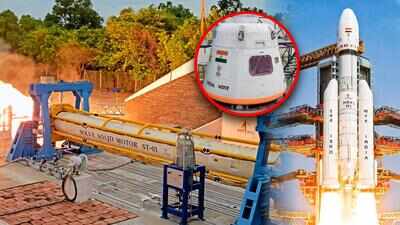
BENGALURU — In a significant milestone that brings India closer to its maiden human spaceflight mission, the Indian Space Research Organisation (ISRO) has successfully tested a newly developed solid rocket motor. Designed specifically to power the specialized test vehicle used for Gaganyaan’s upcoming high-altitude parachute deployment trials, the recent static test marks a crucial engineering hurdle cleared by the nation's premier space agency.
As the countdown to India’s first crewed orbital mission accelerates, propulsion experts and aerospace analysts are closely monitoring these rigorous ground tests. Parachute systems represent one of the most critical safety links in returning astronauts safely to Earth, and ISRO’s latest development underscores a meticulous approach to human-rated reliability.
Propulsion Breakthrough for Safety Systems
The newly tested motor is engineered to propel a dedicated test-bed rocket that will simulate extreme aerodynamic conditions and dynamic pressures. During actual flight, this vehicle will loft Gaganyaan's massive parachute cluster to high altitudes, allowing engineers to test deployment sequences under simulated re-entry stresses.
According to preliminary telemetry data released following the test firing at ISRO’s propulsion complexes, all primary performance parameters—including chamber pressure, thrust curves, and nozzle integrity—met or exceeded pre-test design models. This successful firing confirms the structural and thermal readiness of the motor for upcoming flight-test operations.
- Mission-Critical Objective: The motor powers a dedicated vehicle designed solely to validate the Gaganyaan crew module's complex multi-stage parachute deceleration system.
- Rigorous Testing: Static ground tests subject the propulsion hardware to extreme thermal and mechanical loads to guarantee zero-failure margins during actual flight.
- Human-Rating Focus: Every component developed under the Gaganyaan umbrella now undergoes strict redundancy and safety evaluations to meet international crewed spaceflight standards.
The Gaganyaan Deceleration Architecture

Bringing a multi-tonne crew module safely back through Earth’s atmosphere is an engineering tour de force. The Gaganyaan descent system relies on a sequential deployment of multiple parachutes, including pilot chutes, drogue chutes, and massive main parachutes designed to slow the capsule down to a safe landing velocity.
Because these parachutes must deploy at supersonic and transonic speeds while enduring violent thermal and aerodynamic buffeting, ground simulations alone are insufficient. The rocket motor tested by ISRO will provide the exact flight trajectory and dynamic pressure environment required to test these parachutes in real-world atmospheric conditions.
| Parameter | Specification / Status |
|---|---|
| Agency | Indian Space Research Organisation (ISRO) |
| Primary Focus | Solid rocket motor for parachute test vehicle |
| Target Mission | Gaganyaan Human Spaceflight Programme |
| Test Venue | ISRO Propulsion Test Facility, Bengaluru region |
| Significance | Validates deceleration dynamics under high dynamic pressure |
Strategic Context and Global Aerospace Outlook
ISRO’s latest propulsion milestone comes at a time of intense activity for India’s space sector. Beyond uncrewed precursor missions, the agency is fine-tuning its astronaut training protocols, life support systems, and launchpad infrastructure at the Satish Dhawan Space Centre in Sriharikota.
Industry observers note that mastering human-rated parachute deployment places India into an elite club of spacefaring nations capable of independent crewed return operations. While commercial partnerships and international space cooperation continue to expand—highlighted by recent diplomatic engagements involving high-level technology exchanges—ISRO remains deeply committed to indigenous engineering for core safety systems.
What Lies Ahead for the Test Campaign
With the static motor test successfully completed, ISRO is expected to integrate the propulsion unit into the test vehicle assembly. Subsequent milestones will include integrated wet dress rehearsals and the formal clearance for the flight test campaign off the coast of India.
As scientists and engineers analyze the high-speed telemetry from the recent firing, public and scientific anticipation continues to build. Every successful static test brings India one definitive step closer to seeing its national flag carried into low-Earth orbit by its own astronauts.
Frequently Asked Questions
What is the purpose of the new ISRO motor test?
The newly tested solid rocket motor is designed to power a specialized test vehicle that will simulate extreme flight conditions to test and validate the parachute deployment system for the Gaganyaan crew module.
Why are parachute tests crucial for the Gaganyaan mission?
Parachutes are vital for safely decelerating the crew module as it re-enters Earth's atmosphere. Testing them under realistic aerodynamic and thermal loads ensures the absolute safety of future Indian astronauts during return and landing.