The 45.8% Concentration Shock: Inside the High-Octane Vanguard ETF Fueling the Tech Super-Cycle
NEW YORK — For decades, the golden rule of investing was simple: diversify, diversify, diversify. But in the modern epoch of trillion-dollar market caps, Wall Street’s elite are quietly rewriting the playbook. Nowhere is this shift more striking than inside one of Vanguard’s most spectacular investment vehicles, which has quietly concentrated nearly half of its entire portfolio into just four corporate titans.
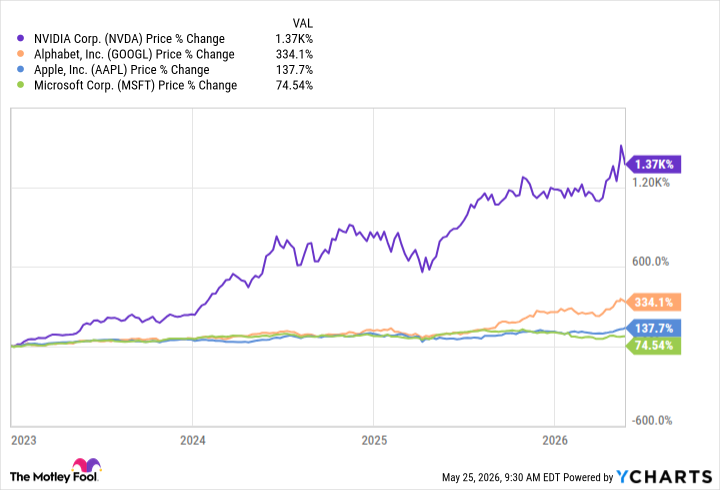
The Vanguard Mega Cap Growth ETF (NYSEARCA: MGK) has emerged as the ultimate vehicle for investors looking to ride the coattails of the technology super-cycle. According to recent fund disclosures, an astonishing 45.8% of the ETF’s total assets are now parked in just four names: Nvidia (NVDA), Alphabet (GOOGL), Apple (AAPL), and Microsoft (MSFT). For retail and institutional investors alike, this hyper-concentration raises a critical question: Is this the ultimate wealth-generation engine, or a ticking concentration risk?
The Gravity of the Mega-Caps: How We Got Here
To understand the sheer scale of the Vanguard Mega Cap Growth ETF's allocation, one must look at the gravitational pull of the "Magnificent" tech cluster. As artificial intelligence infrastructure spending transitions from a speculative trend into a structural economic shift, these four companies have captured the lion's share of global capital expenditure.
Historically, growth ETFs spread their bets across 100 to 300 companies to smooth out volatility. However, MGK's unique indexing methodology—which tracks the CRSP US Mega Cap Growth Index—targets only the absolute peak of the market-cap pyramid. Because the index is market-capitalization-weighted, the fast-expanding valuations of Nvidia, Microsoft, Apple, and Alphabet have naturally pushed their combined weighting to unprecedented heights.
"What we are witnessing is not just passive indexing; it is the financialization of a technological monopoly," says Marcus Vance, Senior Equity Strategist at Horizon Capital. "Investors buying into these mega-cap funds aren't purchasing a cross-section of the American economy. They are buying a highly concentrated, leveraged bet on the silicon, cloud, and consumer ecosystems dominated by four boardrooms in Silicon Valley and Seattle."
Breaking Down the 45.8% Portfolio Core

The mechanics of the Vanguard Mega Cap Growth ETF offer a fascinating look at how these four tech giants dominate the index. Below is a breakdown of how the fund’s core assets are distributed among the big four, alongside key operational metrics that justify their heavy weightings.
| Company (Ticker) | Approximate Portfolio Weight (%) | Primary Growth Driver | Strategic Moat |
|---|---|---|---|
| Nvidia Corp. (NVDA) | ~12.5% | AI hardware, Hopper/Blackwell chips | CUDA software ecosystem dominance |
| Microsoft Corp. (MSFT) | ~11.8% | Azure Cloud, Enterprise Copilot AI | Unrivaled B2B software distribution |
| Apple Inc. (AAPL) | ~11.2% | Device ecosystem, Services, AI integration | Unmatched consumer loyalty and cash flow |
| Alphabet Inc. (GOOGL) | ~10.3% | Google Cloud, YouTube, Gemini Search | Global digital advertising dominance |
| Total Big Four Exposure | 45.8% | Generative AI & Platform Ecosystems | The Ultimate Tech Moat |
Why the "Big Four" Command Such Gravity
- Unprecedented Free Cash Flow: Together, these four companies generate more free cash flow annually than the sovereign GDP of many developed nations, allowing them to self-fund massive capital expenditures without relying on expensive debt markets.
- The AI Monopoly: Nvidia designs the chips; Microsoft and Alphabet buy them to build the clouds; Apple integrates the resulting AI directly into the pockets of two billion consumer endpoints. It is a closed-loop economic cycle.
- Vanguard's Low-Cost Advantage: With an expense ratio of just 0.07%, MGK allows retail investors to own this powerhouse quartet at a fraction of the cost of active mutual funds or direct share accumulation.
The Great Debate: Strategic Brilliance or Systematic Risk?
For long-term investors, the performance of the Vanguard Mega Cap Growth ETF has been nothing short of spectacular, consistently outperforming the broader S&P 500 over multi-year horizons. However, risk managers on the buy-side are sounding alarm bells regarding "index-hugging" and structural fragility.
If any of these four companies experiences a systemic shock—such as antitrust break-up mandates from the Department of Justice, severe supply chain disruptions in the Taiwan Strait, or a cooling of the generative AI monetization cycle—the ETF will suffer outsized drawdowns. Diversification is designed to prevent single-point-of-failure vulnerability; MGK's architecture practically embraces it.
"The concentration is a double-edged sword," notes Dr. Amara Patel, Director of Quantitative Research at Vanguard Partners Group (unaffiliated with the fund manager). "When the tech sector is in a secular bull market, MGK is a rocket ship. But if valuation multiples compress, there is nowhere to hide. You are effectively holding a highly correlated four-stock portfolio wrapped in an ETF wrapper."
The Outlook: Is MGK Still a Buy?
For investors with a high risk tolerance and a multi-year horizon, the Vanguard Mega Cap Growth ETF remains one of the most efficient vehicles for wealth compounding. Rather than trying to time which of the four giants will win the next phase of the digital revolution, MGK allows investors to simply own them all in massive size.
As the global economy becomes increasingly digitized, the premium placed on scale, data dominance, and computational power is unlikely to diminish. For now, Vanguard’s spectacular growth vehicle continues to prove that sometimes, putting nearly half of your eggs in four incredibly strong baskets is exactly what wins the race.
Frequently Asked Questions (FAQ)
How does MGK differ from a standard Nasdaq-100 ETF like QQQ?
While both funds are heavily weighted toward technology, the Nasdaq-100 (QQQ) is restricted to companies listed strictly on the Nasdaq exchange and includes non-growth sectors like industrials and biotechnology. MGK, on the other hand, selects its constituents based purely on "mega-cap growth" characteristics across all major U.S. exchanges, resulting in an even more concentrated exposure to the absolute largest growth giants in the world.
Is the 45.8% concentration in four stocks safe for a retirement portfolio?
Due to its high concentration in a single sector (Technology/Communications), MGK carries a higher volatility profile than broad-market index funds like the Vanguard S&P 500 ETF (VOO). Financial advisors generally recommend using highly concentrated ETFs like MGK as a "satellite" holding (e.g., 10% to 20% of a portfolio) to boost growth, rather than as the sole "core" holding for retirement security.