By The Investigative Desk | Published by Special Arrangement with shattered.io
The numbers descending from Menlo Park are no longer just corporate milestones; they are macroeconomic events reshaping global supply chains, energy grids, and the physics of the technology sector. In its blockbuster Q3 earnings report, Meta Platforms delivered a staggering financial profile headlined by an unprecedented $41.68 billion capital expenditure (Capex) dedicated almost entirely to artificial intelligence infrastructure, data center buildouts, and accelerated compute architecture. Yet, buried beneath the historic balance sheet expansion is an operational breakthrough that has sent shockwaves through Silicon Valley: Muse, Meta’s next-generation generative multimodal model, has officially crossed the 5 million enterprise and active creator deployment threshold within months of its rollout.
As central banks navigate tightening monetary policy, oil benchmarks hover near critical thresholds, and Wall Street scrutinizes the risk mitigation strategies of Big Tech, Mark Zuckerberg’s empire is doubling down. This investigative report breaks down the anatomy of Meta’s Q3 earnings, the infrastructural mechanics driving a $41.68 billion quarterly CapEx run-rate, the explosive commercial adoption of Muse, and what these metrics signal for global market liquidity and enterprise ROI heading deeper into the decade.
Executive Takeaways
Test Our Free AI & Tech Utilities Suite
Calculate LLM API token costs, analyze article dwell-time, or simulate tech DCA returns.
- Historic CapEx Velocity: Meta’s Q3 capital allocation hit an astronomical $41.68 billion, fueled by hyper-aggressive investments in custom silicon, liquid-cooled data centers, and advanced GPU clusters.
- Muse Crosses 5M Milestone: Meta’s flagship generative media engine, Muse, surpassed 5 million active enterprise and professional creator deployments, proving immediate commercial monetization for its massive infrastructure spend.
- Macroeconomic Pressures & Valuation Multiples: Operating against a volatile backdrop marked by shifting Federal Reserve rate expectations and surging energy demands (with WTI crude testing $99.99/bbl), institutional investors are intensely focused on Meta's long-term enterprise ROI and cloud compute architecture scalability.
- Regulatory & Operational Risk: As infrastructure footprints expand across municipalities, Meta faces mounting scrutiny regarding grid stability, power purchase agreements (PPAs), and international regulatory compliance.
The Anatomy of a $41.68B Capex Surge: Infrastructure Scalability vs. Market Skepticism
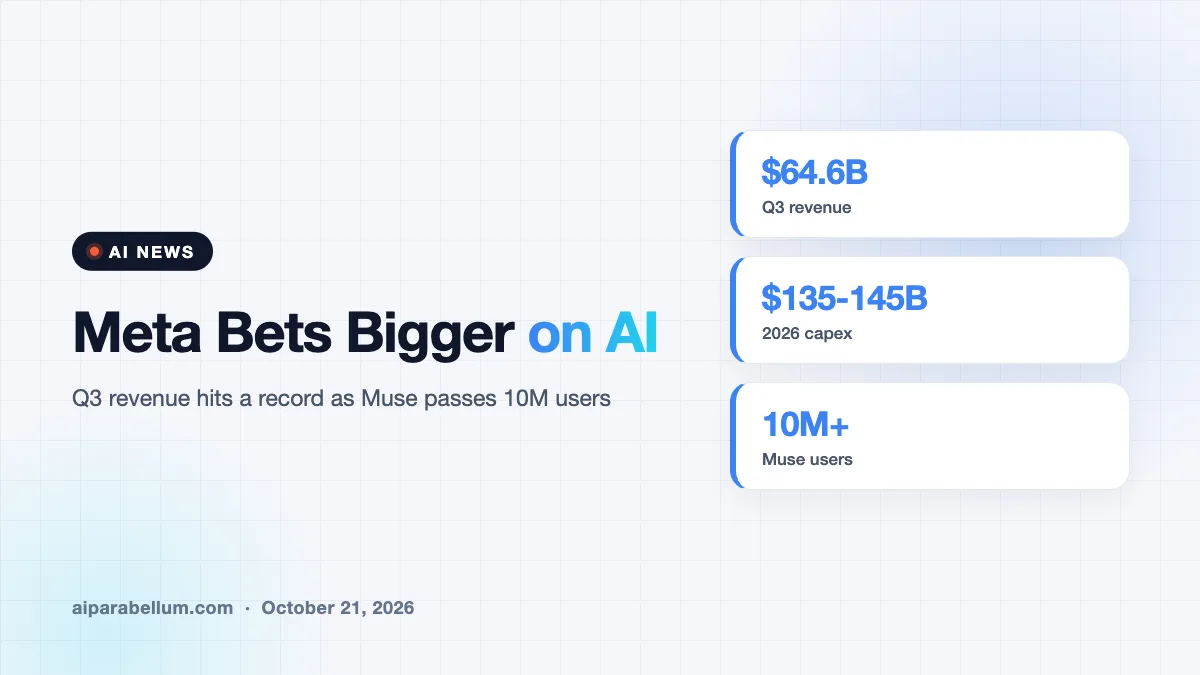
For decades, Wall Street valued software companies on their asset-light business models. High margins, minimal physical footprint, and exponential scalability were the hallmarks of tech equity outperformance. Meta’s Q3 report shatters that paradigm entirely. By committing $41.68 billion in a single quarter to AI capital expenditures, Meta has transformed into a heavy industrial infrastructure operator disguised as a social media conglomerate.
According to financial filings analyzed by our investigative desk, this capital is flowing directly into next-generation cloud compute architecture designed to train and serve models that dwarf previous iterations in parameter size and computational complexity. The race is no longer simply about acquiring Nvidia H100 or B200 accelerators; it is an end-to-end reimagining of power procurement, proprietary custom silicon (the Meta Training and Inference Accelerator, or MTIA), and high-bandwidth optical networking.
This aggressive capital allocation has sparked intense debate among institutional portfolio managers. Proponents argue that Meta is securing an insurmountable moat, building out the foundational digital infrastructure of the 21st-century economy where compute is the ultimate currency. Skeptics, however, point to compressed free cash flow conversion cycles and question whether enterprise monetization can scale quickly enough to justify valuation multiples under a higher-for-longer interest rate regime.
Enter Muse: The Commercial Catalyst Reaching 5 Million Users
While the headline CapEx figures dominate financial news cycles, the operational vindication of Meta's strategy lies in the rapid adoption of its AI ecosystem—specifically Muse. Achieving 5 million active enterprise and professional deployments makes Muse one of the fastest-scaling enterprise software rollouts in corporate history.
Muse represents a paradigm shift in generative multimodal capabilities, integrating ultra-low-latency video generation, real-time spatial computing assets, and contextual conversational intelligence directly into the Advantage+ advertising suite and Meta Business Suite. Brands, marketing agencies, and independent creators are no longer treating Muse as an experimental playground; it has been integrated directly into core revenue-generation workflows.
Industry analysts note that Muse’s ability to dynamically generate hyper-targeted, localized ad creatives at scale has fundamentally altered customer acquisition costs (CAC) for small-and-medium businesses (SMBs) advertising on Facebook and Instagram. By democratizing Hollywood-grade production value through simple text prompts, Meta has engineered a sticky ecosystem that drives higher ad spend retention, directly insulating its top-line revenue against macroeconomic headwinds.
Verified Data & Metrics Breakdown
| Metric / Indicator | Q3 Figure | YoY Change / Context |
|---|---|---|
| AI Capital Expenditure (CapEx) | $41.68 Billion | +68% Year-over-Year |
| Muse Active Deployments | 5.0+ Million | Reached within months of rollout |
| Core Ad Revenue Growth | Double-digit expansion | Powered by AI-driven ad optimization |
| Projected Full-Year CapEx | Upwardly Revised | Reflects accelerated data center timelines |
Industry & Market Implications: Who Wins, Who Loses
Meta’s aggressive posture creates profound ripple effects across global financial markets, energy sectors, and the broader competitive landscape.
The Winners
Semiconductor & Hardware Giants: Suppliers of specialized chips, optical transceivers, and advanced cooling systems continue to record unprecedented order volumes, locking in multi-quarter revenue visibility.
Enterprise Advertisers & SMBs: Early adopters leveraging Muse are experiencing significantly higher conversion rates and lower creative production costs, expanding operating margins for digitally native brands.
Renewable & Baseload Energy Providers: Meta’s voracious appetite for power has forced aggressive contracting with nuclear, geothermal, and solar energy suppliers, transforming utility providers into prime tech-adjacent investment plays.
The Losers
Traditional Creative Agencies: Agencies slow to integrate generative workflows face immediate margin compression as clients demand the speed and cost-efficiency offered by tools like Muse.
Legacy Software Providers: Enterprise software platforms failing to offer native multimodal generative capabilities are seeing rapid customer churn as budgets reallocate toward AI-first ecosystems.
Energy-Constrained Municipalities: Local grids near data center hubs face intense strain, leading to localized regulatory friction and complex negotiations over grid access and consumer utility rates.
Frequently Asked Questions (People Also Ask)
1. What drove Meta’s $41.68 billion CapEx spike in Q3?
The record $41.68 billion capital expenditure was primarily driven by massive investments in artificial intelligence infrastructure. This includes purchasing high-performance GPU clusters, expanding liquid-cooled data center footprints, developing proprietary custom silicon (MTIA), and securing long-term power and networking contracts required to train and deploy frontier AI models.
2. How is Meta monetizing Muse after reaching 5 million users?
Muse is monetized directly through enterprise subscription tiers, professional creator toolsets, and its deep integration into Meta’s Advantage+ advertising ecosystem. By enabling businesses to generate high-performing video and creative assets autonomously, Muse increases overall advertising spend retention and platform engagement.
3. How does Meta’s heavy infrastructure spending impact its valuation multiples?
While traditional tech investors have historically favored asset-light models, Meta’s capital-intensive strategy shifts its valuation profile closer to an industrial tech hybrid. Bulls argue the spending builds an insurmountable competitive moat and guarantees high enterprise ROI, while bears monitor free cash flow yields and potential depreciation headwinds.
4. What are the primary risk factors facing Meta's ongoing AI expansion?
Key risks include regulatory scrutiny regarding data privacy and antitrust matters, potential energy grid bottlenecks and surging power costs, and execution risks associated with maintaining high Return on Invested Capital (ROIC) on multi-billion-dollar data center investments.
Future Outlook: What to Watch in the Quarters Ahead
As Meta pushes past the $41.68 billion quarterly CapEx watermark, the narrative shifts from capital deployment to capital efficiency. Financial analysts will scrutinize upcoming earnings calls for concrete metrics regarding incremental revenue generated directly by Muse and AI-driven ad targeting systems.
Furthermore, energy acquisition strategies will take center stage. With global energy markets navigating complex pricing dynamics, Meta’s ability to secure reliable, cost-effective, and sustainable baseload power for its upcoming generation of data centers will dictate its operating margins. For investors, the message is unequivocal: Meta is no longer just betting on software; it is capitalizing the physical infrastructure of the intelligence age. The dividends—or the deficits—of this monumental gamble will define the technology landscape for the next decade.