Executive Takeaways
- Unprecedented Capital Allocation: Meta’s Q3 earnings report revealed a staggering $41.68 billion designated for AI-driven capital expenditures, redefining hyperscale infrastructure investments against a backdrop of macroeconomic tightening.
- The Muse Inflection Point: Meta’s next-generation generative framework, Muse, officially surpassed 5 million active enterprise and creator deployments, signaling a rapid path to monetization.
- Macroeconomic Crosswinds: The aggressive spend occurs amid complex global market liquidity shifts, including shifting Federal Reserve policy expectations and surging energy demands tied to WTI crude hovering near $99.99.
- Valuation Multiples and Risk: Wall Street analysts are aggressively reassessing free cash flow yields and return on invested capital (ROIC) as Big Tech enters a high-stakes infrastructure arms race.
NEW YORK — In an earnings season already defined by macro-economic friction and volatile asset pricing, Meta Platforms has delivered a financial statement that fundamentally alters the valuation framework for the entire technology sector. Reporting a jaw-dropping $41.68 billion in quarterly artificial intelligence capital expenditures (Capex), Chief Executive Mark Zuckerberg and Chief Financial Officer Susan Li have signaled that Meta is doubling down on foundational infrastructure scalability, regardless of near-term margin compression.
Yet, buried beneath the staggering headline-grabbing expenditure figures lies a critical product milestone that justifies the aggressive capital allocation: Muse, the company’s flagship generative multimedia and neural synthesis engine, has officially crossed the 5 million active deployment threshold. For institutional investors, venture capitalists, and enterprise technology leaders scrutinizing the intersection of cloud compute architecture and monetization, this report serves as a definitive case study in high-stakes technological transformation.
The Catalytic Shift: Unpacking Meta’s $41.68 Billion AI Capex
Test Our Free AI & Tech Utilities Suite
Calculate LLM API token costs, analyze article dwell-time, or simulate tech DCA returns.
For the past twenty-four months, Wall Street has monitored an escalating infrastructure arms race among hyperscalers. Alphabet, Microsoft, Amazon, and Meta have systematically transformed data center real estate, silicon supply chains, and power grid capacities. However, Meta’s latest Q3 disclosures represent an exponential leap in capital velocity.
The $41.68 billion AI Capex figure is not merely a line item for server procurement; it represents an exhaustive, vertically integrated overhaul of Meta’s cloud compute architecture. To sustain the training and real-time inference workloads of advanced foundational models, the company has had to secure massive allotments of next-generation AI accelerators, architect proprietary custom silicon (the Meta Training and Inference Accelerator, or MTIA), and secure long-term renewable and baseload energy contracts.
From a risk mitigation standpoint, this spending velocity has triggered intense debate across financial institutions. Skeptics argue that such capital intensity risks diminishing free cash flow yields and compressing price-to-earnings multiples. Conversely, executive leadership maintains that under-investing in the generative AI paradigm poses an existential threat to long-term market share. By front-loading infrastructural capacity, Meta aims to eliminate bottlenecks that currently plague competitors struggling with GPU scarcity and power latency.
Muse Hits 5 Million: Translating Compute into Commercial Velocity
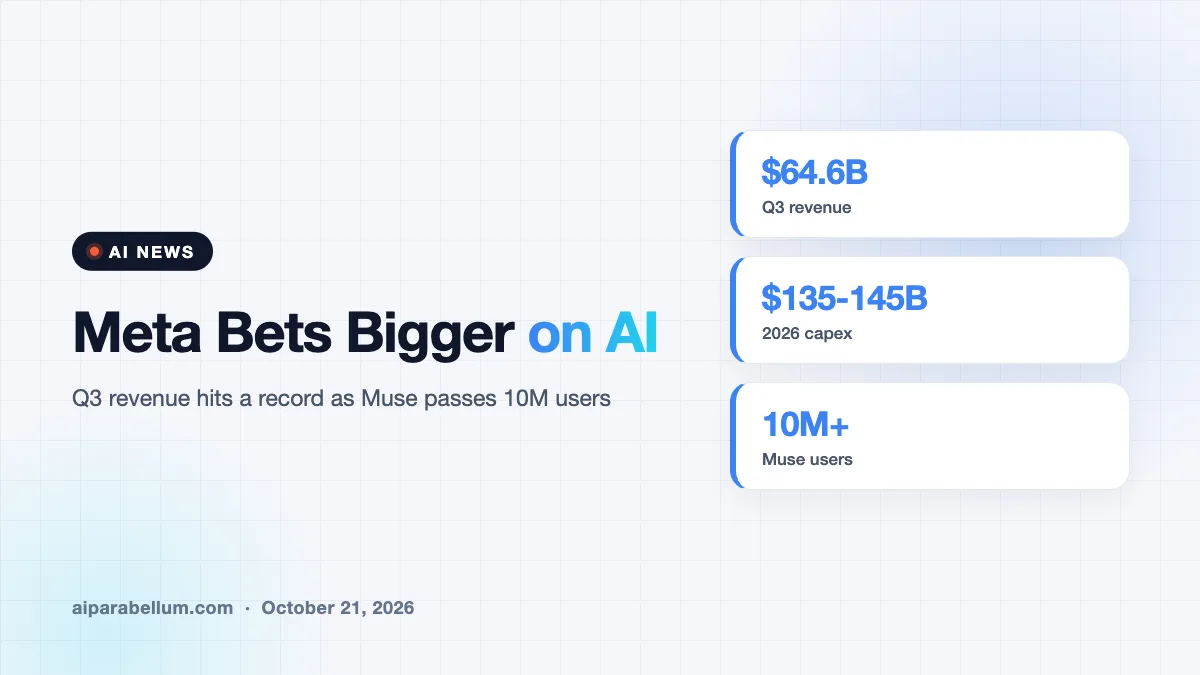
Critics of Big Tech's aggressive infrastructure spending have long demanded tangible evidence of product-market fit and enterprise ROI. Meta answered that critique in Q3 by highlighting the rapid adoption curve of Muse.
Reaching 5 million active enterprise and professional creator deployments faster than any comparable generative media architecture in tech history, Muse has transitioned from a bleeding-edge research project into a core revenue driver. The platform leverages advanced neural representations to empower real-time video generation, high-fidelity audio synthesis, and automated ad-creative optimization across the Facebook, Instagram, and WhatsApp ecosystems.
Enterprise adoption has proven particularly lucrative. Brands leveraging Muse’s API integrations report a dramatic reduction in creative production overhead coupled with a measurable lift in campaign conversion rates. This dual engine—driving internal operational efficiencies while supercharging digital advertising effectiveness—provides the fundamental justification for the multi-billion-dollar infrastructure outlay underpinning it.
Verified Data & Metrics Breakdown
To contextualize Meta’s Q3 financial and operational performance, the following data matrix outlines key metrics extracted from the wire reports and regulatory filings:
| Metric / Indicator | Q3 Reported Figure | Strategic Significance |
|---|---|---|
| AI Capital Expenditures (Capex) | $41.68 Billion | Accelerated data center expansion, custom silicon deployment, and power acquisition. |
| Muse Active Deployments | 5 Million | Validates enterprise and creator demand, establishing a clear path to software monetization. |
| Macroeconomic Backdrop (WTI Crude) | ~$99.99 per barrel | Reflects broader energy cost pressures impacting heavy compute facilities and data center operations. |
| Core Advertising Margin Contribution | Robust / Stable | Core ad revenue continues to fund the aggressive AI infrastructure buildout without immediate liquidity strain. |
Industry & Market Implications
The ripple effects of Meta’s Q3 earnings report extend far beyond Menlo Park, impacting global financial markets, semiconductor manufacturers, and energy markets.
- Semiconductor and Hardware Manufacturers: Companies supplying advanced networking gear, high-bandwidth memory (HBM), and specialized processors remain the primary immediate beneficiaries of Meta’s $41.68B Capex commitment. Demand visibility for Tier-1 hardware vendors has been extended well into late 2027.
- Energy Infrastructure and Grid Operators: With data center power demands skyrocketing, tech giants are increasingly intersecting with traditional energy markets. The convergence of heavy AI compute loads with macroeconomic realities—such as WTI crude testing elevated thresholds near $99.99—places premium value on energy efficiency, proprietary power generation, and nuclear baseload agreements.
- Regulatory Compliance and Antitrust Scrutiny: As Meta consolidates its leadership in generative foundational models and scales proprietary platforms like Muse, regulatory bodies in both the European Union and the United States are expected to heighten scrutiny regarding ecosystem lock-in and computational gatekeeping.
Frequently Asked Questions (People Also Ask)
Why is Meta spending $41.68 billion on AI Capex in a single quarter?
Meta’s massive capital expenditure reflects its long-term strategic bet on artificial intelligence infrastructure. This funding covers the physical and digital architecture required to train next-generation models, build advanced data centers, procure scarce specialized silicon, and secure necessary power agreements to maintain global market leadership.
What is Muse and how does it generate revenue for Meta?
Muse is Meta’s state-of-the-art generative multimedia and neural synthesis platform. It enables creators and enterprises to generate high-quality video, audio, and advertising assets efficiently. Revenue is generated through enterprise API subscriptions, premium creative toolsets, and enhanced ad-targeting capabilities that drive higher advertiser ROI on Meta’s platforms.
How does macroeconomic volatility and energy pricing impact Meta’s AI buildout?
Massive AI data centers require unprecedented amounts of electricity. Fluctuations in energy markets—exemplified by elevated commodity benchmarks like WTI crude near $99.99—directly influence the operational expenditure (OpEx) of powering and cooling these massive computing clusters, pushing hyperscalers to invest heavily in independent renewable and nuclear energy sources.
What are the primary risks associated with Meta’s current capital allocation strategy?
The primary risks include potential over-provisioning of hardware if AI adoption slows, near-term compression of free cash flow, and regulatory headwinds regarding data privacy and market dominance. However, executive leadership views these risks as secondary to the existential danger of falling behind in the AI revolution.
Future Outlook & Strategic Milestones
As Meta looks toward the upcoming fiscal year, the narrative will inevitably shift from capital deployment to capital efficiency. Wall Street will demand granular proof that the $41.68 billion quarterly run-rate is translating into durable, high-margin revenue streams. Key milestones to watch over the next four quarters include:
- Scaling Beyond 5M: Monitoring the enterprise retention and upgrade rates for Muse as it expands into new international markets and specialized industrial verticals.
- Energy Independence Initiatives: Tracking Meta’s partnerships with clean energy providers to power next-generation data centers without incurring prohibitive operational cost increases.
- Silicon Diversification: Assessing the performance and deployment scale of proprietary MTIA chips in reducing reliance on third-party semiconductor suppliers.
Ultimately, Meta’s Q3 report marks a Rubicon moment for corporate technology finance. The era of conservative balance sheet management has been superseded by an aggressive, infrastructure-first paradigm where scale dictates survival. For institutional investors navigating this new normal, the message is unequivocal: the AI transformation is no longer theoretical—it is a capital-intensive, physical reality reshaping the global economy.