Executive Takeaways
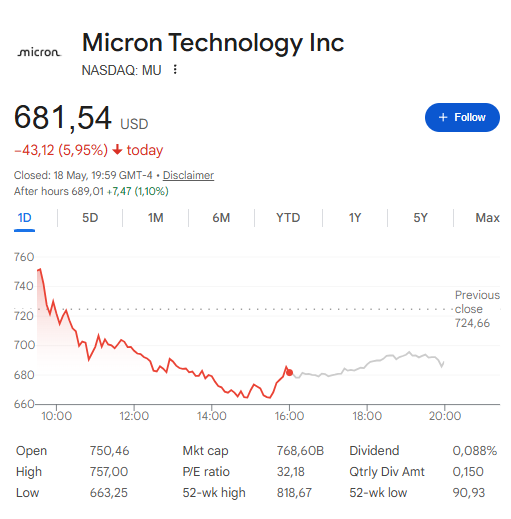
- Equity Market Dislocation: Shares of Micron Technology Inc. (NASDAQ: MU) experienced a sharp, high-volume sell-off following supply chain bottlenecks, margin contraction concerns, and extreme capacity trade-offs between High-Bandwidth Memory (HBM) and standard DRAM output.
- The HBM Capacity Cannibalization Paradox: Surging demand for HBM3e memory modules powering next-generation artificial intelligence compute architecture has forced memory fabrication plants to divert silicon wafers away from standard DDR5 and LPDDR5X production lines at a ratio of approximately 3:1, accelerating broad memory-chip shortages.
- Downstream Capital Allocation Pressure: Cloud hyperscalers, automotive Tier-1 suppliers, and enterprise hardware original equipment manufacturers (OEMs) are facing rising component procurement bills, threatening near-term corporate earnings and enterprise IT return on investment (ROI).
- Structural Valuation Compression: Wall Street analysts are aggressively recalibrating valuation multiples, balancing Micron’s long-term market dominance against immediate front-end yield challenges, elevated capital expenditures (CapEx), and inventory allocation imbalances.
The Catalyst: A Paradox of Peak Demand and Supply Bottlenecks
Test Our Free AI & Tech Utilities Suite
Calculate LLM API token costs, analyze article dwell-time, or simulate tech DCA returns.
In a sharp reminder of the cyclical volatility inherent to the semiconductor capital equipment and memory sectors, Micron Technology Inc. watched its equity valuation contract significantly during high-volume trading. The sell-off, which sent shockwaves across the Philadelphia Semiconductor Index (SOX), was not triggered by a collapse in end-user appetite, but rather by the friction of a historic structural transition within global microelectronics manufacturing.
As enterprise compute demand pivots decisively toward generative artificial intelligence deployment, the global memory industry has slammed into an operational brick wall. Micron, alongside its South Korean counterparts SK Hynix and Samsung Electronics, is grappling with an unprecedented reallocation of silicon wafer capacity. To satisfy the demands of hyperscale cloud providers—including Microsoft, Amazon Web Services, Alphabet, and Meta—and graphics processing unit (GPU) vendors like NVIDIA, Micron has aggressively repurposed cleanroom floor space toward High-Bandwidth Memory (HBM3e and HBM4 architectures).
However, the physics of microchip fabrication enforce severe operational trade-offs. Manufacturing advanced HBM dies requires complex 3D stacking, advanced TSV (Through-Silicon Via) interconnect technology, and significantly larger die sizes compared to conventional DRAM. For every bit of HBM manufactured, approximately three times the wafer capacity of standard DDR5 memory is consumed. Consequently, while Micron's HBM capacity is fully booked through calendar year 2025, the deliberate curtailment of standard server, PC, and mobile memory lines has sparked structural shortages across the broader technology ecosystem—creating a margin squeeze that has panicked institutional investors.
Inside the Fab: Yield Dynamics, CapEx Intensity, and Wafer Trade-Offs
To understand the mechanics driving Micron’s stock plunge, one must look at the front-end fabrication processes at the company’s mega-fabs in Boise, Idaho, and Taichung, Taiwan. The transition to the advanced 1-beta (1b) and upcoming 1-gamma (1g) DRAM node architectures—the latter utilizing Extreme Ultraviolet (EUV) lithography—has proven capital-intensive and fraught with packaging yield complications.
While HBM commands premium pricing and elevated average selling prices (ASPs), its gross margin profile is heavily sensitive to assembly and test yields. Advanced thermo-compression bonding and wafer-level packaging carry higher defect densities during initial ramp phases. When Micron prioritized HBM3e production for top-tier AI accelerator platforms, front-end wafer start allocations for standard LPDDR5X (used in premium smartphones) and DDR5 (used in enterprise cloud servers) were cut dramatically.
This dynamic has created a dual shock:
- Yield-Driven Margin Drag: Non-recurring engineering (NRE) costs and early-stage scrap rates on HBM packaging have temporarily compressed near-term consolidated gross margins below institutional buy-side models.
- Downstream Supply Chain Paralysis: Server OEMs and consumer electronics manufacturers, facing extended lead times for standard memory modules, have begun aggressive double-ordering and panic-bypassing spot markets, inflating short-term input costs while destabilizing global supply visibility.
Compounding these operational frictions is Micron’s massive capital expenditure commitments. The company’s multi-billion-dollar investments in greenfield manufacturing facilities—supported in part by federal grants and tax credits under the U.S. CHIPS and Science Act—have elevated quarterly depreciation and amortization run-rates. Institutional equity analysts are evaluating these capital allocations through a tighter lens, questioning whether near-term free cash flow (FCF) yields can support current forward price-to-earnings (P/E) and EV/EBITDA valuation multiples in an environment of fluctuating yield curves.
Metrics Breakdown: Micron Financial and Industry Benchmarks
The following table illustrates the operational shift and key financial/technical metrics underpinning the current memory market dislocation, comparing baseline performance with real-time operational pressures.
| Metric / Indicator | Pre-HBM Shift Baseline | Current Market Reality | Strategic / Financial Impact |
|---|---|---|---|
| Wafer Efficiency Ratio (DRAM vs. HBM) | 1.0x (Standard Monolithic Die) | ~3.0x Wafer Consumption per HBM Bit | Severe capacity loss for non-AI memory sectors. |
| Blended Gross Margin (%) | 36.5% (Historical High-Cycle) | Compressed by ~350-500 bps (Yield Ramps) | Triggers multiple compression and Wall Street downgrades. |
| Standard DDR5 Contract Pricing | $3.80 - $4.20 per unit base | Surging 18% - 25% QoQ | Increases bill-of-materials (BOM) costs for server OEMs. |
| Capital Expenditure (CapEx) Intensity | ~30% of Consolidated Revenue | Escalated to 38%+ of Revenue | Free cash flow yields squeezed during heavy fab expansion. |
| Lead Times for Enterprise Server Memory | 8 to 12 Weeks | 24 to 32 Weeks | Downstream hardware deployment delays for non-AI servers. |
Downstream Cascade: Who Wins, Who Loses, and Enterprise ROI Realities
The operational pivot at Micron creates a stark bifurcated ecosystem across the technology, enterprise hardware, and automotive landscapes. The memory shortage is no longer confined to semiconductor balance sheets; it has spilled directly into general corporate balance sheets and IT infrastructure budgets.
1. Enterprise Hardware and Server OEMs
Companies like Dell Technologies, Hewlett Packard Enterprise (HPE), and Supermicro are facing an immediate margin squeeze. As Micron and its peers prioritize HBM capacity for AI accelerators, the spot and contract pricing for standard server DRAM (DDR5) and high-capacity enterprise SSDs (NAND flash) has surged. OEM system builders are unable to fully pass these cost increases onto enterprise buyers without dampening demand for standard, non-AI server refresh cycles.
2. Cloud Compute Architecture and Hyperscaler CapEx
For cloud service providers (CSPs), the high unit cost of HBM3e—paired with escalating prices for companion DDR5 memory in host nodes—is inflating the total cost of ownership (TCO) for cloud compute architecture. While hyperscalers continue to pour billions into AI infrastructure to maintain competitive moats, the return on investment (ROI) timeline for non-generative cloud workloads is stretching. Chief Information Officers (CIOs) are being forced to optimize existing server clusters rather than expanding general-purpose compute fleets.
3. Consumer Electronics and Automotive Tier-1 OEMs
Smartphones, personal computers, and advanced driver-assistance systems (ADAS) in modern vehicles rely heavily on low-power memory solutions (LPDDR5/LPDDR4). With fab allocation shifting heavily toward AI data center applications, automotive Tier-1 vendors and mobile OEMs are encountering supply allocations. Microcontroller and processor vendors are warning of extended lead times, threatening vehicle assembly schedules and personal compute refresh rates in late 2024 and early 2025.
4. Competitive Dynamics: SK Hynix and Samsung
The market disruption highlights the intense geopolitical and corporate rivalry among the "Big Three" memory producers. SK Hynix, which captured an early lead in HBM supply to key GPU architects, continues to leverage its advanced Reflow Molded Underfill (MR-MUF) packaging technology. Samsung, utilizing its immense balance sheet and internal foundry capacity, is aggressively ramping its own HBM3e and HBM4 offerings. Micron's strategic decision to skip early HBM generations and leap directly to HBM3e has positioned it as a technical contender, but any execution misstep in fab ramp timing instantly exposes its equity to market share erosion by its South Korean rivals.
Frequently Asked Questions (People Also Ask)
Why did Micron stock drop if demand for AI memory chips is at an all-time high?
While AI-driven demand for High-Bandwidth Memory (HBM) is at record levels, Micron’s equity plunged due to near-term execution and margin risks. Producing HBM requires roughly three times the silicon wafer capacity of standard DRAM, which has severely restricted Micron's production capacity for standard memory (DDR5). Initial yield ramps, high capital expenditures (CapEx), and temporary gross margin pressures on new HBM nodes led institutional investors to re-evaluate near-term cash flows and compress Micron’s valuation multiples.
How does the High-Bandwidth Memory (HBM) shortage affect consumer tech prices?
Because major memory fabrication plants are reallocating cleanroom capacity away from consumer-grade memory (LPDDR5X and standard DRAM) to build lucrative enterprise HBM chips, the overall supply of standard memory chips has tightened. This structural deficit is driving up component prices for smartphones, personal computers, and gaming consoles, which will likely translate into higher retail prices or reduced base-memory specifications for upcoming consumer devices.
What is the wafer trade-off ratio between standard DRAM and HBM3e?
The manufacturing trade-off ratio is approximately 3:1. Because HBM architecture relies on vertical 3D die stacking, micro-bump interconnects, and larger physical die footprints to facilitate massive data throughput, it consumes about three times the silicon wafer area of conventional monolithic DRAM chips for an equivalent output of memory capacity. This fundamental trade-off depletes available capacity for non-AI enterprise applications.
How are enterprise cloud providers adjusting their infrastructure strategies in response?
Cloud providers are re-evaluating capital allocation strategy. To absorb higher memory input costs, hyperscalers are extending the lifecycle of current non-AI server hardware, raising rental pricing on high-performance compute instances, and prioritizing high-margin AI infrastructure deployments over traditional general-purpose cloud services.
Future Outlook: Strategic Milestones and Wall Street Horizons
The sharp sell-off in Micron equity marks a turbulent transition phase as the semiconductor industry shifts from traditional legacy memory cycles to an AI-dominated infrastructure paradigm. Over the coming four to six quarters, institutional markets will closely monitor several key catalysts to gauge whether Micron can stabilize its operational execution and restore free cash flow expansion.
First, execution on the 1-gamma (1g) EUV process node will serve as a critical operational barometer. Successful yield optimization on 1g DRAM will allow Micron to increase bit density per wafer, mitigating some of the capacity losses caused by HBM trade-offs. Second, the commercial ramp of Micron’s HBM3e 12-high (36GB) memory stacks will determine whether the company can maintain or expand its market share within next-generation AI chip architectures, such as NVIDIA's Blackwell family and custom ASICs from hyperscalers.
Furthermore, capital allocation discipline will remain under severe scrutiny. Wall Street requires evidence that Micron’s elevated CapEx spending—focused on greenfield sites in New York and Idaho—can deliver sustainable enterprise ROI without oversupplying legacy market segments once HBM yield curves mature.
For value investors and institutional asset managers, the current equity dislocation reflects the inherent friction of structural technology shifts. If Micron successfully navigates its packaging yield ramps, optimizes its product mix, and leverages CHIPS Act funding to offset capital expenditures, the temporary memory supply shock may ultimately pave the way for structurally higher earnings power. In the near term, however, volatile market dynamics, inventory reallocation, and tight pricing structures across the memory landscape will remain the dominant narrative driving global microelectronics trading desks.