Executive Takeaways
Test Our Free AI & Tech Utilities Suite
Calculate LLM API token costs, analyze article dwell-time, or simulate tech DCA returns.
- Strategic Pivot to Analog Architecture: Sony Consumer Electronics has unveiled a $59.99 vintage-inspired wired headphone model, deliberately stripping out Bluetooth microprocessors, active noise cancellation (ANC) silicon, and lithium-ion cells to capture expanding margin profiles in entry-level hardware.
- Capitalizing on TWS Degradation Fatigue: The deployment targets a growing consumer backlash against planned obsolescence in True Wireless Stereo (TWS) products, where chemical battery degradation limits unit lifespans to 24–36 months.
- High-Margin Amortization Model: By utilizing legacy acoustic tooling, simplified Bill of Materials (BOM) inputs, and passive signal pathways, Sony achieves estimated gross margins exceeding 65%, bypassing expensive software engineering overhead and radio-frequency regulatory certifications.
- ESG & Regulatory Alignment: The product line provides structural compliance tailwinds ahead of aggressive European Union electronic waste mandates, offering a battery-free, infinitely repairable form factor that insulates the balance sheet from battery-disposal liabilities.
The Strategic Anatomy of Sony’s Retro Hardware Revival

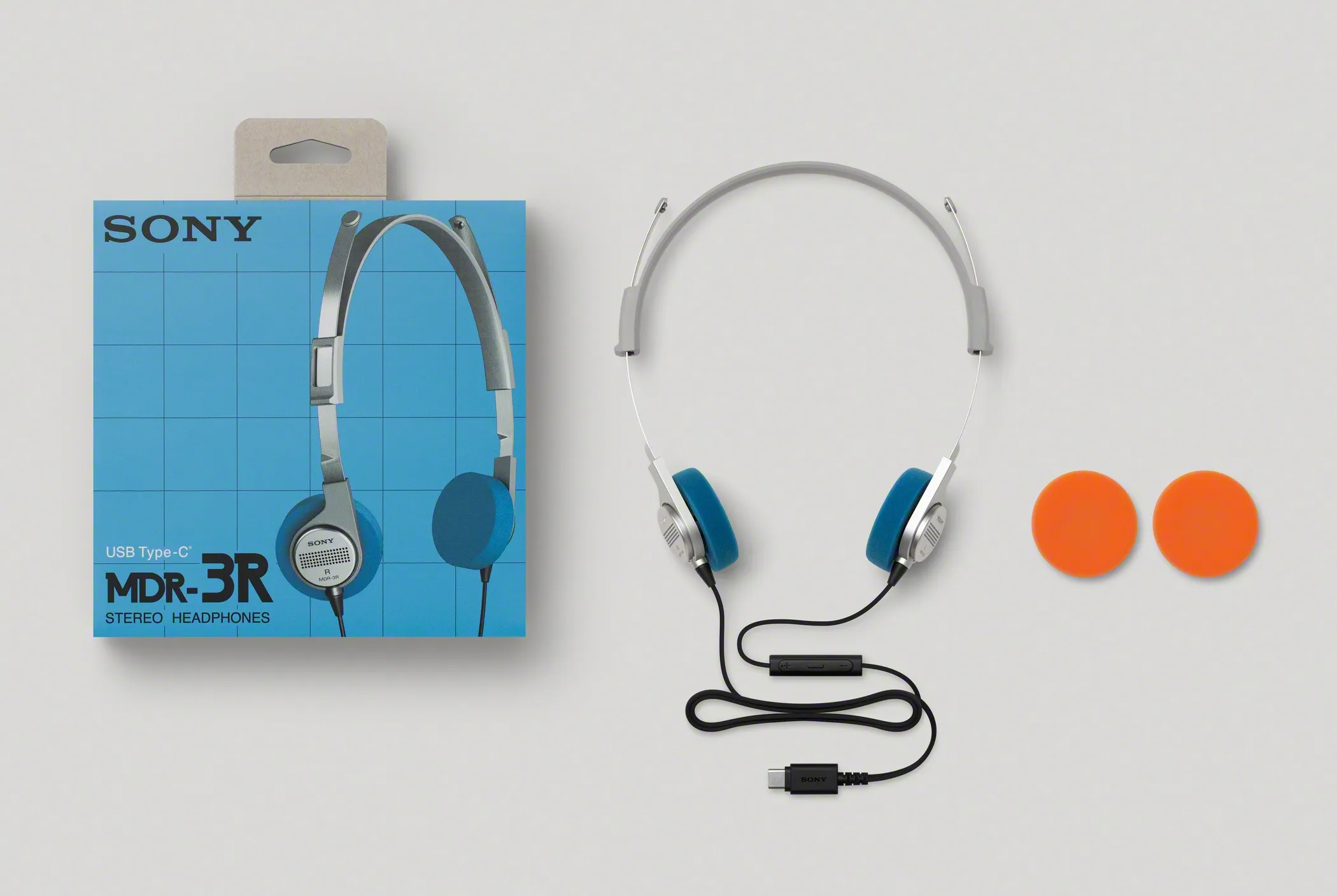
In an enterprise consumer technology landscape dominated by multi-gigahertz digital signal processors, spatial audio algorithms, and escalating silicon fabrication costs, Sony Group Corporation (NYSE: SONY) has executed a striking counter-cyclical capital allocation move. The Tokyo-based conglomerate has officially launched a $59.99 wired, open-air headphone featuring an uncompromising 1980s industrial design language. Behind the aesthetic nostalgia��characterized by stainless-steel headband bands, tactile orange acoustic foam, and geometric earcups reminiscent of the iconic 1979 TPS-L2 Walkman bundled headsets—lies a precise corporate strategy aimed at capturing high-margin liquidity in a maturing personal audio sector.
For the past decade, the global personal audio market was defined by the aggressive push toward True Wireless Stereo (TWS) and premium Active Noise Canceling (ANC) over-ear systems. Market leaders, including Apple, Sony, and Bose, successfully expanded Total Addressable Market (TAM) valuations by pushing average selling prices (ASPs) beyond the $300 threshold. However, this ecosystem created structural friction points: rapidly degrading internal lithium-ion micro-batteries, wireless signal congestion in urban centers, software firmware maintenance costs, and high returns driven by Bluetooth pairing failures.
Sony’s modern $60 wired deployment bypasses these hardware overheads entirely. By re-engineering entry-level analog hardware, the company is capitalizing on a dual convergence: a secular cultural shift among Gen Z and millennial demographics toward retro-tech aesthetics, and a fundamental rationalization of corporate manufacturing expenditure.
The Nostalgia Engine Meets Unit Economics
From an industrial engineering perspective, the new headset utilizes high-flux neodymium magnets coupled with lightweight Polyethylene Terephthalate (PET) dynamic diaphragms. Unlike mid-tier wireless units that require onboard Digital-to-Analog Converters (DACs), low-dropout regulators (LDOs), and complex System-on-Chip (SoC) integration, this analog unit operates purely on passive current driven directly from standard 3.5mm auxiliary outputs or USB-C dongles.
By stripping out radio-frequency (RF) antennas, microcontrollers, and multi-microphone arrays, Sony’s Bill of Materials (BOM) is estimated by industry supply-chain analysts to sit below $8.50 per unit. When weighed against a wholesale price point of roughly $30 to $35, the resulting unit economics offer a gross margin expansion that modern active wireless devices—burdened by licensing fees for Qualcomm APTX or proprietary Bluetooth stacks—rarely achieve at entry-level price points.
Furthermore, Sony leverages decades of fully amortized acoustic tooling and injection-molding infrastructure from its legacy MDR-series lines. This operational leverage allows the firm to generate immediate positive cash flow without incurring the massive Research & Development (R&D) write-downs associated with pioneering new active silicon architectures.
Comparative Hardware & Market Financial Metrics
To understand where Sony's $60 retro entry sits within the broader consumer audio hardware matrix, the table below compares technical specifications, manufacturing paradigms, and corporate financial profiles across relevant market categories.
| Metric / Specification | Sony $60 Retro Model | Sony MDR-7506 (Studio) | Apple AirPods Max | Koss Porta Pro (Competitor) |
|---|---|---|---|---|
| MSRP (USD) | $59.99 | $99.99 | $549.00 | $49.99 |
| Acoustic Architecture | Open-Air Dynamic | Closed-Back Dynamic | Closed-Back Custom Dynamic | Open-Air Dynamic |
| Primary Input Interface | 3.5mm Analog / Oxygen-Free Copper | 3.5mm / 6.3mm Gold Plug | Bluetooth 5.0 / Lightning / USB-C | 3.5mm Analog |
| Active Power / Battery | Passive (0mAh) | Passive (0mAh) | 664mAh Lithium-Ion Rechargeable | Passive (0mAh) |
| Signal Latency | 0 ms (Native Analog) | 0 ms (Native Analog) | 130–200 ms (DSP Dependent) | 0 ms (Native Analog) |
| Estimated Gross Margin % | 60% – 68% | 50% – 55% | 40% – 48% | 55% – 62% |
| Product Lifespan Expectancy | 10+ Years (Restricted to Cable Wear) | 15+ Years (Modular Parts) | 2–4 Years (Chemical Battery Limit) | 10+ Years |
| Regulatory / E-Waste Risk | Negligible (RoHS Compliant) | Negligible | High (Li-ion Disposal / Directives) | Negligible |
Industry & Market Implications
1. Capital Allocation & Portfolio Risk Mitigation
For consumer hardware conglomerates, maintaining top-line revenue growth in personal audio has become increasingly capital-intensive. Developing high-tier ANC flagships demands continuous capital expenditure in custom silicon, machine-learning noise suppression algorithms, and over-the-air (OTA) software maintenance. By introducing low-cost, durable analog peripherals, Sony diversifies its revenue streams and mitigates portfolio risk.
The lower capital intensity of passive analog products shields balance sheets from quick write-offs caused by rapid software obsolescence. Furthermore, it creates a recurring secondary revenue pipeline driven by Gen Z users who view analog headsets not as legacy gear, but as fashion-forward lifestyle accessories that complement physical audio media (vinyl, CDs, and cassette tapes).
2. ESG Compliance & Supply Chain Resilience
Regulatory bodies—most notably the European Commission—are intensifying scrutiny around electronic waste, right-to-repair access, and non-replaceable lithium-ion energy cells. Wireless earbuds and active headphones represent significant e-waste vectors; once their miniature batteries lose charge retention capacity, the entire unit is frequently discarded due to ultrasonic housing welds that prevent safe battery replacement.
By shipping a product built entirely around simple polymer housings, steel bands, and passive copper wiring, Sony lowers its extended producer responsibility (EPR) overhead. The supply chain resilience of this line is equally robust: devoid of rare-earth heavy battery chemistries and advanced node semiconductors, manufacturing lead times are immune to geopolitical wafer-foundry bottlenecks and cobalt supply shocks.
3. Anti-Digital Movement and the "Corded Aesthetic"
From a consumer behavior standpoint, the high sales volume of budget wired headphones signals a structural shift in digital consumption habits. A growing segment of younger consumers actively seeks out low-friction, analog technology to combat "notification fatigue" and perpetual connectivity. The physical wire serves as both a visual fashion statement—communicating intentional disconnection—and an operational advantage: zero dropouts, zero audio processing latency, and zero requirement to monitor battery charge percentages.
Frequently Asked Questions (People Also Ask)
Why are tech manufacturers re-investing in entry-level wired headphones when wireless tech is dominant?
While wireless tech offers convenience, it faces severe structural limitations regarding chemical battery degradation, high production costs, software maintenance liabilities, and environmental compliance risks. Manufacturers are re-investing in wired models because they carry high profit margins, require zero ongoing software support, utilize amortized production assets, and directly target consumers seeking durable, zero-latency, fashion-oriented audio gear.
Do $60 retro wired headphones offer sound quality comparable to premium wireless models?
Purely in terms of raw acoustic transparency and signal integrity, high-quality wired headphones eliminate audio compression artifacts inherent in standard Bluetooth codecs (such as SBC or AAC). Because analog signals transport uncompressed data directly to the driver without latency or digital compression, a well-tuned $60 wired dynamic driver can outperform similarly priced—or even more expensive—wireless options in acoustic dynamic range and transient response, though it lacks digital enhancements like active noise cancellation.
How does the lack of a lithium-ion battery impact the environmental footprint and product lifecycle?
Without an internal lithium-ion battery, a headset avoids the primary point of failure common to modern personal audio. Battery degradation typically renders wireless headphones unusable within two to four years. Passive wired headphones can operate reliably for decades, requiring only earpad replacements or simple cable repairs, drastically reducing electronic waste, carbon-intensive battery mining demands, and toxic disposal liabilities.
Can retro wired headphones be used with modern smartphones that lack 3.5mm headphone jacks?
Yes. Modern smartphone setups utilize passive wired headsets via inexpensive external Digital-to-Analog Converter (DAC) adapters, such as USB-C to 3.5mm or Lightning to 3.5mm dongles. These miniature adapters handle signal processing externally, allowing legacy dynamic drivers to deliver high-fidelity analog sound across all modern mobile platforms and computing hardware without onboard headphone jacks.
Future Outlook & Strategic Roadmap
Sony’s move into high-margin retro hardware represents an early indicator of market consolidation in entry-level consumer audio. Over the next 12 to 24 months, competing audio manufacturers—including Sennheiser, Audio-Technica, and Skullcandy—are projected to launch similar retro-styled analog lines aimed at capturing Gen Z aesthetic demand while maintaining healthy EBITDA margins amid macroeconomic pressure.
Strategic milestones to monitor moving forward include:
- Modular Cable Integration: Future iterations will likely feature detachable USB-C to 3.5mm modular cables with embedded, low-power DAC chips directly within the cable assembly, ensuring seamless ecosystem cross-compatibility without sacrificing passive driver housing geometry.
- Cross-Merchandising with Physical Media: Integration with Sony Music Group’s physical vinyl and cassette re-issue pipelines, bundling retro hardware with limited-edition analog music pressings to capture higher consumer surplus.
- E-Waste Regulatory Benchmarks: Potential industry-wide pivots toward fully modular, screw-assembled wired designs that meet upcoming EU circular economy quotas, establishing a new design standard across global consumer electronics manufacturing.
Ultimately, Sony’s $60 retro wired launch proves that in an era of hyper-digitization, stripping away complexity to deliver low-overhead, durable, and visually distinctive analog hardware is not just a nostalgic exercise—it is brilliant balance-sheet strategy.