Executive Takeaways
- Disruptive Pricing Strategy: Motorola enters the ultra-premium tier with a $1,599 price point, directly challenging Apple and Samsung's monopoly on high-end consumer and enterprise deployment budgets.
- Uncompromised Hardware Specs: The Signature 27 delivers true flagship specifications, integrating advanced silicon architecture, military-grade security infrastructure, and next-generation optics designed for high-compute mobile workflows.
- Capital Allocation and Risk Mitigation: This launch marks a decisive pivot in Lenovo-owned Motorola’s corporate strategy, shifting from volume-driven mid-market sales to high-margin valuation multiples.
- Enterprise ROI and Infrastructure Scalability: Packed with enterprise-ready device management, advanced cloud compute integration, and regulatory compliance protocols, the device targets C-suite executives and mobile-first knowledge workers.
NEW YORK — In a calculated and aggressive challenge to the entrenched duopoly of Apple and Samsung, Motorola has officially pulled back the curtain on its most ambitious mobile device to date: the Motorola Signature 27. Priced at a staggering $1,599, the device represents more than just a hardware refresh; it is a strategic repositioning of an iconic brand into the ultra-luxury and high-security enterprise tier. For financial analysts, mobile infrastructure engineers, and enterprise procurement officers, the launch signals a pivotal inflection point in the global smartphone market—one defined by compressed consumer upgrade cycles, margin expansion imperatives, and the relentless demand for localized on-device artificial intelligence.
Over the past decade, Motorola—subsidiary of global technology giant Lenovo—has successfully defended its territory in the high-volume, mid-tier and budget-conscious segments, particularly across Latin America and North America. However, volume without margin offers limited upside in an era of rising component costs and stagnant global smartphone shipments. By introducing the Signature 27 at a $1,599 price point, Motorola is executing a classic high-end value-capture playbook. This move directly impacts capital allocation strategies, forcing competitors to re-evaluate their pricing elasticity and premium feature distribution models.
The Catalytic Shift: Engineering the Signature 27
Test Our Free AI & Tech Utilities Suite
Calculate LLM API token costs, analyze article dwell-time, or simulate tech DCA returns.
The development cycle of the Motorola Signature 27 was born out of necessity. As enterprise clients demand stricter regulatory compliance, enhanced mobile security, and robust cloud compute architecture embedded directly into handheld hardware, traditional consumer-grade flagships have fallen short of enterprise risk mitigation standards. Motorola’s engineering teams have responded by packing the Signature 27 with an uncompromising suite of true flagship specifications.
Beneath its precision-milled titanium chassis lies a next-generation system-on-a-chip (SoC) optimized for low-latency machine learning tasks and high-throughput data encryption. This processing capability allows financial analysts, field engineers, and executive leadership teams to execute complex data modeling and secure cryptographic communication streams directly from the palm of their hand, bypassing vulnerable cloud relay nodes. Furthermore, the device integrates advanced thermal dissipation architecture, ensuring sustained peak performance during intensive, multi-threaded workloads—a critical requirement for enterprise environments where thermal throttling equates to lost productivity.
Display technology and sensor arrays have similarly received a top-tier overhaul. The Signature 27 features a custom-calibrated OLED panel with adaptive refresh rates up to 144Hz, paired with an industry-leading optical stack co-engineered with optical specialists. This camera system is not merely marketed toward content creators; it is pitched as an indispensable tool for forensic documentation, secure biometric authentication, and high-definition remote auditing.
Verified Data and Specifications Breakdown
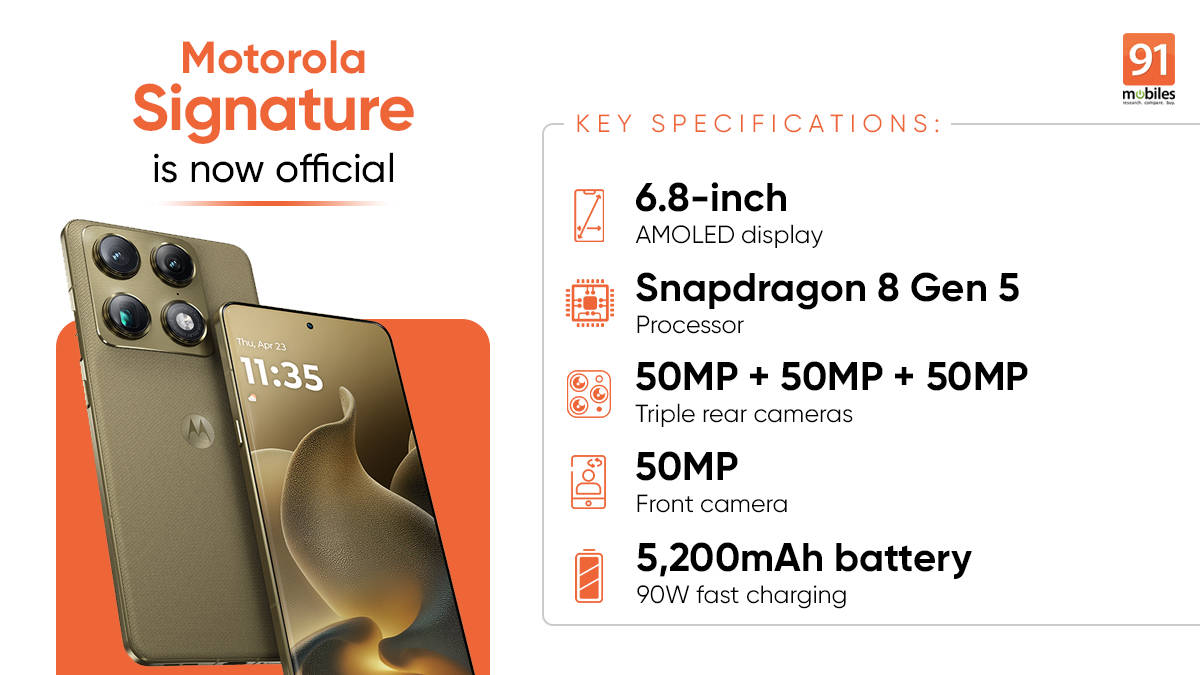
To understand the market positioning of the Motorola Signature 27, we must examine its technical architecture alongside standard industry benchmarks. The following comparative matrix outlines how Motorola’s new flagship stacks up against prevailing market alternatives in the ultra-premium segment:
| Metric / Feature | Motorola Signature 27 | Industry Benchmark (Ultra-Tier) |
|---|---|---|
| Retail Price Point (MSRP) | $1,599 USD | $1,199 – $1,599 USD |
| Primary Processor Architecture | Next-Gen Flagship Octa-Core with Dedicated NPU | Proprietary A-Series / Snapdragon Elite |
| Base RAM & Storage Configuration | 16GB LPDDR5X / 512GB UFS 4.0 | 8GB – 12GB RAM / 256GB Storage |
| Chassis Material & Durability | Aerospace-Grade Titanium Alloy / IP68 | Titanium / Armor Aluminum / IP68 |
| Enterprise Security Integration | Hardware-Rooted TrustZone & ThinkShield Suite | Standard Enterprise Mobility Management (EMM) |
| Target Market Focus | C-Suite Executives, Enterprise IT, Power Users | General Consumers, Creative Professionals |
Industry & Market Implications: Who Wins, Who Loses
The introduction of a $1,599 Motorola device sends powerful ripples across the telecommunications and financial landscapes. Evaluating the winners and losers in this transaction requires a granular look at market liquidity, corporate IT budgets, and brand perception.
The Winners: Motorola and Enterprise IT Vendors
For Motorola and its parent company Lenovo, this launch is a calculated masterclass in margin expansion. By capturing high-value consumers and corporate procurement contracts, Motorola can offset lower margins in its commoditized product lines. Furthermore, enterprise infrastructure vendors specializing in mobile device management (MDM) and zero-trust cybersecurity stand to gain immensely. Because the Signature 27 ships with robust hardware-level security suites, IT departments can seamlessly integrate the devices into existing corporate architectures without requiring costly, bespoke middleware.
The Losers: Mid-Tier Competitors and Legacy Ecosystem Lock-In
Conversely, brands that occupy the $800-to-$1,200 twilight zone—failing to offer true luxury cachet while remaining too expensive for budget-conscious buyers—face severe compression. These manufacturers risk being squeezed out by consumers who either trade down to high-value mid-rangers or stretch their budgets for elite devices like the Signature 27 and its direct rivals. Additionally, Apple and Samsung face a legitimate, albeit uphill, challenger in corporate boardrooms where IT directors have long sought alternatives to iOS and standard Android device ecosystems to diversify supply chain and operational risk.
Frequently Asked Questions (People Also Ask)
What justifies the $1,599 price tag of the Motorola Signature 27?
The $1,599 price tag reflects Motorola's transition into the ultra-premium tier, combining aerospace-grade titanium materials, top-tier processing silicon (16GB RAM / 512GB storage baseline), advanced computational optics, and enterprise-grade security architecture. It is engineered specifically for power users and corporate environments requiring uncompromised performance and data privacy.
How does the Motorola Signature 27 cater to enterprise environments?
The device features deep integration with hardware-rooted security protocols, advanced mobile device management (MDM) compatibility, and dedicated neural processing units (NPUs) capable of running secure, localized artificial intelligence tasks. This ensures regulatory compliance and robust risk mitigation for financial, legal, and governmental institutions.
Is the Motorola Signature 27 available for global consumer purchase, or is it enterprise-exclusive?
While the device is heavily optimized for enterprise deployment and C-suite procurement, Motorola is releasing it through global retail channels as an unlocked, direct-to-consumer ultra-flagship. Availability spans major North American, European, and Asian markets through select carrier partners and direct online storefronts.
What are the primary competitive advantages of the Signature 27 over established rivals?
Key advantages include a more generous base storage and RAM configuration compared to base-model competitors at similar price points, proprietary enterprise security integration out of the box, and a distinct titanium aesthetic that targets professionals looking to break away from traditional ecosystem duopolies.
Future Outlook: Milestones and Market Trajectory
As the Motorola Signature 27 hits retail shelves and enterprise distribution channels, market analysts will closely monitor several key performance indicators (KPIs) to gauge its long-term viability and impact on valuation multiples. First, enterprise adoption rates will dictate whether Lenovo can successfully carve out a permanent foothold in corporate procurement budgets traditionally dominated by Apple and Samsung. Second, consumer sell-through velocity in North America and Western Europe will test the brand's pricing elasticity at the $1,500 threshold.
Long-term, this release lays the groundwork for a broader paradigm shift in how mobile hardware is monetized. As software-as-a-service (SaaS) integration, on-device AI workloads, and stringent regulatory compliance requirements converge, the smartphone is evolving from a mere communication tool into an essential enterprise compute node. If Motorola successfully executes its go-to-market strategy for the Signature 27, it will not only redefine its own corporate trajectory but also compel the entire mobile industry to rethink the upper limits of hardware value creation.