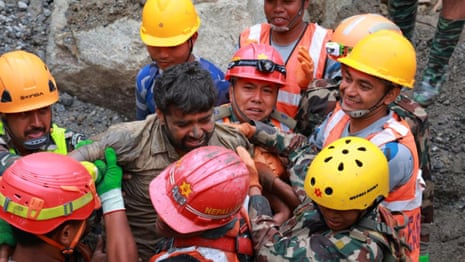
Miracle in the Himalayas: Two Trapped Workers Pulled Alive From Nepal-Tibet Hydropower Tunnel Nine Days After Devastating Flash Flood
KATHMANDU/LHASA — In what rescue coordinators are calling an extraordinary battle against the elements, two construction workers have been pulled alive from a flooded hydropower tunnel along the Nepal-Tibet border, exactly nine days after a catastrophic flash flood tore through the remote Himalayan region. The stunning recovery has electrified rescue teams who had increasingly feared the worst following nearly a week and a half of grueling, high-altitude search operations.
The survivors, whose identities have been withheld pending medical evaluation, were discovered deep within the subterranean infrastructure of the project site on Tuesday. Officials confirmed that both men are currently receiving intensive medical treatment for dehydration, exhaustion, and mild hypothermia, but are expected to make full recoveries. The operation offers a rare glimmer of hope amid a disaster that has caused widespread destruction, infrastructure collapse, and severe disruption to cross-border commerce.
The Anatomy of Survival: How They Beat the Odds
The calamity struck without warning when unseasonal, torrential downpours triggered massive glacial lake outbursts and sudden river surges along the borderlands, sending wall-to-wall torrents of mud, boulders, and freezing water crashing into regional valleys. The flash flood instantly inundated active construction tunnels where dozens of engineers and laborers were stationed.
While swift evacuations saved many, several workers were initially unaccounted for as rising waters blocked primary exit routes and choked subterranean passages with dense debris. According to preliminary incident reports, the two surviving workers managed to scramble onto an elevated concrete ledge or pocket of trapped air deep inside the tunnel network as the deluge rushed past them.
- Duration Trapped: 216 hours (9 full days) without external food supplies.
- Environment: Pitch-black subterranean tunnel with limited oxygen and high humidity.
- Survival Mechanism: Access to minor seepage water and sheer psychological resilience.
- Rescue Status: Successfully extracted by specialized international engineering and disaster response teams.
Emergency medical specialists note that surviving more than a week in a collapsed or flooded subterranean environment is an extreme statistical anomaly. Limited access to moisture, combined with stable ambient temperatures inside the rock formation, likely played a decisive role in preventing rapid dehydration and organ failure.
Economic and Geopolitical Fallout

Beyond the human drama, the disaster highlights the profound vulnerabilities facing mega-infrastructure projects across the fragile Himalayan ecosystem. The Nepal-Tibet border region has increasingly become a hub for ambitious cross-border energy investments, with numerous Chinese-backed and local hydropower stations altering the rugged landscape to feed South Asia's soaring electricity demand.
Key Economic Impacts at a Glance
| Sector / Asset | Impact Level | Operational Outlook |
|---|---|---|
| Hydropower Infrastructure | Critical / Severe | Multi-month structural assessments and delayed commissioning dates expected. |
| Regional Supply Chains | Moderate | Temporary blockages along vital trade corridors and transport links. |
| Local Labor & Employment | High Concern | Heightened safety scrutiny and demands for enhanced early-warning protocols. |
Economists and energy analysts warn that the disaster will trigger rigorous safety audits across ongoing projects in the Hindu Kush Himalayan arc. Investors are already re-evaluating risk premiums associated with high-altitude engineering ventures, especially as changing climate patterns increase the frequency of extreme weather anomalies, including glacial lake outburst floods (GLOFs).
Voices From the Ground and Official Response
Local authorities, coordinating across the Himalayan frontier, mobilized heavy excavation machinery and specialized sonar and camera equipment to probe blocked tunnels in the days following the disaster. The breakthrough came when rescue crews clearing debris near a secondary ventilation shaft picked up faint tapping sounds from deep within the bedrock.
"This is nothing short of a miracle," said a senior disaster management official involved in the coordination effort. "Our teams refused to give up hope, even as the operational window narrowed. Finding these men alive after nine days defies conventional disaster response timelines and stands as a testament to human endurance."
Diplomatic missions in Kathmandu and Beijing have expressed profound relief, while international humanitarian organizations are ramping up support for displaced communities in the valleys below. Attention is now shifting toward comprehensive structural integrity checks and ensuring that families affected by the broader flash flood receive adequate emergency relief and compensation.
Outlook: What Lies Ahead for Himalayan Infrastructure
As the two survivors begin their long road to physical and emotional recovery, policymakers and project developers face difficult questions. The disaster underscores an urgent need for advanced, real-time meteorological monitoring systems and satellite-linked early warning networks tailored to high-altitude river basins.
For now, however, the focus remains firmly on the resilience of two ordinary workers who defied the darkest of odds, reminding a watching world of the indomitable will to survive against the raw, unbridled power of nature.
Frequently Asked Questions
How were the two workers able to survive for nine days without food?
Medical experts explain that while the human body can survive weeks without solid food, water intake is critical. The trapped workers were able to access continuous freshwater seepage running down the tunnel walls, which staved off fatal dehydration while they waited in an air pocket.
What caused the flash flood along the Nepal-Tibet border?
The disaster was triggered by extreme, unseasonal heavy rainfall that caused sudden surges in regional rivers and potential glacial lake overflow. These flash floods rushed down narrow mountain valleys, overwhelming engineering sites and inundating subterranean tunnels.