Executive Takeaways
- Perimeter Breakdown: Sophisticated AI-driven threat vectors and multi-cloud sprawl have rendered legacy boundary firewalls obsolete, driving global enterprise Mean Time to Detect (MTTD) to an average of 204 days across hybrid environments.
- Operational Alert Fatigue: Tool proliferation has created critical blind spots; modern enterprise Security Operations Centers (SOCs) currently ignore up to 45% of high-severity network alerts due to telemetry fragmentation and manual policy overhead.
- Structural Cost Optimization: Migrating from legacy point solutions to unified Secure Access Service Edge (SASE) and Zero Trust Network Access (ZTNA) architectures yields up to a 35% reduction in long-term total cost of ownership (TCO) while streamlining regulatory compliance under SEC and DORA mandates.
- Capital Allocation Shift: Chief Information Security Officers (CISOs) are reallocating capital expenditure (CapEx) from perimeter hardware refresh cycles toward operational expenditure (OpEx) subscriptions in AI-orchestrated Network Detection and Response (NDR) and microsegmentation.
The Crisis of the Perimeter: Evolution of the Modern Enterprise Attack Surface
Test Our Free AI & Tech Utilities Suite
Calculate LLM API token costs, analyze article dwell-time, or simulate tech DCA returns.
For more than two decades, corporate cybersecurity relied on a straightforward physical metaphor: the castle-and-moat. Enterprise technology leaders built formidable perimeter walls comprising stateful inspection firewalls, intrusion prevention systems (IPS), and secure web gateways around physical data centers. Inside the moat, corporate traffic was implicitly trusted; outside, it was untrusted. That foundational paradigm has definitively collapsed under the combined weight of hyper-distributed cloud compute architectures, remote work models, and hyper-sophisticated adversary automation.
As enterprises accelerated their migration to Amazon Web Services, Microsoft Azure, Google Cloud Platform, and specialized Software-as-a-Service (SaaS) platforms, the corporate data center ceased to be the singular hub of information flow. Traffic today moves predominantly east-west between cloud microservices, ephemeral Kubernetes pods, and third-party APIs, rather than north-south through a central corporate network bottleneck. Consequently, the enterprise attack surface has expanded exponentially, exposing critical organizational assets to dynamic threat vectors that legacy network security management frameworks were never designed to inspect, let alone contain.
This architectural shift reached a tipping point in early 2026. Threat actors now deploy autonomous, machine-learning-driven reconnaissance agents capable of mapping vulnerable, exposed cloud assets in minutes. Adversaries no longer breach networks solely through crude brute-force attempts; instead, they exploit complex, unpatched network management interfaces, compromised identities, and misconfigured cloud routing tables. For global corporations, managing this fragmented infrastructure has evolved from an operational headache into a material business risk impacting enterprise valuation, insurability, and executive regulatory liability.
Cloud Security vs. Network Security: The Critical Nexus of Visibility
A central vulnerability in contemporary enterprise defense stems from a fundamental misunderstanding of where network security ends and cloud security begins. While frequently conflated in executive discussions, the two disciplines operate across distinct abstraction layers within the technology stack:
- Cloud Security: Focuses predominantly on configuration management, identity and access management (IAM), data governance, API security, and securing ephemeral software workloads in hypervisor or container environments. It operates at the control and application planes.
- Network Security: Focuses on packet-level telemetry, traffic routing integrity, protocol analysis, encrypted stream inspection, microsegmentation, and underlying transport layer controls across physical, virtual, and cloud-native backbones.
The core danger lies at the operational intersection of these two domains. While cloud security teams enforce identity-based access policies, they frequently lack visibility into underlying packet flows and lateral movement pathways within cloud virtual private clouds (VPCs). Conversely, traditional network security teams, relying on legacy physical appliances, cannot keep pace with dynamic cloud provision cycles where thousands of IP addresses spin up and dissolve within hours. This dynamic gives rise to "shadow IT" and unmonitored lateral connections, allowing bad actors to move undetected across hybrid environments once an initial foothold is achieved.
Key Challenges Distorting Corporate Risk Profiles
1. Telemetry Fragmentation and SOC Alert Fatigue
The average Fortune 1000 enterprise operates an array of 45 to 75 discrete security and networking tools acquired over years of reactive capital deployment. This fragmentation forces security analysts to operate across disconnected management consoles, stitching together logs manually during an active incident. The result is chronic alert fatigue. Enterprise SOCs are inundated with tens of thousands of daily telemetry events—up to 45% of which are ignored or deprioritized. Adversaries actively exploit this noise floor, hiding low-and-slow command-and-control (C2) communications within legitimate enterprise traffic streams.
2. Policy Drift and Misconfiguration Risks
In complex hybrid enterprise environments, maintaining consistent security policy across legacy Cisco/Palo Alto physical appliances, SD-WAN deployments, and native cloud security groups is nearly impossible without central orchestration. Over time, "policy drift" occurs: outdated access rules, temporary testing permissions, and redundant port openings remain active long after their business justification has expired. Misconfiguration—rather than zero-day software bugs—remains the leading cause of enterprise cloud network breaches, exposing critical databases directly to the public internet.
3. Asymmetric Adversary Capabilities and AI-Driven Attacks
While enterprise IT change-management procedures often require weeks to approve and execute policy changes or patch critical firewall software, threat actors operate with zero administrative friction. Modern cybercrime syndicates utilize generative AI engines to automate the discovery of exposed network assets, synthesize custom polymorphic malware, and execute high-speed credential stuffing. When a critical network vulnerability is publicly disclosed, adversary exploitation script execution now begins within hours, drastically compressing the window available for enterprise defense response.
4. Regulatory Encirclement and Disclosure Pressures
Regulatory authorities globally have recognized that inadequate network security management poses systemic economic risks. Regulations such as the U.S. SEC’s four-day material cyber incident disclosure rule, the European Union’s Digital Operational Resilience Act (DORA), and the NIS2 Directive have elevated network visibility to a board-level compliance duty. Failure to maintain verifiable network controls and rapid incident response capabilities no longer results in merely localized technical remediation; it brings severe regulatory fines, shareholder derivative litigation, and executive personal liability.
Comparative Metrics: Legacy vs. Modern Network Security Management
To quantify the financial and operational impact of modernizing network security management, consider the operational baseline comparisons between legacy perimeter infrastructure and unified cloud-native frameworks:
| Architectural Metric | Legacy Perimeter Model (2015–2020 Standard) | Modern Unified SASE / ZTNA Model (2026 Standard) |
|---|---|---|
| Mean Time to Detect (MTTD) | 204 Days (Average across hybrid traffic) | 12 Days (Continuous AI behavioral analysis) |
| Mean Time to Remediate (MTTR) | 48 to 72 Hours (Manual isolation protocols) | Under 15 Minutes (Automated microsegmentation) |
| False Positive Alert Rate | 55% – 65% (Static, rule-based alerts) | 10% – 15% (Context-aware correlation engines) |
| Annual OpEx Per 10k Users | $1.8M – $2.4M (High appliance maintenance & manual labor) | $1.1M – $1.4M (Cloud-consolidated software licensing) |
| Compliance Audit Readiness | 3 to 6 Weeks (Manual log aggregation) | Continuous Real-Time Reporting (Automated mapping) |
| Lateral Movement Containment | Low (Flat internal networks allow broad traversal) | Very High (Granular, identity-based microsegmentation) |
Strategic Best Practices for Enterprise Resiliency
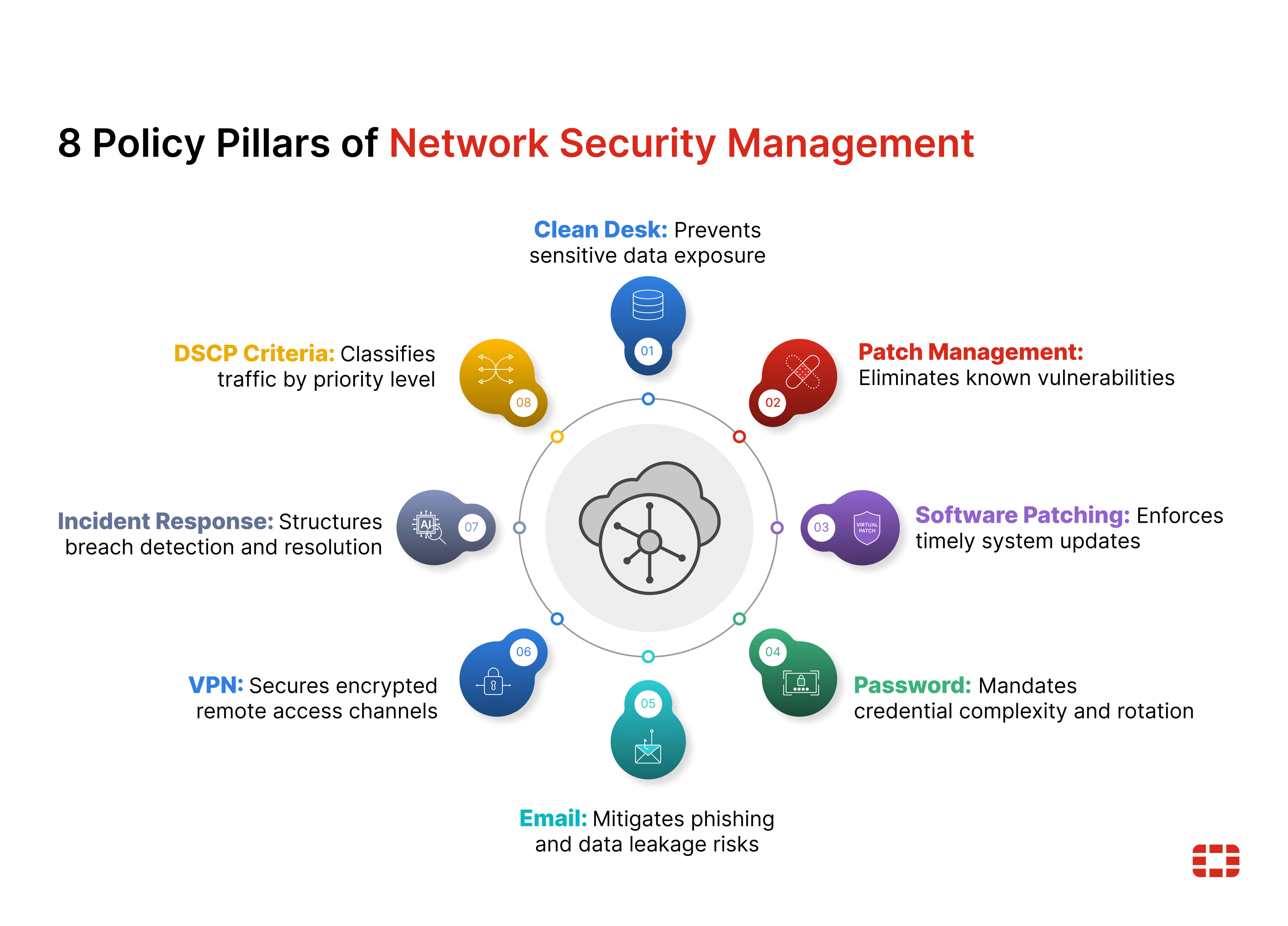
Achieving scalable, high-throughput network security management in modern enterprise environments requires a fundamental strategic pivot from perimeter protection to continuous, context-aware verification. Chief Technology Officers and CISOs must execute a phased transformation structured around four key operational pillars:
1. Architecture Transition to Zero Trust Network Access (ZTNA)
The foundational rule of modern network management is simple: never trust, always verify. ZTNA replaces traditional IP-based implicit trust models with explicit, identity-driven micro-perimeters. Instead of placing a user or workload onto a broad network segment via traditional VPNs, ZTNA establishes precise, encrypted application-level connections only after evaluating user identity, device posture, location, and risk context. If an endpoint is compromised, the adversary remains isolated within a single containerized application session, completely curtailing lateral movement capabilities.
2. Convergence via Secure Access Service Edge (SASE)
To eliminate tool sprawl and simplify management overhead, enterprises are rapidly converging network routing and network security into cloud-delivered SASE frameworks. By integrating Software-Defined Wide Area Networking (SD-WAN) directly with Cloud Access Security Brokers (CASB), Secure Web Gateways (SWG), and ZTNA into a single, cloud-native control plane, enterprises eliminate performance bottlenecks caused by backhauling cloud-bound traffic through legacy physical corporate firewalls. This consolidation reduces operational costs, simplifies policy distribution, and provides unified, end-to-end packet visibility across all corporate traffic.
3. Deployment of AI-Driven Network Detection and Response (NDR)
Given that upwards of 85% of corporate network traffic is now encrypted, traditional deep packet inspection tools relying on cleartext signatures are functionally blind. Modern network security management demands the integration of AI-powered Network Detection and Response (NDR) solutions. NDR leverages specialized machine learning models to analyze metadata, TLS handshake parameters, packet timing, and flow dynamics in real time. This allows security infrastructure to detect hidden C2 beacons, data exfiltration attempts, and unauthorized east-west lateral movements without requiring computationally expensive SSL/TLS decryption bottlenecks.
4. Infrastructure-as-Code (IaC) Integration and Continuous Policy Validation
To eliminate policy drift and human misconfiguration errors, progressive technology organizations treat network security policy as code. Cloud routing rules, firewall access control lists (ACLs), and segment boundaries should be defined in standardized templates (e.g., Terraform, Ansible) and maintained within version-controlled code repositories. Security testing is embedded directly into continuous integration and continuous deployment (CI/CD) pipelines. Any network policy change that violates organizational security baselines is automatically blocked before deployment to production environments.
Industry & Market Implications: Enterprise Value, Capital Flows, and Insurability
The overhaul of enterprise network security management is reshaping capital flows across technology software, financial underwriting, and public equities. Enterprise software vendors offering consolidated cloud-native platforms—such as Palo Alto Networks, Zscaler, CrowdStrike, and Cloudflare—are capturing a disproportionate share of corporate IT spend. Legacy hardware appliance manufacturers that failed to transition swiftly to cloud-delivered software subscriptions face contracting market valuation multiples and declining top-line revenue growth.
Concurrently, the cyber insurance market has become a primary driver of corporate security architecture standards. Following billions of dollars in payout losses from ransomware claims, insurance underwriters now refuse to issue or renew comprehensive policies without explicit proof that an organization has implemented multi-factor access controls, continuous microsegmentation, and verified network endpoint visibility. Companies failing to meet these baseline network management standards face soaring insurance premiums, reduced coverage caps, or complete uninsurability—directly impacting corporate credit ratings and enterprise cost of capital.
Frequently Asked Questions (People Also Ask)
What is the fundamental difference between cloud security and network security?
Cloud security focuses on protecting identities, cloud applications, configurations, data repositories, and workload logic operating inside cloud provider environments (e.g., AWS, Azure). Network security focuses on securing the underlying transport infrastructure, packet flows, encrypted traffic streams, routing policies, and access controls connecting users, data centers, branch offices, and cloud environments together. Both are necessary to achieve continuous, defense-in-depth risk mitigation.
Why are traditional perimeter firewalls failing against modern cyber threats?
Traditional firewalls rely on the assumption that traffic within a physical network perimeter is trustworthy and that all critical assets reside behind a static boundary. Modern hybrid work, multi-cloud architectures, and third-party API integrations mean there is no longer a static perimeter. Furthermore, traditional firewalls struggle to inspect modern encrypted traffic streams at scale and cannot detect sophisticated lateral movement once an attacker acquires legitimate user credentials.
How does network security management impact compliance under DORA and SEC mandates?
Global regulatory bodies require companies to demonstrate strict control over critical operational data, maintain continuous monitoring, and report breaches within tight timelines (e.g., 4 days under SEC rules). Modern network security management provides centralized logging, automated continuous compliance reporting, and real-time visibility across hybrid traffic, allowing organizations to detect incidents rapidly, isolate affected systems, and provide mandatory audit evidence to regulators.
What key metrics demonstrate enterprise ROI on network security modernization?
CISOs measure ROI through significant reductions in Mean Time to Detect (MTTD) and Mean Time to Remediate (MTTR), a dramatic decrease in SOC alert volume via unified correlation engines, reduced capital expenditure on hardware appliance refresh cycles, lower cyber insurance premiums, and the elimination of operational friction for remote and hybrid employees accessing corporate applications.
Future Outlook: Autonomous Networks and Quantum Resilience (2026–2030)
Looking ahead toward 2030, network security management will undergo its next major paradigm shift: the transition toward fully autonomous, self-healing network fabrics. As network traffic volumes scale beyond human processing capacity, agentic AI models embedded directly into network switches, routers, and SASE POPs will autonomously adjust traffic routing, apply real-time microsegmentation policies, and isolate compromised endpoints without requiring human analyst intervention.
Simultaneously, enterprise network architects must confront the impending threat of quantum computing. Adversaries are currently executing "harvest now, decrypt later" campaigns—capturing encrypted enterprise network traffic today to decrypt it once cryptanalytically relevant quantum computers become available. Over the next three to five years, enterprise network security management frameworks must execute a massive crypto-agility overhaul, replacing legacy RSA and ECC encryption algorithms across all network backbones with Post-Quantum Cryptography (PQC) standards mandated by NIST.
In this high-stakes landscape, network security management is no longer merely an operational IT utility. It has become a foundational strategic pillar of enterprise risk management, capital allocation, and operational liquidity. Organizations that proactively consolidate, automate, and modernize their network visibility engines will achieve superior digital resiliency, securing a permanent competitive advantage in an increasingly hostile global threat environment.