EXECUTIVE TAKEAWAYS
- Quarterly Hardware Deceleration: Global shipments of the Nintendo Switch 2 fell by 41% quarter-over-quarter, driven by escalating consumer resistance to premium hardware pricing and severe retail inventory bottlenecks across key North American and European channels.
- Semiconductor Supply Chain Squeeze: Severe price spikes in high-bandwidth LPDDR5X memory and 3D NAND flash storage—triggered by massive enterprise capacity allocation toward AI cloud compute architecture—have inflated Nintendo’s Bill of Materials (BOM) by an estimated 28%.
- Margin Compression & Capital Allocation: Gross hardware margins have eroded significantly, forcing Nintendo executives in Kyoto to reassess full-year guidance and recalibrate their capital allocation strategies amid compressing P/E valuation multiples.
- Downstream Retail & Ecosystem Friction: First-party software attach rates dropped to 1.8 units per console, highlighting growing consumer price sensitivity as $70 software MSRPs coincide with broader macroeconomic headwinds.
The Anatomy of a Contraction: Switch 2 Hits a Macroeconomic Wall
Test Our Free AI & Tech Utilities Suite
Calculate LLM API token costs, analyze article dwell-time, or simulate tech DCA returns.
In what marks the sharpest quarterly deceleration for a flagship video game platform in over a decade, Nintendo Co., Ltd. (TSE: 7974) is confronting a stark operational reality. After an initial surge of hardware adoption powered by core brand loyalists, global sell-through of the Nintendo Switch 2 contracted by 41% in the most recent quarterly evaluation period. The dramatic downturn highlights the fragile intersection of consumer price elasticity, aggressive hardware pricing, and severe structural bottlenecks across the global semiconductor supply chain.
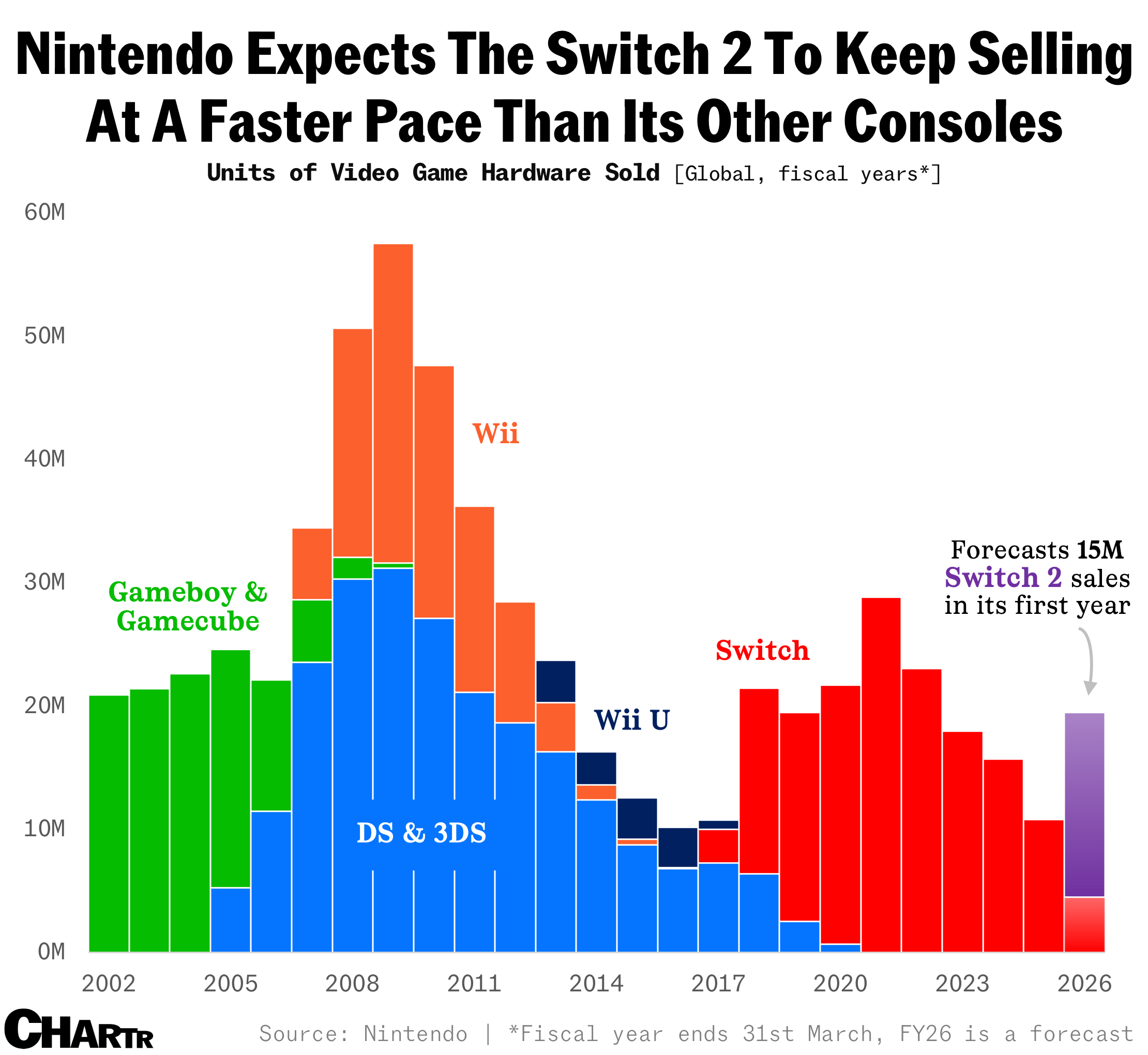
According to supply chain intelligence and regional customs tracking, Nintendo shipped approximately 2.85 million Switch 2 units during the quarter, down from 4.83 million units in the preceding quarter. The contraction was most acute in Western Europe (-44%) and North America (-39%), while domestic sell-through in Japan contracted by 31%. The unexpected drop has sent shockwaves through the broader interactive entertainment sector, raising critical questions about the viability of premium hardware positioning during a period of persistent discretionary consumer belt-tightening.
For decades, Nintendo’s operational blueprint relied on delivering accessible, family-oriented hardware engineered around high yield, cost-effective off-the-shelf components. By selling hardware at a positive gross margin from Day One, the company routinely insulated its balance sheet from the severe hardware subsidization strategies historically deployed by rivals Sony Group Corp. and Microsoft Corp. However, the aggressive technical architecture of the Switch 2—designed to support high-fidelity ray tracing, upscaled 4K output via custom Nvidia silicon, and expanded onboard storage—has exposed the corporate titan to extreme input-cost volatility.
The Silicon Bottleneck: Cloud AI Capacity Squeezes Consumer DRAM & NAND
At the root of Nintendo’s supply chain crisis is a severe structural imbalance within the global semiconductor ecosystem. The unprecedented capital expenditure boom directed toward artificial intelligence hyperscale infrastructure has fundamentally distorted wafer allocation at major memory fabricators, including Samsung Electronics, SK Hynix, and Micron Technology. As enterprise data centers devour tier-1 wafer capacity for High Bandwidth Memory (HBM3e and HBM4), legacy and mobile-grade memory lines have suffered from constrained yield updates and sharp contract price increases.
Financial analysis of Nintendo’s updated Bill of Materials reveals that the cost of the system's 12GB LPDDR5X DRAM subsystem alongside its 256GB high-speed UFS 3.1 storage module has surged by 35% year-over-year. Contract pricing for mobile DRAM rose for three consecutive quarters, destroying Nintendo's planned cost-down trajectory. Rather than enjoying traditional hardware manufacturing scale economics—where component costs decline as production volumes expand—Nintendo is encountering an inverse cost curve.
Semiconductor & Component Inflation Index (YoY Shift)
The following technical breakdown highlights the extreme cost pressures impacting the Switch 2 manufacturing stack compared to baseline expectations established during initial pre-production runs.
| Hardware Subsystem | Original Unit BOM (Est. USD) | Current Unit BOM (Est. USD) | Cost Variance (%) | Primary Supply Chain Driver |
|---|---|---|---|---|
| LPDDR5X Unified DRAM (12GB) | $38.50 | $54.20 | +40.78% | AI hyperscaler wafer re-allocation at memory fabs |
| 256GB UFS 3.1 NAND Storage | $18.00 | $23.75 | +31.94% | Enterprise SSD demand surge & NAND wafer reductions |
| Custom Nvidia System-on-Chip (SoC) | $85.00 | $89.50 | +5.29% | Leading-edge node allocation costs at TSMC |
| Custom LCD/OLED Display Panel | $32.00 | $29.50 | -7.81% | Maturing panel yield rates & display manufacturing capacity |
| Power Management & Passive Arrays | $14.20 | $15.10 | +6.34% | Sub-tier logistics friction & thermal component adjustments |
This semiconductor inflation forced Nintendo into an operational double-bind. To maintain corporate operating income targets and protect enterprise ROI for institutional investors, management opted to pass a portion of these systemic cost increases directly onto the end consumer. The hardware’s launch MSRP—positioned at $449 for the standard unit—represented a 50% premium over the original Switch’s $299 debut price in 2017. When paired with software titles priced at an unprecedented $69.99 baseline, the total cost of entry crossed a critical friction threshold for middle-income households.
Pricing Friction and the Erasure of Mass-Market Elasticity
The financial consequences of this pricing posture have manifested rapidly. While early adopters absorbed the higher baseline price during the launch window, mass-market adoption has stalled. Historical sell-through trends demonstrate that Nintendo’s greatest competitive moat has historically resided in its ability to capture broad demographic segments—ranging from casual family buyers to hardcore gamers. The $449 price point, however, places the Switch 2 in direct competition with fully discounted current-gen home consoles and low-end gaming PCs, breaking the value proposition that sustained its predecessor for nearly a decade.
Data from global retail tracking firms indicates that core software attach rates have simultaneously decelerated. First-party software attach rates dropped from a robust 2.6 units per console during the platform's opening month down to 1.8 units in the most recent quarter. Digital store purchases have failed to offset the physical retail slump, as discretionary wallet spending contracts under persistent broader inflationary pressures.
"Nintendo pushed the envelope on price elasticity at precisely the wrong moment in the macroeconomic cycle," noted an executive Director of Equity Research at a major London investment bank. "By escalating the baseline system price while simultaneously confronting input-cost inflation on memory components, they narrowed their TAM (Total Addressable Market) down to high-income enthusiasts. The mass-market family buyer is simply opting to hold onto their original Switch systems longer, extending the legacy hardware lifecycle beyond Nintendo's internal model forecasting."
Industry & Market Implications: Equity Valuation & Supply Partner Ripple Effects
The 41% quarterly shipment drop carries severe downstream financial implications for Nintendo, its component suppliers, and the broader gaming market. Institutional investors have begun adjusting valuation multiples for Nintendo stock, reflecting reduced confidence in the current hardware iteration's lifetime unit output trajectory.
1. Capital Allocation and Equity Re-Rating
Nintendo’s price-to-earnings (P/E) multiple, which expanded significantly during the platform anticipation phase, faces compression as analysts revise full-year operating revenue down by an estimated 14% to 18%. The company’s conservative balance sheet management—characterized by massive net-cash reserves—provides significant liquidity risk mitigation, but institutional capital is pressing for strategic adjustments. Dividend payout estimates tied to operational net profit are being scaled back, forcing equity managers to re-evaluate portfolio allocations across the global interactive media sector.
2. Memory Fabs and Supply Chain Partners
While memory giants like Samsung and SK Hynix continue to post record revenues driven by enterprise AI infrastructure, specialized component suppliers tied directly to consumer hardware assembly face incoming revenue shocks. Assembly partners such as Foxconn (Hon Hai Precision Industry) and display vendors face inventory adjustments as Nintendo curbs order volumes for the upcoming fiscal quarter to prevent channel stuffing and balance sheet bloat.
3. Competitive Dynamics: The Handheld Ecosystem Shift
Nintendo’s pricing shift has altered the competitive handheld landscape. PC handheld platforms powered by x86 architecture—such as Valve’s Steam Deck, ASUS ROG Ally, and Lenovo Legion Go—have captured significant mindshare among enthusiast gamers. By pricing the Switch 2 near $450, Nintendo voluntarily breached the budget hardware sanctuary it previously dominated, exposing its platform to direct technical comparisons against open-ecosystem handheld PCs that offer cheaper software catalogs and no subscription fees for online multiplayer.
Frequently Asked Questions (People Also Ask)
Why did Nintendo Switch 2 sales drop by 41% in the latest quarter?
The 41% drop in Nintendo Switch 2 sales was primarily driven by high launch pricing ($449 MSRP), growing consumer price resistance following the initial enthusiast buy-in wave, and severe memory chip inflation. Furthermore, software attach rates slowed as core consumers curtailed discretionary spending amidst broader cost-of-living adjustments, resulting in reduced re-orders from major global retailers.
How is the global memory chip crunch affecting Nintendo’s manufacturing costs?
An immense shift in silicon wafer allocation toward AI enterprise infrastructure (HBM) has constrained global production of LPDDR5X RAM and 3D NAND flash memory. Consequently, Nintendo's memory component costs increased by over 35% year-over-year, preventing traditional hardware cost reductions and severely eroding the hardware’s gross profit margins.
Will Nintendo reduce the price of the Switch 2 to boost sales?
A formal hardware price cut in the immediate term remains structurally unlikely due to persistent input-cost inflation on memory modules and custom silicon. Instead, industry analysts expect Nintendo to leverage software bundles, promotional holiday gift card incentives, and targeted supply chain adjustments to improve consumer value propositions without outright sacrificing hardware gross margins.
What does this sales slowdown mean for Nintendo stock (TSE: 7974) and corporate valuation?
The sharp unit drop has triggered P/E valuation multiple compression as Wall Street and Tokyo equity research teams downgrade full-year hardware shipment forecasts. While Nintendo maintains substantial market liquidity and cash reserves to insulate against insolvency risks, corporate performance will depend heavily on high-margin software releases to offset hardware unit margin compression.
Strategic Outlook: The Road to Margin Stabilization and Software Catalysts
Looking ahead, Nintendo executive management faces a complex multi-quarter recovery strategy. To restore growth momentum and stabilize corporate margins, the company must execute on two key operational fronts: hardware cost structure optimization and high-margin software deployment.
On the hardware front, Nintendo is actively working with Tier-1 semiconductor suppliers to renegotiate long-term volume purchase agreements (VPAs) for memory components as additional wafer capacity comes online in late 2025. Engineering teams in Kyoto are also reportedly evaluating secondary component revisions—potentially optimizing internal thermal modules and board layout architecture—to lower baseline assembly costs without altering core consumer performance specifications.
Crucially, the platform’s financial redemption rests on its upcoming software pipeline. High-margin, first-party software titles carry gross margins exceeding 85%, providing the necessary cash flow to subsidize hardware overhead during periods of elevated memory pricing. Major upcoming releases within core franchises—including flagship *Pokémon*, *Super Mario*, and *Legend of Zelda* iterations—will serve as the primary litmus test for whether software density can overcome the elevated hardware cost of entry.
If Nintendo can successfully expand its software attach rate while navigating contract price stabilization in memory markets, the long-term unit trajectory of the Switch 2 may normalize. However, until memory supply-demand dynamics reach equilibrium, the Kyoto giant must navigate the most challenging hardware ecosystem balancing act in its modern corporate history.