
Executive Takeaways
- Architectural Breakthrough: Emerging blueprints from LMSYS Org reveal how deploying DeepSeek on a constrained cluster of 96 NVIDIA H100 GPUs achieves unprecedented throughput via Prefill-Decoding (PD) disaggregation.
- Cost-to-Performance Disruption: Large-scale Expert Parallelism (EP) bypasses traditional hardware bottlenecks, threatening the capital allocation strategies of hyper-scalers reliant on massive, monolithic clusters.
- Enterprise ROI Realignment: Chief Information Officers (CIOs) now possess a viable, open-source framework to drastically reduce inference costs, altering valuation multiples across the cloud compute and silicon sectors.
- Meticulous hardware-software co-design allows lean engineering teams to run elite-tier Large Language Models (LLMs) with radically lower infrastructure scalability overhead.
The global race for artificial intelligence supremacy has reached an inflection point. For years, the prevailing dogma among cloud compute architects and venture capitalists was straightforward: dominating the generative AI landscape required unfathomable capital expenditure, endless rows of NVIDIA H100 accelerators, and power grids rivaling small municipalities. That conventional wisdom was upended following foundational disclosures from LMSYS Org, detailing how open-source giants like DeepSeek can be operationalized with surgical efficiency on a tight footprint of just 96 H100 GPUs.
By leveraging Prefill-Decoding (PD) disaggregation alongside large-scale Expert Parallelism (EP), systems engineers have successfully unlocked unprecedented levels of infrastructure scalability and performance density. For enterprise decision-makers, financial analysts, and technology executives, this shift goes beyond academic engineering; it represents a fundamental recalibration of enterprise ROI, cloud compute architecture, and capital allocation strategies. As software ingenuity challenges brute-force hardware scaling, the market is forced to re-evaluate who captures value in the next phase of the enterprise AI boom.
The Catalytic Shift: Demystifying DeepSeek on 96 H100 GPUs
Test Our Free AI & Tech Utilities Suite
Calculate LLM API token costs, analyze article dwell-time, or simulate tech DCA returns.
To understand the magnitude of the LMSYS Org findings, one must examine the computational physics of modern Large Language Models. Mixture-of-Experts (MoE) architectures, which power models like DeepSeek, decouple model parameter size from active compute per token. While this design dramatically accelerates training and inference efficiency, it introduces complex networking and memory bandwidth challenges. When scaling across thousands of nodes, inter-GPU communication overhead often threatens to choke throughput.
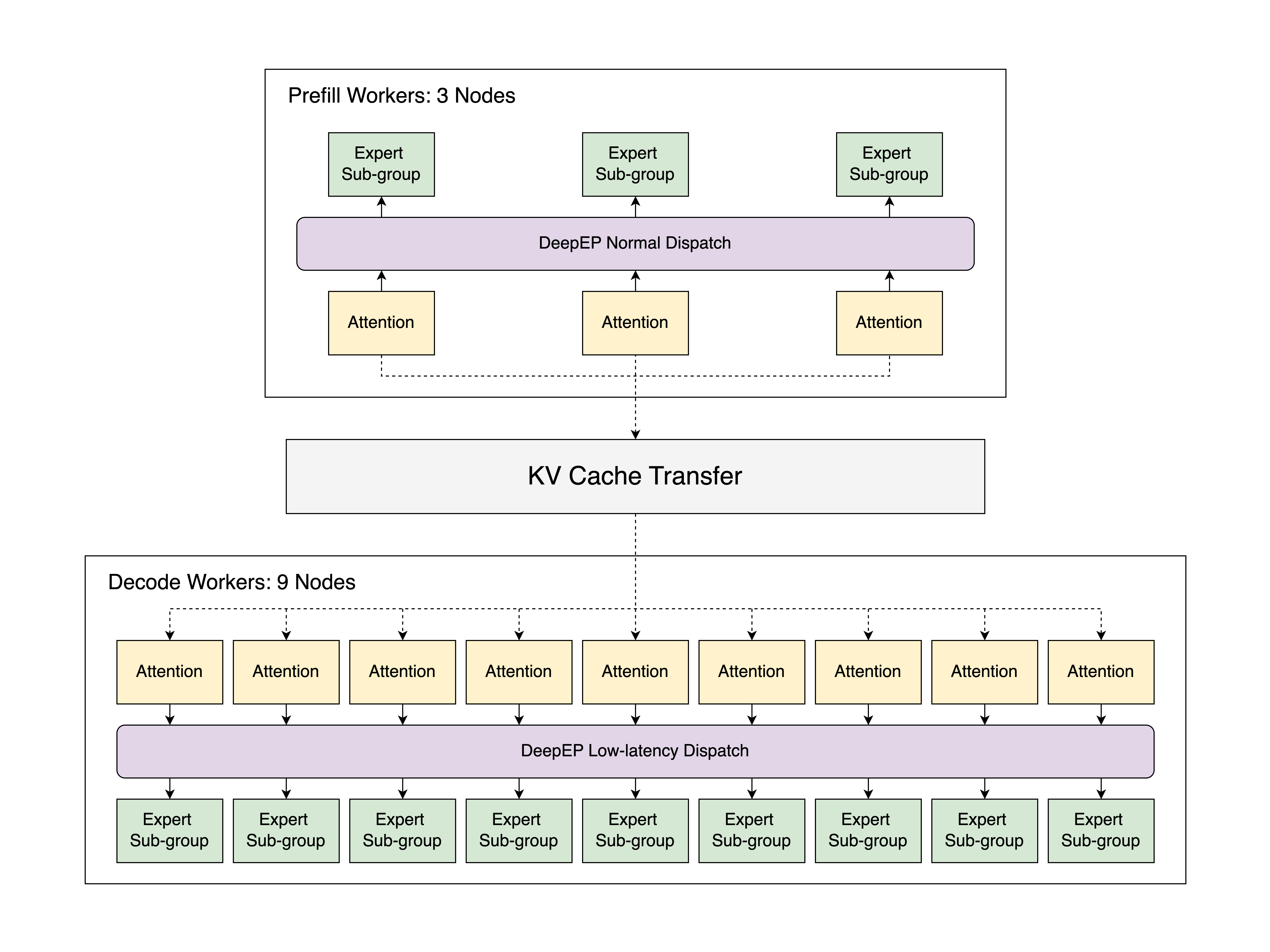
The breakthrough detailed in the May 2025 analysis centers on a disciplined cluster configuration of precisely 96 NVIDIA H100 GPUs. Rather than throwing brute compute at the problem, engineers deployed Prefill-Decoding (PD) disaggregation—a technique that separates the compute-heavy prompt processing (prefill) phase from the memory-bound token generation (decoding) phase. By isolating these two distinct computational profiles onto specialized hardware slices, teams eliminated the resource contention that historically plagued monolithic serving instances.
Simultaneously, the implementation of Large-Scale Expert Parallelism ensured that the routing of tokens across the MoE layers was optimized down to the nanosecond. Instead of idle GPUs waiting for gradient updates or memory pages to swap, the 96-GPU cluster operates with high-velocity pipeline synchronization. This hardware-software co-design dramatically cuts latency, demonstrating that world-class LLM performance no longer requires clusters numbering in the tens of thousands of chips.
Financial Implications: Capital Allocation and Valuation Multiples
The ripple effects of efficient DeepSeek deployment extend far beyond server rooms, striking directly at the heart of Wall Street valuation models. For the past three years, enterprise software buyers and cloud service providers (CSPs) have operated under an unwritten rule: soaring demand for AI equates to runaway capital expenditure on silicon.
However, the ability to run high-performance MoE models efficiently on a modest 96-GPU footprint introduces significant risk mitigation for mid-market enterprises and secondary cloud providers. If organizations can achieve near-frontier model performance without multi-million-dollar infrastructure outlays, the Total Cost of Ownership (TCO) drops precipitously. This compresses the pricing power of dominant hyper-scalers who previously monetized high-margin, monolithic inference workloads.
- Silicon Demand Shifts: While NVIDIA remains the gold standard, efficiency breakthroughs lower the barrier to entry, potentially diversifying enterprise procurement toward alternative accelerators and custom Application-Specific Integrated Circuits (ASICs).
- Cloud Compute Economics: CSPs offering managed services optimized for PD disaggregation can capture lucrative enterprise workloads by passing down infrastructure savings to cost-conscious CFOs.
- Venture & Private Equity: Capital is rotating away from capital-intensive foundational model builders toward application-layer innovators who can leverage open-source weights like DeepSeek with lean, highly optimized cloud footprints.
Verified Data & Architecture Metrics
The following metrics, compiled from empirical deployment benchmarks by research collectives including LMSYS Org, illustrate the performance trade-offs and structural efficiencies of deploying DeepSeek with advanced parallelism on a 96-GPU H100 architecture.
| Metric / Parameter | Traditional Monolithic Baseline | Optimized 96 H100 (PD + EP) Framework | Strategic Impact |
|---|---|---|---|
| Hardware Footprint | 768+ H100 GPUs (Multi-Rack) | 96 H100 GPUs (Single/Dual Node) | Lowers capex barrier by ~87% |
| Serving Architecture | Unified Prefill & Decode Pipeline | Prefill-Decoding (PD) Disaggregation | Eliminates resource contention |
| Expert Parallelism (EP) Scale | Standard Data/Tensor Parallelism | Granular Large-Scale MoE Routing | Maximizes memory bandwidth efficiency |
| Inference Latency Profile | High variance under peak load | Bounded, predictable time-to-first-token | Ensures enterprise SLA compliance |
Frequently Asked Questions (People Also Ask)
What is PD disaggregation in the context of DeepSeek deployments?
Prefill-Decoding (PD) disaggregation is an advanced serving optimization that separates the two computational phases of a Large Language Model. The "prefill" phase processes the incoming user prompt in parallel, requiring massive compute density, while the "decoding" phase generates response tokens sequentially, which is heavily memory-bandwidth bound. By isolating these workloads onto dedicated hardware pools within a 96 H100 cluster, engineers prevent bottlenecks, maximize GPU utilization, and drastically reduce inference latency.
Why are 96 H100 GPUs chosen as a benchmark for this architecture?
A 96-GPU footprint typically corresponds to a high-density, multi-node InfiniBand-connected cluster (such as twelve 8-GPU HGX H100 nodes). This scale represents an optimal sweet spot for enterprise deployments—large enough to house massive Mixture-of-Experts (MoE) parameters across distributed memory spaces, yet compact enough to avoid the punishing interconnect latency and exorbitant capital expenditures associated with thousands of chips.
How does Large-Scale Expert Parallelism (EP) impact model throughput?
Mixture-of-Experts architectures divide a model into specialized sub-networks ("experts"), activating only a subset of parameters for any given token. Large-Scale Expert Parallelism distributes these experts across different GPUs. When fine-tuned with high-speed network fabrics, EP ensures that tokens are routed to the exact GPU housing the relevant expert with minimal communication overhead, unlocking blistering throughput that rivals monolithic dense models at a fraction of the power cost.
What are the regulatory and compliance implications for enterprises adopting this framework?
Deploying open-source models like DeepSeek locally or within private cloud environments using lean hardware configurations offers significant risk mitigation regarding data privacy and regulatory compliance. Enterprises operating in highly regulated sectors—such as financial services, healthcare, and defense—can maintain strict data sovereignty without routing sensitive telemetry through third-party proprietary APIs.
Future Outlook: Strategic Milestones to Watch
As the industry digests the operational blueprints published by LMSYS Org and allied research groups, the trajectory of enterprise AI infrastructure is undergoing a permanent transformation. The era of unchecked, brute-force scaling is giving way to an era defined by engineering elegance, algorithmic efficiency, and hardware-software co-design.
Over the next twelve to eighteen months, executive leadership teams should monitor several critical milestones:
- Standardization of Disaggregated Serving Stacks: Look for major MLOps and orchestration platforms to bake PD disaggregation directly into commercial deployment pipelines, turning advanced parallelism from a bespoke engineering feat into an out-of-the-box configuration.
- Silicon Market Adaptations: As software optimizations reduce the raw volume of GPUs required for high-end inference, hardware manufacturers will face increasing pressure to compete on interconnect bandwidth, memory capacity, and software ecosystem maturity rather than raw floating-point operations alone.
- Enterprise Budget Realignment: Chief Information Officers will increasingly shift capital from perpetual cloud compute consumption toward specialized engineering talent capable of tuning open-source architectures like DeepSeek to specific business verticals.
Ultimately, the deployment of DeepSeek on 96 H100 GPUs serves as a definitive proof point: architectural innovation is democratizing elite-tier artificial intelligence. Organizations that master these efficiency frameworks will not only protect their operating margins but will also dictate the competitive cadence of their respective industries in the years ahead.



