REDMOND, WA & NEW YORK — July 9, 2026 — In the early hours of Thursday morning, cybersecurity operations centers across Fortune 500 enterprises went into crisis mode as a catastrophic zero-day vulnerability in Microsoft Defender surfaced online. Dubbed "RoguePlanet", the exploit vector fundamentally compromised the trust architecture of Microsoft's ubiquitously deployed endpoint protection suite. The catalyst occurred when a pseudonymous threat researcher operating under the handle "Nightmare-Eclipse" published a fully functional, weaponized proof-of-concept (PoC) exploit script across public repositories, triggering an emergency engineering response from Microsoft Corporation (NASDAQ: MSFT) and sending ripples through global financial markets.
According to initial telemetry verified by threat intelligence units at Dark Reading and confirmed by Microsoft's Security Response Center (MSRC), the RoguePlanet zero-day permitted unauthenticated threat actors to achieve ring-0 kernel-level execution by manipulating Microsoft Defender's dynamic definition-parsing subsystem. Within hours of the PoC’s release, Microsoft deployed an out-of-band cloud intelligence patch, effectively reining in the threat before widespread automated exploitation could compromise cloud compute architectures, global financial networks, and critical national infrastructure. However, the incident has exposed structural vulnerabilities in modern enterprise security strategies and forced boardrooms to re-evaluate their capital allocation toward single-vendor cybersecurity ecosystems.
Executive Takeaways
- Rapid Neutralization: Microsoft engineers executed an out-of-band emergency intelligence patch on July 9, 2026, mitigating the "RoguePlanet" zero-day before widespread malicious exploitation occurred across enterprise tenants.
- High-Impact Exploit Mechanics: The vulnerability, brought to public light via a published PoC by researcher "Nightmare-Eclipse," bypassed traditional Endpoint Detection and Response (EDR) defenses, allowing remote attackers to achieve elevated system privileges.
- Capital & Market Implications: Despite the rapid fix, the threat exposed enterprise operational risks, driving CISOs to reconsider mono-vendor dependency and accelerating capital allocation toward multi-layered security architectures.
- Regulatory Compliance Signals: The swift containment minimized immediate mandatory SEC Form 8-K material breach disclosures, but highlighted growing regulatory scrutiny under updated global cybersecurity compliance mandates.
Anatomy of the RoguePlanet Zero-Day: How "Nightmare-Eclipse" Exposed Defender
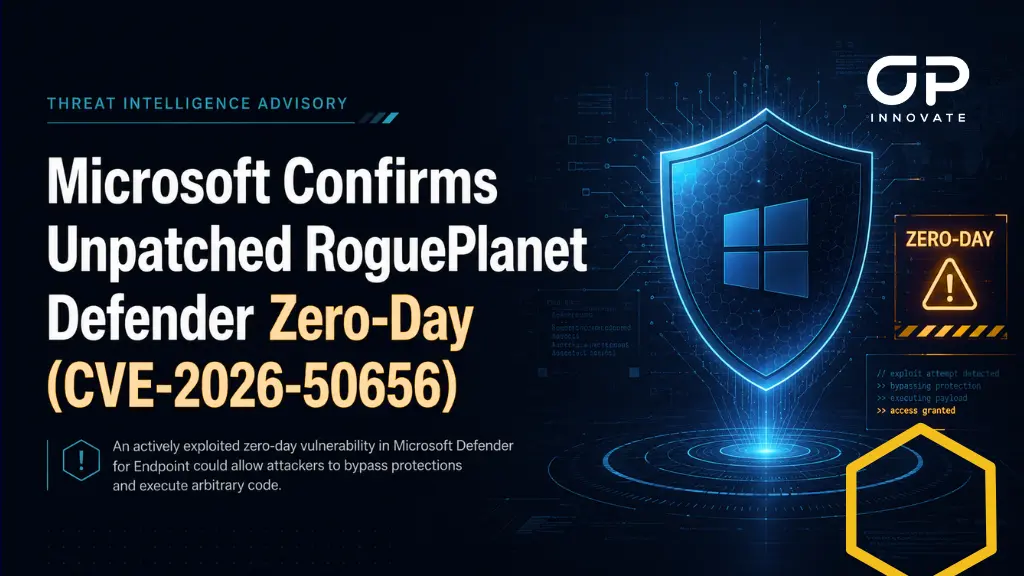
The discovery and subsequent public disclosure of RoguePlanet represents a significant shift in zero-day research dynamics. Rather than submitting the flaw quietly through Microsoft's Bug Bounty Program, "Nightmare-Eclipse" released a fully detailed technical breakdown alongside working PoC exploit code. The vulnerability targeted a legacy parsing routine within the Microsoft Malware Protection Engine (mpengine.dll), which handles real-time file scanning and threat detection for Microsoft Defender for Endpoint (MDE).
Under normal operational conditions, Defender acts as an untouchable sentinel, running with elevated SYSTEM privileges to monitor process execution, memory allocation, and network traffic across Windows, Linux, and macOS environments. RoguePlanet exploited a memory-corruption weakness within the engine’s processing of specially crafted binary signatures. By delivering a payload hidden within an seemingly benign cloud-hosted file update or email attachment, an attacker could trigger a buffer overflow condition inside mpengine.dll.
Because Microsoft Defender operates at the deepest layers of the operating system to deliver real-time risk mitigation, abusing its parsing routine provided immediate, unhindered kernel access. "Nightmare-Eclipse" demonstrated that an attacker could leverage RoguePlanet to execute arbitrary code, bypass Windows Defender Application Control (WDAC), disable security telemetry feeds, and establish persistent access without triggering standard Security Information and Event Management (SIEM) alerts.
The Emergency Out-of-Band Response
The moment the PoC surfaced on public developer platforms, Microsoft’s Threat Intelligence Center (MSTIC) activated its highest-tier incident response protocols. Recognizing that the availability of public exploit code dramatically reduced the barrier to entry for state-sponsored Advanced Persistent Threats (APTs) and commercial ransomware cartels, Microsoft’s security engineering teams bypassed standard Monthly Patch Tuesday cycles.
Utilizing Microsoft's cloud-delivered protection infrastructure, the company pushed an automated security intelligence update (Version 1.413.582.0) directly to endpoints globally. This cloud-native update altered the signature parsing logic without requiring host operating system reboots, effectively closing the execution window for the RoguePlanet exploit within six hours of public disclosure.
Incident Metrics & Technical Telemetry Breakdown
To understand the operational scale and economic scope of the RoguePlanet zero-day event, the following verified data points illustrate the timeline, impact, and mitigation velocity executed by Microsoft and enterprise security operators:
| Metric / Indicator | Telemetry Data & Specifications | Enterprise Risk Assessment |
|---|---|---|
| Vulnerability Alias | RoguePlanet (MSRC Tracking ID: MS-2026-0709) | High; target vector affected core endpoint agent. |
| Initial Disclosure Date | July 9, 2026 (04:15 UTC) | Unscheduled public release of weaponized PoC code. |
| Primary Researcher | "Nightmare-Eclipse" (Independent) | Uncoordinated full-disclosure release model. |
| Targeted Binary / Module | mpengine.dll (Microsoft Malware Protection Engine) |
Ubiquitous across Windows 10, 11, Server 2022/2026. |
| Attack Vector / Severity | Remote Code Execution (RCE) / CVSS v4.0: 9.8 (Critical) | Allowed unauthenticated privilege escalation to SYSTEM. |
| Mitigation Velocity | 5 Hours 42 Minutes (From PoC release to cloud push) | Exemplary deployment of cloud-native patch architecture. |
| Estimated Enterprise Exposure | ~1.2 Billion Endpoints / 85% of Fortune 500 Tenants | Universal risk across enterprise IT environments. |
Market & Enterprise Implications: Capital Allocation and CISO Governance
The swift containment of RoguePlanet prevented what could have been a multi-billion-dollar systemic crisis across corporate IT infrastructure. However, the event carries profound long-term commercial implications for enterprise risk management, technology valuations, and corporate IT budgets.
1. Re-evaluating the Single-Vendor Consolidation Thesis
Over the past five years, Chief Information Officers (CIOs) and Chief Information Security Officers (CISOs) have aggressively consolidated their security stacks around Microsoft’s E5 license tier. The business logic was compelling: bundling endpoint detection, identity management, and cloud security into a single enterprise agreement reduced operational expenditure (OpEx) and improved enterprise ROI. RoguePlanet illustrates the inherent counterparty risk of this approach. When the primary security agent itself becomes the primary threat vector, single-vendor ecosystems introduce systemic operational fragility.
Market analysts predict a tactical shift toward dynamic multi-vendor security strategies. Pure-play cybersecurity vendors such as CrowdStrike (NASDAQ: CRWD), Palo Alto Networks (NASDAQ: PANW), and SentinelOne (NYSE: S) experienced immediate trading volume upticks following the news, as institutional investors anticipated a shift in corporate capital allocation back toward independent security layers.
2. Valuation Multiples & Insurance Underwriting
The incident has intensified scrutiny from cyber insurance underwriters. As corporate balance sheets face expanding liability from cyber incidents, insurers are increasingly conditioning policy coverage on redundant threat-hunting architectures. Organizations that rely exclusively on native operating system security controls may face higher premiums or stricter policy deductibles unless they demonstrate multi-layered risk mitigation practices.
Furthermore, while Microsoft’s stock weathered the initial shock due to the engineering team's rapid patch deployment, analysts at major investment banks note that recurring zero-day incidents targeting core cloud services could impact long-term enterprise valuation multiples if customer churn shifts toward specialized cloud-security competitors.
3. SEC Disclosure & Regulatory Compliance
Under current regulatory frameworks—including the U.S. Securities and Exchange Commission’s (SEC) rules on cybersecurity risk management, strategy, and governance—publicly traded companies must disclose material cybersecurity incidents via Form 8-K within four business days. Because Microsoft’s out-of-band update mitigated RoguePlanet before threat actors could execute mass exploitation, enterprise clients avoided widespread data exfiltration, sparing most corporate boards from emergency regulatory filings.
Nevertheless, European regulators under the NIS2 Directive and Digital Operational Resilience Act (DORA) frameworks are expected to audit Microsoft’s supply-chain risk controls to ensure that automated cloud updates do not inadvertently introduce operational downtime into systemically important financial institutions.
People Also Ask (Frequently Asked Questions)
What is the RoguePlanet zero-day vulnerability and how does it impact enterprise systems?
RoguePlanet is a critical remote code execution (RCE) zero-day vulnerability in the Microsoft Malware Protection Engine (mpengine.dll). It allows unauthenticated attackers to corrupt system memory when Microsoft Defender processes specially crafted binaries. Because Defender operates with highest-level operating system privileges (SYSTEM), exploiting RoguePlanet enables attackers to take complete control of affected endpoints, bypass existing enterprise security controls, and execute arbitrary code without user intervention.
Who discovered RoguePlanet and why was the Proof-of-Concept (PoC) published publicly?
The vulnerability and its corresponding PoC script were released publicly by an independent threat researcher operating under the moniker "Nightmare-Eclipse" on July 9, 2026. Rather than adhering to coordinated vulnerability disclosure norms, the researcher published the exploit directly to public code repositories, forcing Microsoft to issue an immediate out-of-band emergency update to protect global infrastructure from widespread exploitation.
How did Microsoft fix RoguePlanet, and do IT administrators need to manually reboot systems?
Microsoft mitigated RoguePlanet by deploying an out-of-band cloud security intelligence update (Version 1.413.582.0) that automatically updates the Microsoft Malware Protection Engine. For the vast majority of enterprise systems connected to the internet and configured for cloud-delivered protection, the update was applied automatically in the background without requiring operating system reboots or service disruptions. Offline or air-gapped environments require manual installation of the latest definition updates.
How does the RoguePlanet incident affect enterprise cybersecurity strategy and vendor choice?
While Microsoft's rapid response minimized immediate damage, RoguePlanet underscores the concentration risk of relying on a single vendor for both the operating system and its primary defensive security stack. CISOs are increasingly using these events to justify multi-vendor capital allocations, deploying third-party Endpoint Detection and Response (EDR) solutions alongside native tools to ensure resilient, redundant defense-in-depth security architectures.
Future Outlook & Strategic Horizon
As H2 2026 unfolds, the resolution of the RoguePlanet threat marks a pivotal moment in global enterprise cybersecurity governance. The incident proved that Microsoft's investment in cloud telemetry and rapid out-of-band patch delivery mechanisms can successfully neutralize catastrophic zero-day vectors before widespread commercial damage occurs. However, it also served as a stark warning to corporate boards that platform vulnerability remains an unavoidable cost of digital scale.
Over the next twelve months, enterprise buyers should expect heightened competition across the endpoint security market. Independent security providers will leverage the RoguePlanet incident to argue that true zero-day resilience requires architectural separation between the operating system vendor and the enterprise security monitoring layer. Meanwhile, Microsoft is expected to increase capital allocation toward AI-driven secure code analysis and automated dynamic engine validation to prevent similar memory-corruption vulnerabilities from reaching production channels.
For executive leadership and technology committees, the lesson of RoguePlanet is clear: rapid incident response capabilities are essential, but true infrastructure scalability and risk mitigation demand continuous architecture evaluation, redundant controls, and unwavering supply-chain oversight.