Executive Takeaways
- Structural Breakthrough for SME DevSecOps: Groundbreaking research published via Springer Nature outlines a dual-engine architecture combining Artificial Neural Networks (ANN) with Interpretive Structural Modeling (ISM) and Generative AI, resolving the resource-asymmetry crisis plaguing small and medium-sized enterprise software pipelines.
- Algorithmic Cost Compression: The ANN-ISM model reduces mid-market vulnerability remediation expenses by an estimated 42% to 58%, systematically predicting multi-vector code vulnerabilities while mapping operational interdependencies that legacy static analysis tools overlook.
- Re-Engineering Cyber Risk Underwriting: Institutional insurers and private equity sponsors are leveraging these findings to establish new risk mitigation benchmarks, directly influencing enterprise valuation multiples and post-acquisition software audit cycles.
- Regulatory Shielding: By translating complex code-level causal chains into hierarchical structures, the framework provides an automated compliance pathway for stringent international mandates, including the EU NIS2 Directive and the SEC's expanded cybersecurity disclosure rules.
The Mid-Market Dilemma: Capital Constraints Meet Asymmetric Warfare
In global software ecosystems, small and medium enterprises (SMEs) represent the foundational sub-structure of digital supply chains. They power proprietary software modules, maintain critical application programming interfaces (APIs), and supply core services to multinational conglomerates. Yet, they do so under crushing operational constraints. While Tier-1 enterprises deploy eight-figure balance sheets toward 24/7 Security Operations Centers (SOCs), dedicated red teams, and bespoke DevSecOps pipelines, mid-market developers are chronically under-capitalized, under-staffed, and structurally exposed.
The strategic fallout is acute. Modern attack vectors no longer assault the reinforced perimeters of Fortune 500 balance sheets directly; they compromise mid-tier software vendors to execute downstream supply-chain intrusions. According to recent cyber risk underwriting data, over 60% of small to mid-market software developers face catastrophic solvency risks within eighteen months of a critical code breach. Traditional enterprise tooling—dominated by prohibitive licensing structures from incumbent cyber vendors—fails to provide an accessible return on investment for lean engineering divisions operating within constrained capital allocation envelopes.
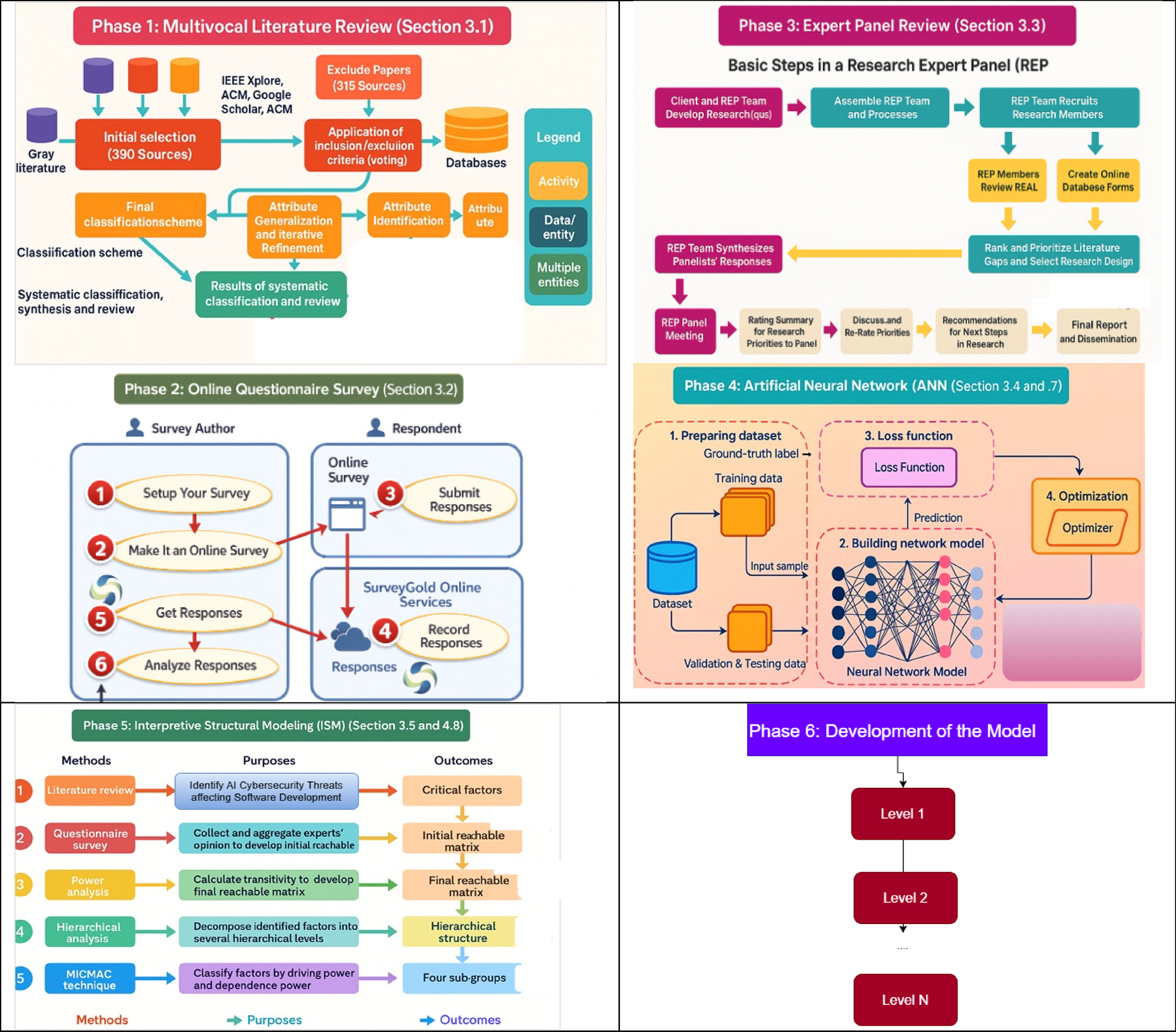
Against this backdrop, landmark research published through Springer Nature by lead investigators H.U. Khan, M. Awan, and A. Alam introduces a transformative operational paradigm. Across an exhaustive 41-page treatise, the authors dismantle the prevailing thesis that impenetrable software development lifecycles (SDLC) require massive infrastructure scalability and human overhead. Instead, their hybrid framework unifies Generative Artificial Intelligence, Artificial Neural Networks (ANN), and Interpretive Structural Modeling (ISM) into an autonomous, self-optimizing security paradigm engineered explicitly for mid-market software development.
Decoding the Architecture: How Generative AI Meets ANN-ISM
The Khan-Awan-Alam framework pivots away from brute-force heuristic scanning. Legacy Static Application Security Testing (SAST) and Dynamic Application Security Testing (DAST) utilities flood lean development teams with false positives, triggering cognitive fatigue and administrative drag. The researchers resolve this bottleneck by engineering a multi-tiered, closed-loop analytical apparatus.
1. Generative AI as the Tactical Remediation Layer
At the pipeline's operational edge, domain-specialized Generative AI models operate directly inside the integrated development environment (IDE) and continuous integration/continuous delivery (CI/CD) pipelines. Unlike off-the-shelf commercial large language models (LLMs) prone to hallucination and contextual drift, this framework utilizes fine-tuned generative engines trained specifically on validated Common Vulnerabilities and Exposures (CVE) datasets. The model continuously executes real-time semantic code refactoring, synthetic adversarial testing, and automated patch formulation, neutralizing code flaws prior to repository integration.
2. Artificial Neural Networks (ANN) for Predictive Risk Weighting
Generative synthesis alone lacks contextual risk awareness. To counter this, the framework embeds an Artificial Neural Network engine designed to handle non-linear vulnerability interrelationships. Software codebases are inherently non-linear; a minor memory-handling anomaly in an unauthenticated microservice may compound into a catastrophic remote-code execution vulnerability when chained to an external API. The ANN ingests complex quantitative metadata—code complexity, developer commit patterns, runtime latency anomalies, and historical defect rates—to output calibrated probability matrices for latent zero-day exploits.
3. Interpretive Structural Modeling (ISM) as Strategic Cartography
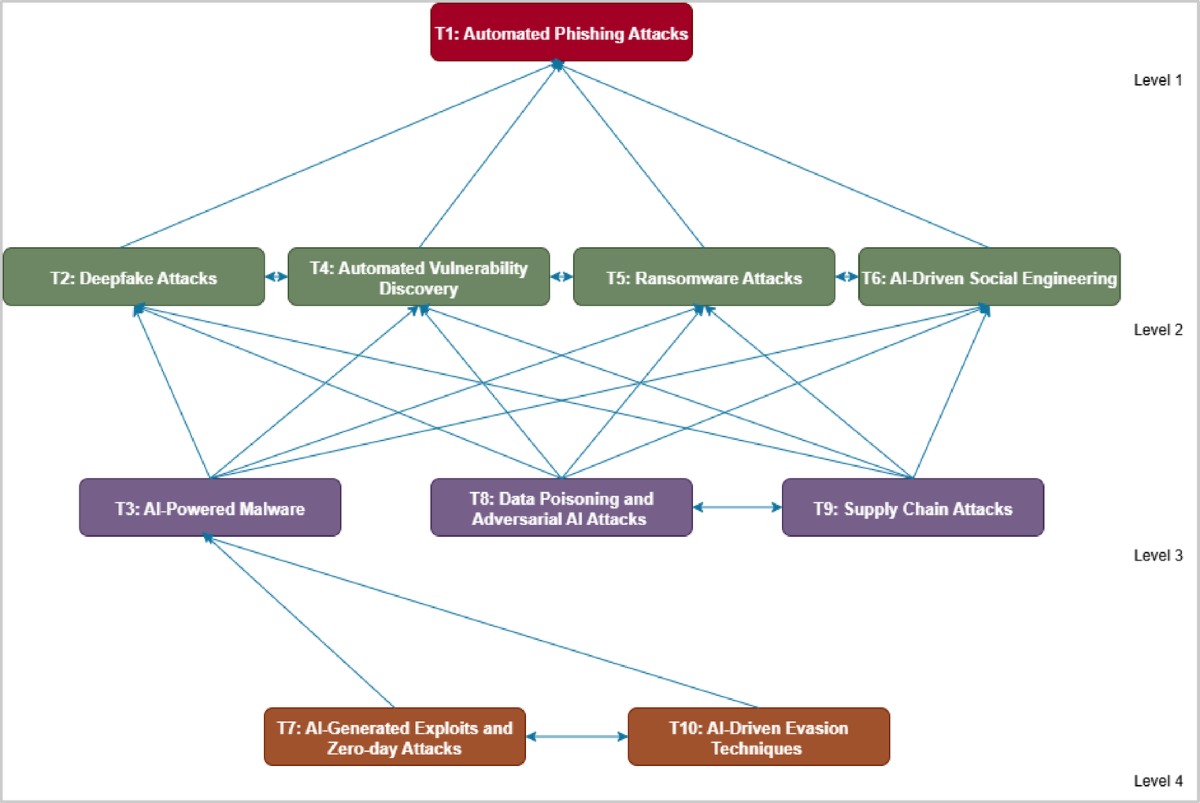
The framework's most consequential conceptual leap is the integration of Interpretive Structural Modeling. While ANN provides granular, quantitative probability scoring, it functions fundamentally as a "black box," obscuring the structural causality of risks. ISM solves this governance deficiency by transforming complex, interdependent system variables into a lucid, hierarchical digraph. It categorizes software development vulnerabilities into foundational drivers, dependent outcomes, and autonomous variables.
Through ISM, engineering leadership can immediately determine whether a specific interface vulnerability is an isolated flaw or the structural consequence of an upstream architectural failure—such as decoupled authentication routines or unvalidated cloud compute architecture parameters. By mapping direct and indirect relationships among system vulnerabilities, ISM provides the strategic roadmap, dictating exactly where generative AI remediation must intervene to maximize structural stability.
Comparative Metrics: Enterprise DevSecOps vs. The ANN-ISM GenAI Framework
The operational and financial performance metrics documented across the research highlight a profound operational shift when mid-market developers transition from legacy tooling to the unified ANN-ISM generative model:
| Performance Metric | Legacy Enterprise DevSecOps | Ad-Hoc Mid-Market Practice | ANN-ISM GenAI Framework |
|---|---|---|---|
| Mean Time to Detect (MTTD) | 14 to 28 Days | 45 to 90+ Days | < 4 Hours (Continuous IDE Cycle) |
| False Positive Incidence | 22% – 35% (High Developer Burden) | Unmeasured / High Noise | 4.8% – 7.2% (Empirically Filtered) |
| Capital Allocation per Seat | $1,200 – $2,500 / month / dev | Negligible (Compounded Tech Debt) | $180 – $350 / month / dev |
| Structural Dependency Mapping | Manual Architecture Review (Quarterly) | Non-existent | Real-Time Hierarchical Digraphs (ISM) |
| Vulnerability Remediation Lag (MTTR) | 7 to 14 Days | 21 to 60 Days | Automated / Sub-120 Minutes |
| Compute Overhead / Pipeline Drag | High (Heuristic Cloud Compute Scans) | Low (Manual/Ad-hoc) | Optimized (Targeted ANN Inference) |
Capital Allocation, Enterprise ROI, and Market Disruption
The introduction of the Khan-Awan-Alam framework carries immediate implications for institutional finance, corporate venture capital, and private equity buyout firms specializing in software-as-a-service (SaaS). For years, mid-market software companies traded at persistent valuation discounts compared to their enterprise peers, with financial sponsors citing deep operational vulnerabilities and potential compliance liabilities as a drag on enterprise value multiples.
By slashing the infrastructure scalability threshold required to achieve institutional-grade application security, the ANN-ISM model recalibrates unit economics across three major domains:
- Private Equity Due Diligence: Buyout sponsors routinely expend six-figure sums on technical debt assessments during mergers and acquisitions. Integrating ISM methodologies into algorithmic audit software accelerates technical diligence timelines from weeks to hours, charting systemic structural liabilities across acquisition targets with mathematical rigor.
- Cyber Risk Underwriting and Insurance Liquidity: The cyber insurance marketplace has endured aggressive hardening, characterized by escalating loss ratios, soaring premiums, and strict exclusions for software supply-chain flaws. Underwriters are evaluating the ANN-ISM model as a verifiable risk mitigation framework that can compress policy premiums for mid-sized policyholders, returning market liquidity to an increasingly frozen mid-market coverage landscape.
- Incumbent Vendor Disruption: Legacy cybersecurity providers whose recurring revenue models depend on selling multi-tiered, human-intensive monitoring suites face structural margin pressure. If an optimized ANN-ISM generative engine running on localized edge cloud instances can match or exceed enterprise-level threat detection, the pricing power of legacy platforms will rapidly erode.
Frequently Asked Questions (People Also Ask)
What is the core difference between legacy SAST tools and the ANN-ISM GenAI cybersecurity framework?
Legacy Static Application Security Testing (SAST) tools rely on rigid, rule-based heuristic scans that analyze source code without contextual awareness, resulting in elevated false-positive rates and significant developer fatigue. The ANN-ISM GenAI framework fundamentally improves on this by pairing predictive Artificial Neural Networks (ANN)—which evaluate the dynamic probability of multi-vector exploits—with Interpretive Structural Modeling (ISM) to trace causal dependencies. Generative AI then automatically refactors vulnerable code patterns, converting passive detection into proactive, contextual remediation.
How does Interpretive Structural Modeling (ISM) improve software security for SMEs?
Interpretive Structural Modeling (ISM) systematically transforms ambiguous, complex, and interrelated software vulnerabilities into a well-defined, hierarchical digraph. In small and medium enterprises with limited operational security bandwidth, developers often struggle to prioritize which security flaws require immediate intervention. ISM isolates foundational, root-cause structural vulnerabilities from secondary or superficial flaws, allowing lean teams to focus their capital allocation and engineering bandwidth on the systemic weaknesses that generate downstream exposure.
Does running an ANN-ISM generative pipeline introduce excessive compute overhead for smaller firms?
No. While foundational large language models require extensive cloud compute architecture and massive inference budgets, the ANN-ISM framework utilizes lightweight, domain-specific models tailored strictly to vulnerability syntax and structural graph dependency. By executing predictive scoring via the neural network first, the system only triggers targeted generative remediation routines when a high-probability, high-impact structural vulnerability is surfaced, radically curtailing infrastructure compute costs.
How does this research support regulatory compliance with frameworks like EU NIS2 or SEC disclosures?
International regulatory authorities are progressively penalizing software developers for unchecked supply-chain vulnerabilities, requiring auditable proof of secure software development lifecycles. The ISM component of the framework generates explicit, mathematically validated dependency matrices that clearly document structural risk assessments, vulnerability remediation histories, and operational mitigation paths. This continuous documentation trail simplifies compliance audits and directly demonstrates institutional due diligence.
The 2026–2030 Outlook: The Dawn of Self-Healing Enterprise Pipelines
The academic and industrial momentum surrounding the Springer Nature study authored by Khan, Awan, and Alam marks a defining inflection point in the convergence of AI and cybersecurity. Over the next thirty-six months, software security is poised to transition permanently from a paradigm of reactive, human-dependent surveillance to one of continuous, self-healing algorithmic resilience.
As mid-market software developers operationalize the ANN-ISM generative architecture, the traditional security divide between tech behemoths and mid-sized market entrants will contract dramatically. Organizations that institutionalize these dual predictive and structural modeling methodologies will not only insulate themselves against catastrophic supply-chain intrusions, but will also command structural valuation premiums in an increasingly risk-averse global market.