Executive Takeaways
- Paradigm-Shifting Architecture: Microsoft unveiled the Majorana 1 chip, introducing a topological qubit design engineered to solve the industry's critical decoherence and error-correction bottlenecks.
- Enterprise ROI & Cloud Integration: Positioned for seamless deployment via Azure Quantum, the hardware targets complex combinatorial optimization, materials science, and financial modeling at scale.
- Capital Allocation Shift: The breakthrough alters enterprise risk mitigation strategies, threatening to compress the valuation multiples of pure-play superconducting and trapped-ion hardware firms lagging in topological stability.
- Commercial Timeline: While foundational physics milestones have been cleared, infrastructure scalability, cryogenic enclosure demands, and regulatory compliance frameworks will dictate enterprise adoption velocity through 2030.
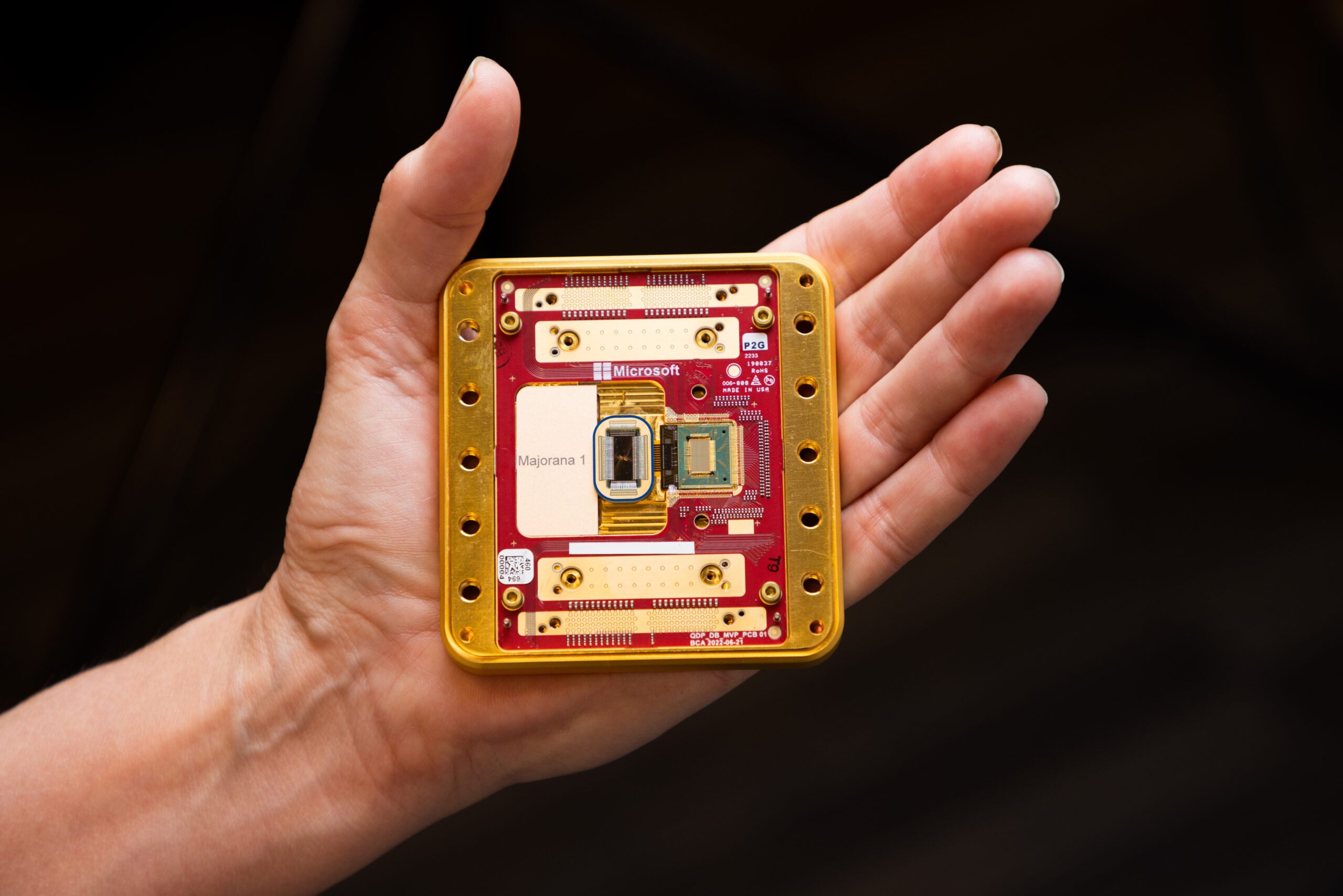
REDMOND, Wash. — For decades, the holy grail of high-performance computing has been shadowed by a persistent ghost: decoherence. Traditional quantum processors, reliant on fragile superposition states, have historically functioned like delicate glass sculptures in a seismic zone, requiring millions of noisy physical qubits to construct a single fault-tolerant logical unit. On February 19, 2025, Microsoft altered the technological landscape with the official introduction of the Majorana 1 chip, the world’s first topological quantum processor designed to bypass traditional error-correction roadblocks through hardware-level stabilization.
Unveiled to the global scientific and financial communities, the Majorana 1 represents more than an incremental engineering milestone; it is a foundational re-architecting of how quantum information is stored, manipulated, and scaled. For corporate balance sheets, venture capital allocators, and chief technology officers, the arrival of topological qubits forces an immediate re-evaluation of enterprise capital expenditure cycles, risk mitigation strategies, and the timeline for commercial return on investment (ROI) in deep tech.
The Physics of Permanence: Rethinking Quantum at Scale
To understand the market implications of Microsoft’s Majorana 1, one must first examine the underlying physics that separated theoretical quantum supremacy from practical enterprise utility. Conventional quantum architectures—championed by industry heavyweights utilizing superconducting circuits or trapped ions—suffer from environmental noise. Stray magnetic fields, thermal fluctuations, and material defects routinely corrupt quantum states, demanding staggering computational overhead dedicated entirely to error correction.
Microsoft’s long-term bet, spearheaded by its Station Q research network and advanced hardware teams, centered on non-Abelian anyons and Majorana zero modes—quasi-particles that act as their own antiparticles. By braiding these exotic entities in a topological superconductor, information is stored non-locally across a physical structure rather than in a single vulnerable point. This topological protection acts as a natural shield against local perturbations.
As lead researchers noted during the launch, the hardware's operational philosophy can be boiled down to a simple, disruptive reality: "It just gives you the answer." By engineering stability directly into the physical substrate, the Majorana 1 minimizes the need for massive auxiliary error-correction circuits, dramatically reducing the physical footprint required to execute complex computational workloads.
Financial Implications: Valuations, Capital Allocation, and Enterprise Risk
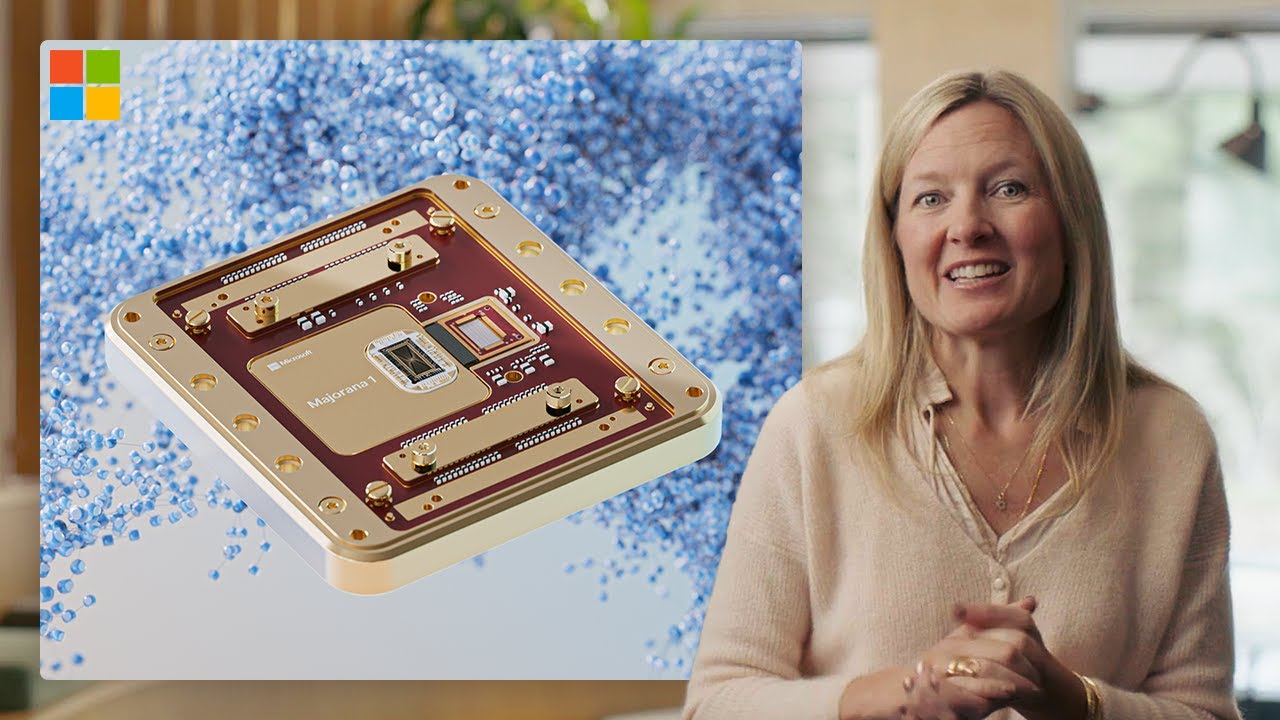
The unveiling of the Majorana 1 sends immediate shockwaves across global capital markets, directly impacting how institutional investors value pure-play quantum startups versus vertically integrated cloud monoliths. Over the past five years, venture capital and public markets have poured billions into early-stage quantum hardware companies. Many of these firms operate on architectures that require complex, error-correction-heavy scaling paths.
| Architectural Metric | Conventional Superconducting / Trapped-Ion | Microsoft Majorana 1 (Topological) |
|---|---|---|
| Error Protection Mechanism | Software-heavy quantum error correction (QEC) | Hardware-level topological braiding & protection |
| Overhead Requirement | Millions of physical qubits per logical qubit | Exponentially reduced physical-to-logical ratio |
| Cloud Integration Pathway | Various hybrid classical-quantum models | Native Azure Quantum infrastructure integration |
| Primary Enterprise Target | Early experimental discovery & chemical simulation | Mission-critical commercial optimization at scale |
For corporate treasuries and chief financial officers, this hardware leap alters risk mitigation models. Companies operating in high-stakes sectors—such as pharmaceutical discovery, global logistics, aerospace engineering, and quantitative finance—can no longer treat quantum computing as a distant, speculative research-and-development line item. The transition from noisy intermediate-scale quantum (NISQ) systems to fault-tolerant topological hardware accelerates the timeline for achieving genuine enterprise ROI.
Furthermore, Microsoft’s deep integration strategy leverages its existing enterprise moat: the Azure cloud ecosystem. By abstracting the complex cryogenic and control electronics behind secure cloud APIs, Microsoft ensures that enterprise adoption will not require organizations to build in-house quantum infrastructure. Instead, companies will purchase scalable compute cycles via Azure Quantum, ensuring recurring, high-margin revenue streams for Redmond while driving down the total cost of ownership for end-users.
Industry Disruption: Who Wins, Who Loses
Every major technological paradigm shift redraws competitive boundaries. The introduction of the Majorana 1 creates clear victors and pressurized incumbents across the technology sector:
- The Winners — Vertically Integrated Cloud Giants: Companies with massive capital reserves, advanced semiconductor fabrication partnerships, and expansive cloud distribution channels (led by Microsoft) are uniquely positioned to monetize hardware breakthroughs immediately.
- The Pressured — Pure-Play Hardware Startups: Early-stage quantum firms relying solely on noisy architectures now face compressed valuation multiples. Investors are demanding proof of a viable path toward hardware-level error suppression, threatening to starve non-topological upstarts of venture capital liquidity.
- The Enterprise End-Users: Financial institutions, logistics conglomerates, and material science giants stand to gain unprecedented computational capabilities, enabling real-time portfolio risk management, molecular design simulation, and supply chain optimization that were previously mathematically impossible.
People Also Ask (FAQ)
Frequently Asked Questions
What makes Microsoft’s Majorana 1 chip different from traditional quantum processors?
Unlike traditional superconducting or trapped-ion processors that rely on fragile superposition states requiring extensive software-based error correction, the Majorana 1 utilizes topological qubits. By braiding non-Abelian anyons, the chip stores quantum information non-locally, providing hardware-level protection against environmental noise and decoherence.
When will enterprise clients be able to access the Majorana 1 chip?
Microsoft is rolling out access to its topological quantum architecture through the Azure Quantum ecosystem. While initial availability targets advanced research partners and select enterprise early-adopters for co-development, broader commercial cloud availability will scale in alignment with cryogenic infrastructure deployment.
How does topological quantum computing impact existing cybersecurity frameworks?
Fault-tolerant topological processors accelerate the timeline toward cryptographically relevant quantum computers capable of breaking current asymmetric encryption standards (such as RSA and ECC). Consequently, the Majorana 1 reinforces the urgent enterprise mandate to transition toward National Institute of Standards and Technology (NIST)-approved post-quantum cryptography (PQC) standards.
Will enterprises need to purchase specialized hardware to run Majorana 1 workloads?
No. Due to the extreme cryogenic and precision control requirements of topological hardware, Microsoft will host and operate the systems within specialized data center environments. Enterprises will access the compute power remotely via secure cloud APIs, ensuring seamless integration with existing hybrid cloud workflows.
Future Outlook: Milestones on the Horizon
As the dust settles on the initial announcements of February 2025, industry analysts and enterprise architects are turning their focus toward the operational roadmap ahead. The immediate milestone to watch will be independent benchmarking of the Majorana 1’s logical qubit fidelity against simulated and competing hardware benchmarks. Furthermore, enterprise adoption velocity will depend heavily on the maturity of Microsoft’s software development kit (SDK) tooling, allowing classical programmers to translate complex industrial algorithms into topologically protected operations.
Regulatory compliance and export control frameworks will also play a pivotal role. As quantum hardware achieves fault tolerance, geopolitical sensitivities surrounding sovereign compute capabilities will intensify, positioning foundational quantum processors alongside advanced AI accelerators as critical strategic assets.
For executive leadership teams, the message is unequivocal: quantum computing has crossed the threshold from academic physics experiment to enterprise infrastructure reality. Organizations that proactively align their cloud compute architectures, data governance, and cryptographic defenses with the post-NISQ era will capture an insurmountable competitive advantage, while those that hesitate risk navigating a disrupted market with obsolete tools.