Inside Apple’s Secret Robotics Pivot: How ‘HomeView’ Lays the Groundwork for Cupertino’s Next Big Hardware Frontier
Executive Takeaways
- The Post-Titan Strategic Pivot: Following the multi-billion-dollar shuttering of Project Titan (its autonomous vehicle program), Apple has systematically redeployed high-caliber hardware, machine learning, and control-systems engineers toward domestic robotics and spatial ambient computing.
- HomeView as the Stepping Stone (J490): The forthcoming wall- and dock-mountable smart home console—internally associated with the brand concept "HomeView" and powered by "homeOS"—serves as the foundational software and sensor proving ground for Apple's ambient ecosystem.
- The Tabletop Robotics Flagship (J595): Scheduled for a targeted 2026–2027 commercial window, Apple is engineering an advanced tabletop device featuring a display mounted atop a motorized robotic actuator, intended to serve as a command hub powered by Apple Intelligence.
- Ecosystem Defensibility & High-eCPM Economics: By marrying edge-silicon inference with precision mechanical engineering, Apple aims to arrest market-share stagnation in the smart-home vertical, counter Amazon and Google’s commodity-tier hubs, and capture premium recurring Services revenue.
From Scrapped Autonomous Cars to the Tabletop: Cupertino’s Capital Reallocation
When Apple Chief Operating Officer Jeff Williams and Vice President of Technology Kevin Lynch formally shuttered Project Titan in early 2024, they released an estimated $1 billion in annual capital expenditure from a decade-long endeavor that yielded zero consumer shipments. That capital, along with several hundred foundational robotics, sensor-fusion, and kinematic software engineers, did not simply dissipate back into the balance sheet. Instead, it accelerated Cupertino’s most audacious hardware pivot in a generation: embodied artificial intelligence and consumer robotics.
The tip of this spear is manifesting in two distinct, sequential hardware form factors. The first is a compact smart command center, codenamed J490 (frequently referred to in supply-chain and developer corridors alongside consumer-facing concepts like HomeView). The second—and far more complex—is codenamed J595, an enterprise-grade consumer tabletop device boasting an iPad-like display tethered to an articulating, multi-axis robotic actuator arm.
Where Wall Street initially expressed skepticism regarding Apple’s ability to replace the massive potential TAM (Total Addressable Market) of an electric vehicle, institutional analysts are now reassessing the gross-margin profile and capital-allocation efficiency of ambient home robotics. Rather than absorbing the low-margin, capital-intensive manufacturing pitfalls of the automotive sector, Apple is executing an incremental go-to-market strategy that relies on familiar silicon architecture, proprietary operating system extensions, and existing supply-chain contracts in East Asia.
Deconstructing ‘HomeView’: The homeOS Sensor and Software Vanguard
To understand the eventual robotic arm, one must first analyze the J490 "HomeView" console. For nearly a decade, Apple’s smart home footprint has remained fragmented across the Apple TV set-top box and HomePod smart speakers, leaving the screen-centric hub domain entirely to Amazon’s Echo Show and Google’s Nest Hub. J490 rectifies this structural deficit by establishing a unified hardware canvas for homeOS, a specialized operating system built on the tvOS codebase but radically redesigned for ultra-low-latency interaction.
Key technical and hardware specifications revealed through industry intelligence indicate that HomeView will serve as an edge-compute powerhouse disguised as a minimalist home terminal:
- A18-Class Neural Processing: Unlike competitor devices that outsource processing to cloud-based servers, HomeView integrates Apple’s latest baseline A-series silicon. This enables on-device execution of Apple Intelligence models, sub-50-millisecond natural-language intent parsing, and local facial and gesture recognition via an integrated FaceTime camera.
- Contextual Awareness via Sensor Arrays: HomeView introduces an advanced proximity-sensing architecture. Leveraging Ultra-Wideband (UWB) sensors alongside ambient light and infrared arrays, the screen dynamically adjusts its user interface based on user distance—transitioning from a micro-dashboard (time, climate, security status) at six feet to an interactive, touch-dense control panel as a user approaches.
- Matter & Thread Infrastructure: Operating as a primary Thread Border Router, the unit acts as the mission control for Matter-certified local mesh networks, completely decoupling essential home automation from external internet connectivity and reducing latency to near zero.
By establishing this software and sensor foundation in a non-motorized, accessible form factor, Apple effectively mitigates the platform risk for its subsequent, more expensive robotic iteration. HomeView is designed to train consumers on conversational interaction via the revamped Siri, normalize Apple-centric home automation, and iron out real-world edge-inference bugs before introducing mechanical motion.
Project J595: The Leap to Embodied Actuation and Tabletop Robotics
The transition from a static display (J490) to the robotic flagship (J595) represents Apple’s formal entry into embodied AI. Under the direct leadership of Kevin Lynch within Apple’s hardware engineering division, Project J595 seeks to solve the fundamental UX limitation of static smart displays: fixed orientation in dynamic, multi-person spaces.
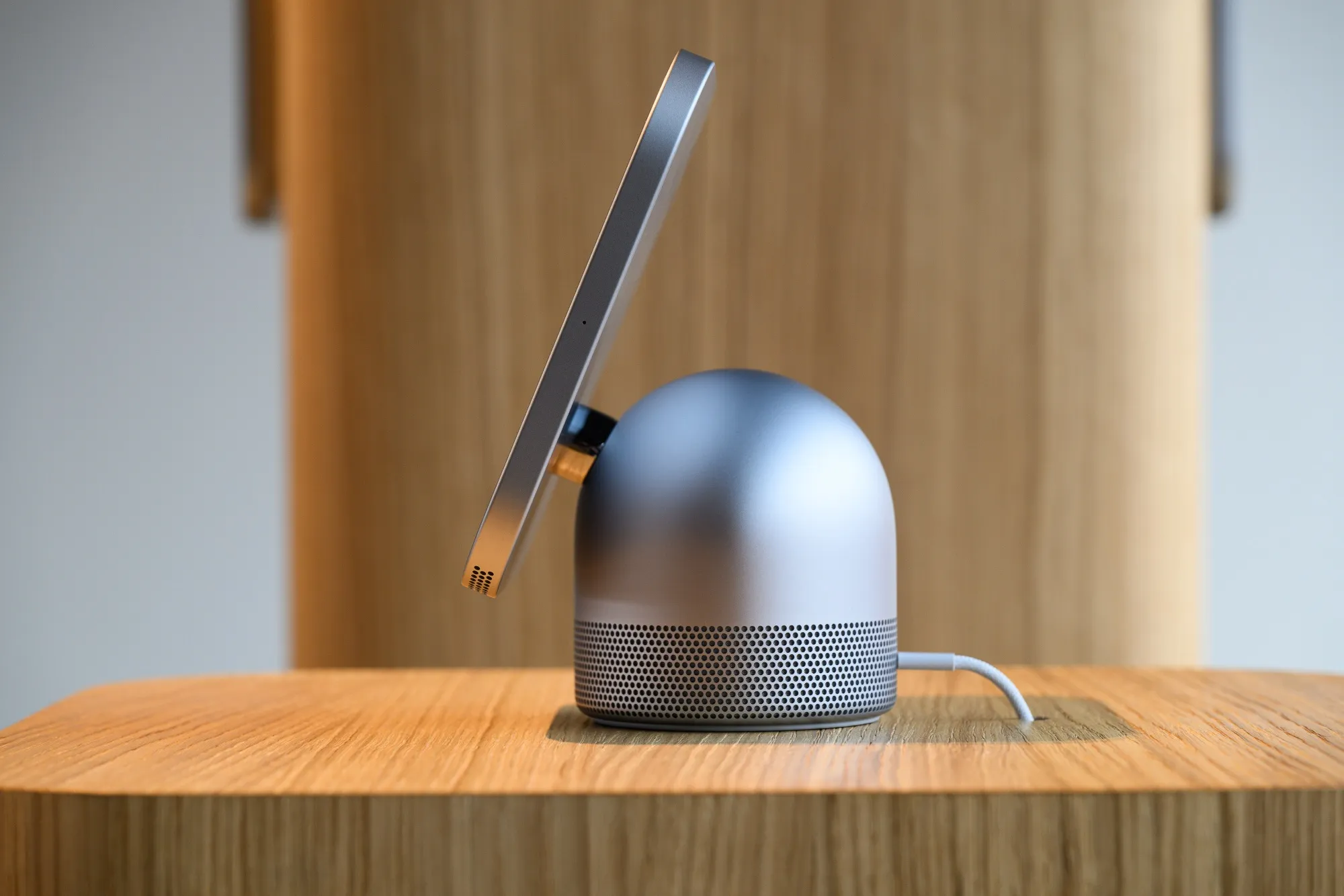
Industry sources close to the prototype development confirm that the device utilizes a precision actuator assembly capable of 360-degree rotation along the horizontal axis and steep tilt actuation along the vertical plane. The display effectively "follows" an individual through a kitchen, conference room, or living space during a FaceTime session, culinary tutorial, or spatial audio presentation.
The mechanical engineering hurdles Cupertino has faced during development have been formidable:
- Acoustic Isolation: Consumer smart hubs rely heavily on far-field microphone arrays for beamforming voice commands. Motorized actuators generate mechanical hum and high-frequency vibrations that degrade signal-to-noise ratios. Apple’s acoustic teams have engineered bespoke brushless DC motors, dampening mounts, and real-time active noise cancellation algorithms to isolate motor operational signatures from the microphone pickup.
- Kinematic Naturalism: Drawing inspiration from Pixar-like character kinematics, Apple's software teams are programming the robotic arm to convey subtle non-verbal cues—tilting the display upward in an attentive posture when the wake-word is triggered, or gently rotating toward a secondary speaker entering the room.
- Structural Center-of-Gravity Management: To avoid base ballast requirements that would inflate shipping weights and production costs, the base station houses the high-density power supply and speaker enclosures, creating a counterweight to the cantilevered screen arm during sudden angular acceleration.
Hardware Matrix: Apple’s Ambient & Robotics Evolution
The following data breakdown details the strategic and technological progression from Apple’s incumbent ambient devices to the upcoming robotic era:
| Device Code / Platform | Estimated Horizon | Target Silicon | Core Interaction Paradigm | Projected Price Tier | Strategic Objective |
|---|---|---|---|---|---|
| HomePod 2 / Apple TV 4K (Current Ambient Footprint) |
Active Commercial | A15 Bionic / S7 SiP | Far-field Voice, Remote UI, AirPlay Streaming | $99 – $299 | Audio-first ecosystem retention; streaming gateway |
| Project J490 (HomeView / homeOS Console) |
Late 2025 / Early 2026 | A18 (Edge Neural Engine) | Touch, Proximity Tracking, Local Siri Intents | $199 – $349 | Establish homeOS platform footprint; counter Echo Show; drive Matter adoption |
| Project J595 (Tabletop Robotic Actuator) |
2026 – 2027 | M-Series / A18 Pro Hybrid | Embodied Motion, Visual Tracking, Spatial Awareness | $999 – $1,299 | Define premium consumer robotics; high-margin enterprise & luxury domestic hardware |
Market Implications: Supply Chain Realignment and Competitor Disruption
The commercial rollout of HomeView and its robotic successor carries profound ramifications for multiple market sectors:
1. Disruption of the Budget Smart Home Oligopoly
Amazon and Google have dominated smart display units through aggressive hardware subsidization, treating devices like the Echo Show as loss leaders to drive retail transactions and cloud data capture. However, both companies have struggled with device-division profitability and enterprise-grade privacy perception. Apple’s privacy-first posture—emphasizing local neural computation over cloud-based telemetry—offers a distinct value proposition for high-net-worth households and enterprise boardrooms seeking secure telepresence options.
2. Actuator and Component Supply-Chain Windfalls
The transition to motorized consumer electronics will introduce new Tier-1 suppliers into Apple's master vendor list. Precision miniature motor manufacturers, such as Nidec Corporation and MinebeaMitsumi, alongside specialized hinge and cinematic component specialists like Foxconn Technology and Luxshare, stand to benefit from the high-margin actuator assemblies required for J595.
3. Defensibility of the Services Ecosystem
Hardware diversification is critical as iPhone replacement cycles lengthen globally. By embedding interactive, moving hardware into the home, Apple secures additional entry points for subscription revenue, including Apple Fitness+, FaceTime-based corporate conferencing tools, and specialized ambient spatial computing experiences that tether directly into the Apple Vision Pro ecosystem.
Frequently Asked Questions (People Also Ask)
What is Apple’s "HomeView" device?
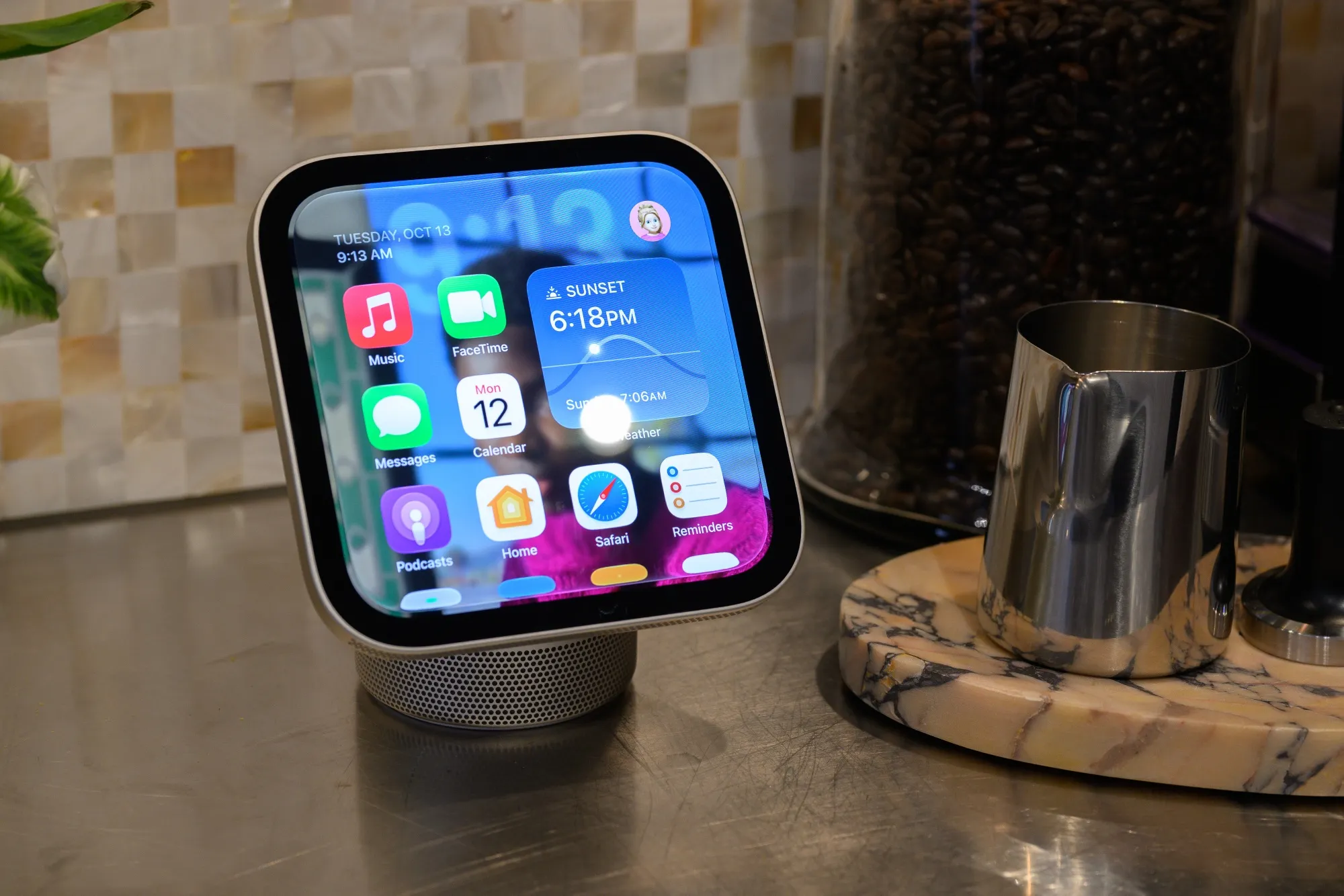
HomeView is the working concept for Apple’s upcoming smart home command console (codenamed J490). It features an approximate 6-inch square display, wall-mount and speaker-dock capabilities, and runs a dedicated operating system known as homeOS. It leverages edge AI via an A18-class processor to control Matter-compatible smart home accessories, handle FaceTime communications, and execute Apple Intelligence tasks locally.
How does HomeView relate to Apple’s rumored robotic arm?
HomeView serves as the technological foundation for the robotic device. While HomeView is a stationary, cost-effective smart display intended to test and scale the homeOS software ecosystem, the subsequent robotic device (codenamed J595) pairs an iPad-sized display with an advanced motorized actuator arm, allowing the screen to tilt, pan, and visually track users throughout a room.
When will Apple launch the robotic tabletop device, and what will it cost?
According to supply chain indicators and market reporting, the J490 smart display is targeted for a late 2025 or early 2026 launch at an accessible price point ($199–$349). The premium tabletop robotic device (J595) is tracking toward a 2026 to 2027 debut, with internal cost modeling projecting a retail price near $1,000, aligning it with premium enterprise telepresence and luxury home automation devices.
Will the robotic Apple display compromise user privacy?
Apple’s primary competitive differentiator is its on-device security architecture. Robotic tracking, facial identification, and voice analysis will be processed entirely on-device via the Neural Engine or mediated through Apple’s cryptographically audited Private Cloud Compute (PCC) infrastructure. Unlike competitor hardware, raw visual and acoustic data from domestic spaces is not monetized for behavioral advertising.
Future Outlook and Strategic Milestones
As Apple marches toward production readiness, key indicators will reveal the precise cadence of Cupertino's robotics strategy. The first major milestone will occur during upcoming developer cycles, where references to homeOS frameworks and unified ambient UI libraries are expected to appear within early iOS and tvOS software development kits (SDKs).
The second indicator will emerge from capital expenditure signaling within the Asian contract manufacturing supply chain, particularly regarding tooling investments for miniature precision gearboxes, optical encoders, and specialized high-torque actuators. Should these orders scale by mid-2025, the initial HomeView deployment will proceed directly on schedule, setting the stage for Apple’s boldest mechanical hardware transition since the original Macintosh.
Ultimately, HomeView is not merely a competitor to existing smart displays; it is the calibration phase for a future where Apple software physically moves within human spaces—an essential evolutionary stepping stone toward full-scale embodied consumer robotics.