Executive Takeaways
- Unprecedented Cosmological Anomaly: Astronomers have identified an isolated, massive cloud of primordial hydrogen gas—designated J0613+52—that exhibits no visible stellar population, marking it as a premier candidate for a primordial "dark galaxy."
- Validation of $\Lambda$CDM Models: The detection provides long-sought observational validation for Cold Dark Matter ($\Lambda$CDM) cosmological framework predictions, demonstrating that dark matter halos can exist without triggering star formation.
- Deep-Tech Infrastructure Catalyst: Processing the high-dimensional radio frequency spectra required to detect these stealth structures is accelerating enterprise capital expenditure in high-performance computing (HPC), AI-driven signal filtering, and cloud compute architecture.
- Market Implications: Advanced radio-frequency (RF) signal extraction and multi-messenger data processing frameworks developed for deep-space research are creating high-value enterprise spin-offs across commercial radar, defense surveillance, and satellite data analytics.
In the quiet high-altitude corridors of deep-space observational science, a catastrophic cataloging anomaly has yielded one of the most profound cosmological breakthroughs of the decade. Astronomers leveraging the Robert C. Byrd Green Bank Telescope (GBT) have stumbled upon an isolated, starless cloud of neutral hydrogen gas—a primordial structure residing roughly 270 million light-years from Earth. Lacking any optical counterpart, visible stellar clusters, or internal ignition source, the object (cataloged as J0613+52) represents what astrophysicists have long theorized but rarely verified: an intact, pristine "dark galaxy" surviving undisturbed since the early universe.
For decades, standard cosmological models—specifically the Cold Dark Matter ($\Lambda$CDM) paradigm—predicted that the cosmos should be teeming with low-mass dark matter halos that failed to accrete sufficient baryonic matter or ignite runaway star formation. However, observational confirmation remained elusive due to the overwhelming optical glare of neighboring luminous galaxies and the extreme difficulty of isolating ultra-faint neutral hydrogen ($H_I$) emissions. The discovery of J0613+52 not only validates key mathematical foundations of modern astrophysics, but it also signals a fundamental shift in how state-backed research institutes and private deep-tech funds allocate capital toward petabyte-scale radio astronomy infrastructure, specialized sensor arrays, and machine-learning compute architecture.
The Catalog Error That Unlocked Cosmology’s Long-Lost Ghost
The discovery of J0613+52 was not the product of a targeted deep-space survey, but rather an exquisite serendipity driven by advanced spatial data cross-referencing. While conducting a high-resolution survey of low-surface-brightness galaxies using the Green Bank Telescope, the research team accidentally mispointed the instrument's beam parameters toward coordinate coordinates previously deemed barren. Instead of dead background noise, the receiver captured an intense, highly defined 21-centimeter ($21\text{ cm}$) neutral hydrogen spin-flip transition line signature.
Subsequent multi-wavelength cross-examinations conducted via optical surveys, including the Sloan Digital Sky Survey (SDSS) and the Pan-STARRS array, revealed no visible light, star formation clusters, or atmospheric continuum emissions across the coordinate grid. The gas mass alone is calculated at an astonishing 1.0 to 1.5 billion solar masses ($M_\odot$), placing its total fluid mass on par with typical dwarf or small spiral galaxies, yet its stellar luminosity quotient remains functionally zero.
Astrophysicists attribute this unique starless state to two primary factors: gas diffusion density and structural isolation. According to the Kennicutt-Schmidt law, star formation occurs when interstellar gas reaches a critical density threshold, triggering gravitational collapse and subsequent nuclear fusion within dense molecular clouds. In J0613+52, the neutral gas is spread so diffusely across a broad dark matter halo that it never crossed this density threshold. Furthermore, located far from tidal interactions or gravitational encounters with massive galaxy clusters, J0613+52 has suffered no external shockwaves or gravitational shearing that would otherwise compress the gas into star-forming pockets. It is, for all practical intents, an pristine epochal capsule of primordial fuel.
Computational Infrastructure: Processing Petabyte-Scale Signal Artifacts
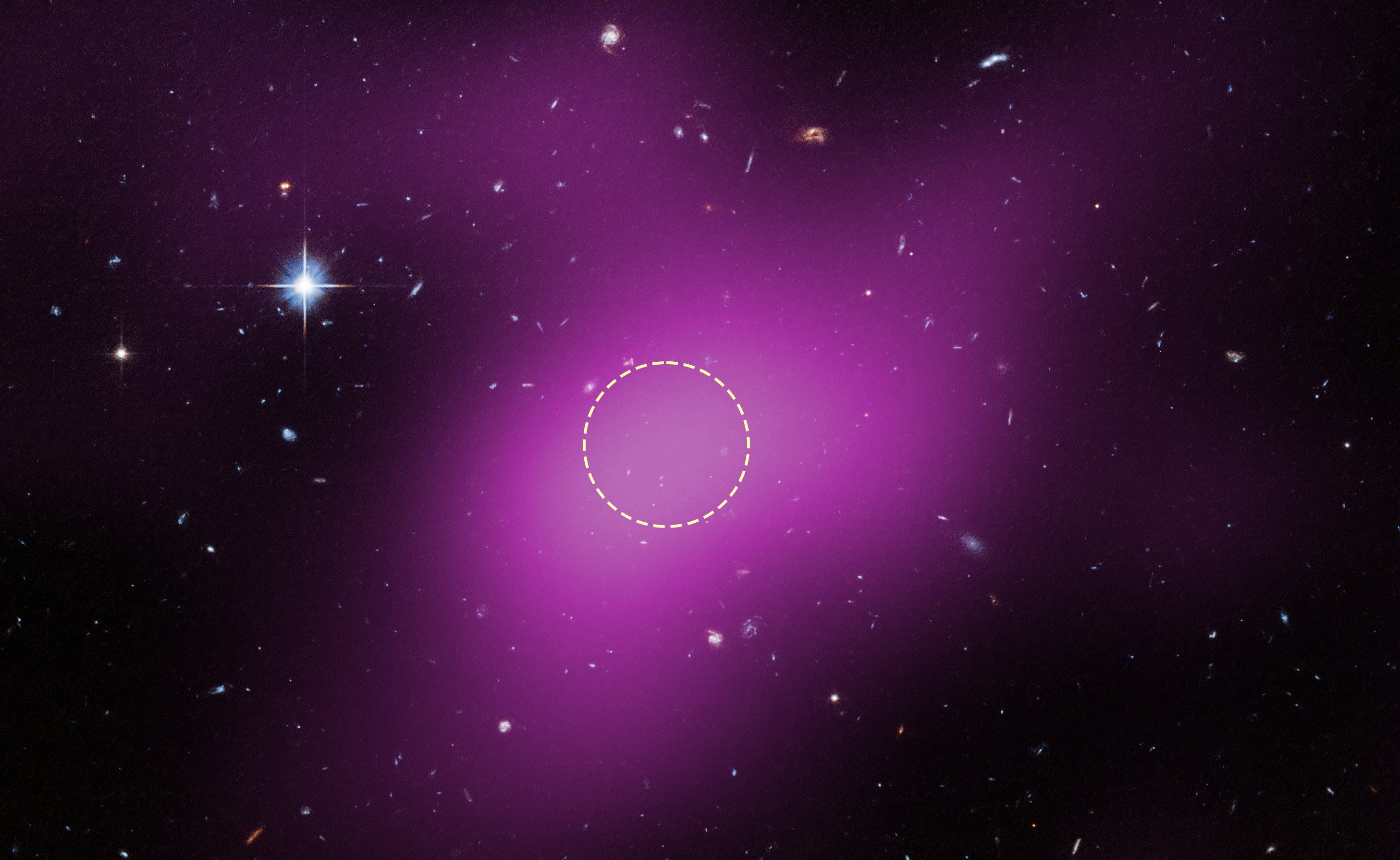
Uncovering an object that yields zero optical luminescence requires a massive leap in processing capabilities. The detection of faint $21\text{ cm}$ neutral hydrogen signatures amid vast oceans of terrestrial radio-frequency interference (RFI) demands state-of-the-art computational workflows. Modern radio telescopes generate tens of terabytes of raw spectral stream data per hour, necessitating low-latency signal extraction at the edge, coupled with distributed cloud compute networks for post-processing multi-dimensional data pipelines.
To differentiate pristine cosmic hydrogen signals from satellite chatter, terrestrial communications, and thermal noise, researchers rely on high-performance compute (HPC) clusters accelerated by modern GPU architectures. Complex algorithmic frameworks, including fast Fourier transforms (FFT) and deep convolutional neural networks (CNNs), are deployed to scan spectral line cubes in real time. This operational reality has elevated radio astronomy from an observational discipline into an intensive big-data enterprise, driving institutional demand for scalable enterprise storage, hyper-converged infrastructure, and custom cloud architecture.
Observational Metrics & Structural Specifications
To contextualize the scale and structural anomalies of J0613+52, the table below contrasts its verified observational parameters against a standard dwarf galaxy and a mature spiral system like the Milky Way.
| Parameter / Metric | Dark Galaxy Candidate (J0613+52) | Standard Dwarf Galaxy (e.g., LMC) | Mature Spiral Galaxy (Milky Way) |
|---|---|---|---|
| Neutral Hydrogen Mass ($M_I$) | ~1.0–1.5 × 10⁹ $M_\odot$ | ~0.5–1.0 × 10⁹ $M_\odot$ | ~8.0 × 10⁹ $M_\odot$ |
| Stellar Mass ($M_*$) | ~0 (Below Detection Floor) | ~2.7 × 10⁹ $M_\odot$ | ~6.0 × 10¹⁰ $M_\odot$ |
| Mass-to-Light Ratio ($M/L$) | > 1,000 $M_\odot/L_\odot$ (Extremely High) | ~10–30 $M_\odot/L_\odot$ | ~2–5 $M_\odot/L_\odot$ |
| Dynamical State | Disturbed / Low-shear Rotation | Tidally Interacting | Ordered Differential Rotation |
| Gas Density vs. Kennicutt Threshold | Sub-critical (No star formation) | Super-critical (Active star formation) | Super-critical (Sustained star formation) |
| Primary Detection Band | Radio / $21\text{ cm}$ Spectral Line | Optical / Infrared / Radio | Full Electromagnetic Spectrum |
Economic, Capital Allocation, and Enterprise Deep-Tech Implications
While the astrophysical implications of J0613+52 dominate scientific literature, the commercial and institutional ramifications across the deep-tech ecosystem are equally transformative. The software systems, hardware components, and analytical frameworks required to detect dark galaxies are directly adjacent to next-generation commercial markets.
1. High-Performance Compute & Algorithmic Scalability
The processing pipelines required to parse dense, noisy spectral data from modern instruments like the Green Bank Telescope, the Five-hundred-meter Aperture Spherical radio Telescope (FAST), and the upcoming Square Kilometre Array (SKA) act as proving grounds for commercial big-data management. Enterprise cloud providers and hardware chipmakers are directly capitalizing on this demand. The deployment of custom tensor-processing units and highly parallelized real-time filtering algorithms for deep-space research serves as an incubator for sub-signal processing technologies utilized in military-grade electronic warfare, space situational awareness, and autonomous vehicle radar systems.
2. Dual-Use Technology and Defense Infrastructure
Detecting extremely weak $21\text{ cm}$ emissions buried under layers of noise requires state-of-the-art Low-Noise Amplifiers (LNAs), cryogenic receiver modules, and phased-array feed technology. Defense primes and aerospace contractors are aggressively acquiring or licensing IP derived from radio astronomy research institutes. The ability to extract high-fidelity signal data from low-signal-to-noise ratio (SNR) environments is vital for counter-stealth systems, satellite communication resilience in jammed environments, and Earth observation telemetry.
3. Strategic Yields & Institutional Venture ROI
Venture capital firms specializing in deep-tech asset classes are increasingly analyzing space-data analytics platforms through the lens of infrastructure scalability. Standard valuation multiples for firms delivering sub-surface or deep-space spatial data processing have expanded as sovereign entities increase capital allocation toward defense and dual-use aerospace technologies. Institutional investors view sovereign funding for deep-space science not as pure expenditure, but as de-risked R&D capital that yields high-value downstream commercial applications.
People Also Ask: Deep-Space Astrophysics & Enterprise Compute FAQs
What exactly is a "dark galaxy"?
A dark galaxy is a theoretical structure containing significant quantities of dark matter and neutral hydrogen gas, but very few or no visible stars. These objects occur when interstellar gas fails to reach the critical density required to trigger star formation, or when intense cosmic phenomena prevent gas from collapsing under gravity. They are considered pristine remnants from the early stages of structure formation in the universe.
How do astronomers detect a galaxy if it emits no visible light?
Astronomers detect dark galaxies using radio telescopes tuned to the $21\text{ centimeter}$ spectral line emission. This radio wave is emitted naturally when the electron of a neutral hydrogen atom spontaneously flips its spin state. By scanning the sky across radio frequencies, radio observatories can map out vast clouds of hydrogen gas that are completely invisible to optical, ultraviolet, or infrared telescopes.
Why is the discovery of J0613+52 significant for physics?
J0613+52 provides strong observational proof for the Standard Cosmological Model ($\Lambda$CDM), which predicts the presence of unlit dark matter halos scattered throughout space. Discovering a massive, completely isolated starless cloud allows scientists to study primordial baryonic matter in a unpolluted state, unimpacted by stellar evolution, supernova shockwaves, or heavy element enrichment.
How does radio astronomy research drive innovation in enterprise technology?
Radio astronomy generates vast datasets that push the boundaries of data processing, high-capacity cloud compute networks, and signal-processing hardware. Technologies developed to filter cosmic noise and analyze terabytes of radio data—such as advanced noise reduction algorithms, spatial data management software, and ultra-sensitive radio receivers—are directly transferred into enterprise domains including telecommunications, medical imaging (MRI), commercial satellite networks, and defense radar systems.
Future Outlook: The Next Horizon in Dark Matter Mapping
The discovery of J0613+52 marks the inception of a new observational paradigm rather than a solitary milestone. Over the next five to seven years, global radio astronomy capacity will experience an exponential expansion as major mega-projects reach operational readiness. Chief among these is the Square Kilometre Array (SKA), an intergovernmental multi-radio telescope array constructed across South Africa and Australia. Once fully operational, the SKA will process exabytes of data annually, generating unprecedented radio maps of the cosmos.
In parallel, optical ground facilities like the Vera C. Rubin Observatory in Chile will begin its ten-year Legacy Survey of Space and Time (LSST). By combining high-frequency optical imaging with deep multi-beam $21\text{ cm}$ radio surveys, researchers will establish an automated cross-matching network designed to spot dark galaxy candidates in real time.
From an enterprise risk and capital perspective, the technologies enabling this deep-space revolution will continue to bleed into commercial sectors. Corporations providing specialized deep-learning pipeline management, low-noise RF hardware, and scalable cloud architectures stand to capture substantial market share as sovereign research grants and defense budgets converge. The cataloging of cosmic dark matter is no longer an academic exercise—it is a primary driver of next-generation computational infrastructure.