Inside the Pentagon’s Orbital Power Shift: SpaceX’s Falcon Heavy Blasts Off on Maiden Spy Flight for U.S. Intelligence Agency
By Senior Bureau Chief & Defense Tech Editor
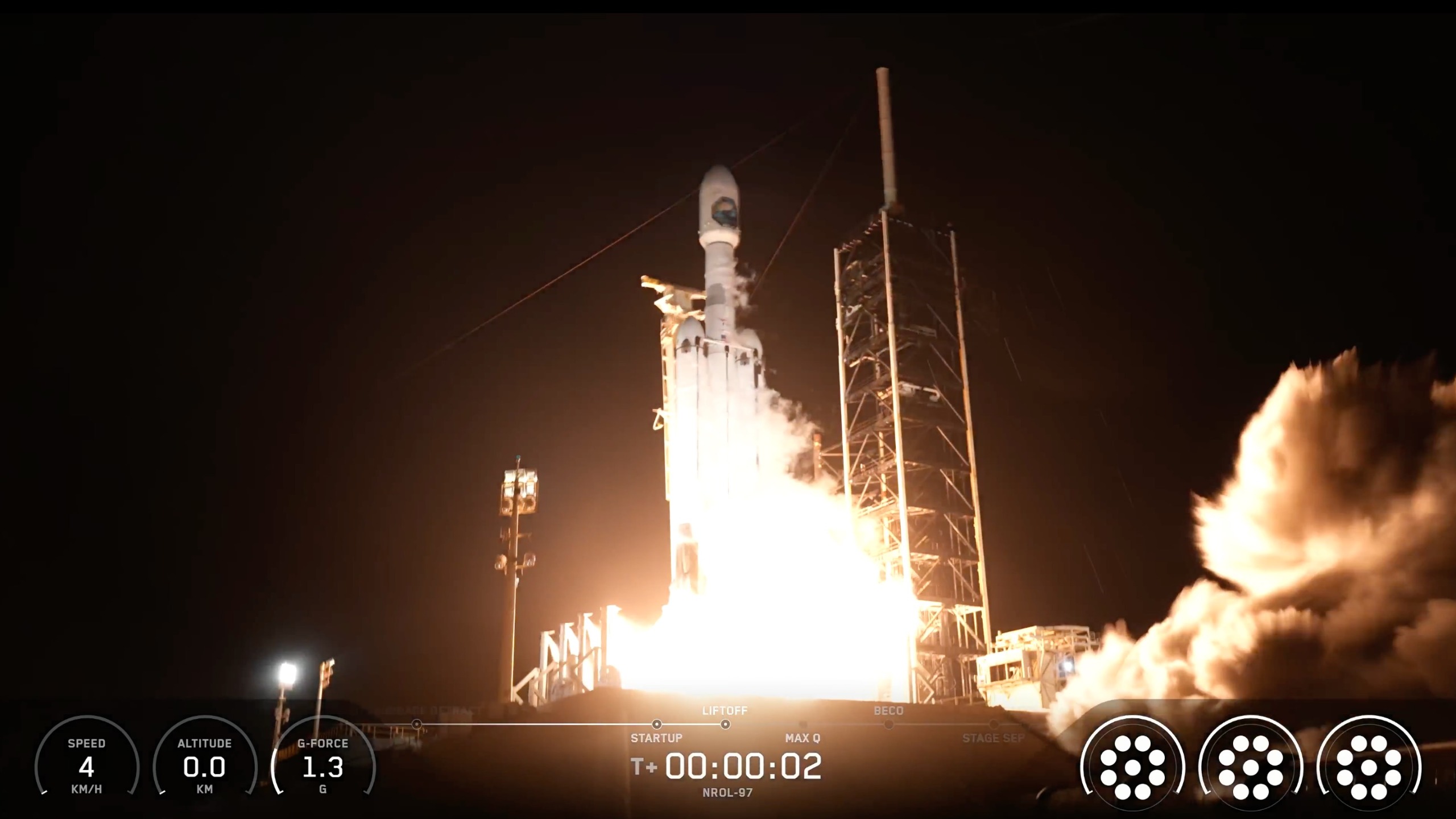
CAPE CANAVERAL, Fla. — In a monumental escalation of the commercial space industry's role in American national security, SpaceX’s triple-core Falcon Heavy rocket lifted off under a veil of strict secrecy on its inaugural mission for the premier U.S. spy satellite agency, the National Reconnaissance Office (NRO).
A New Era in Heavylift National Defense
Rumbling across the Florida Space Coast with more than 5 million pounds of thrust, the 230-foot-tall heavy-lift launcher climbed into the morning skies from historic Launch Complex 39A at NASA’s Kennedy Space Center. The liftoff marks the operational debut of SpaceX’s most powerful operational launch vehicle for the NRO, the secretive intelligence wing charged with designing, building, and operating America’s fleet of orbital eavesdropping and reconnaissance sentinels.
The mission represents an inflection point in the geopolitical balance of orbital defense. For decades, the Pentagon and the U.S. intelligence community relied almost exclusively on legacy aerospace incumbents to haul their heaviest, most classified eyes-and-ears into orbit. With the phased retirement of the United Launch Alliance’s (ULA) venerable Delta IV Heavy, SpaceX has officially cracked the ultra-heavy intelligence market, proving its reusable tri-core architecture can deliver Washington’s most precious defense assets directly into ultra-complex orbits.
Executive Briefing: What You Need to Know
- Historic Milestone: First operational flight of SpaceX’s Falcon Heavy specifically contracted by the National Reconnaissance Office (NRO).
- Orbital Powerplay: Falcon Heavy provides the direct-to-geostationary insertion capability previously dominated by legacy expendable heavy-lift platforms.
- Strategic Cost Disruption: Slashes taxpayer cost per national security heavy launch from roughly $400 million down to an estimated $130–$160 million range.
- Synchronized Recovery: Dual side boosters executed textbook synchronized touchdowns at Landing Zones 1 and 2, while the central core was expended to maximize orbital payload velocity.
- Great Power Competition: The clandestine payload bolsters American space domain awareness and signals intelligence amid escalating orbital friction with Beijing and Moscow.
The Flight Profile: Brutal Physics and Extreme Secrecy
Igniting 27 Merlin 1D engines simultaneously, the Falcon Heavy generated roughly 5.1 million pounds of thrust at liftoff—equivalent to roughly eighteen commercial Boeing 747 aircraft operating at full throttle. Within two-and-a-half minutes, the dual side boosters exhausted their liquid oxygen and rocket-grade kerosene (RP-1) propellant, separating cleanly from the central core stage.
As the core continued its burn toward space, the two flight-proven side boosters executed automated boostback maneuvers, re-entering Earth's atmosphere and touching down in tandem at Landing Zones 1 and 2 at Cape Canaveral Space Force Station. The twin sonic booms reverberating across Central Florida signaled a structural business model disruption: turning what once was disposable national defense hardware into reusable commercial-scale operations.
Per standard operational security protocols for classified NRO operations, SpaceX terminated its public live broadcast shortly after fairing separation. While the exact trajectory, target orbit, and capabilities of the satellite remain state secrets, telemetry data indicates a high-energy flight profile designed to push the spacecraft into a direct Geostationary Earth Orbit (GEO) roughly 22,236 miles above the equator, bypassing the fuel-draining transit through intermediate transfer orbits.
Key Mission & Vehicle Specifications
| Parameter | Details |
|---|---|
| Launch Vehicle | SpaceX Falcon Heavy (3x Falcon 9 Cores / 27 Merlin 1D Engines) |
| Contracting Agency | National Reconnaissance Office (NRO) / U.S. Space Force |
| Launch Site | Launch Complex 39A (LC-39A), Kennedy Space Center, Florida |
| Estimated Mission Cost | ~$150 Million (vs. ~$400 Million on legacy Delta IV Heavy) |
| Side Booster Disposition | Recovered: Synchronized Landing at LZ-1 and LZ-2 |
| Center Booster Disposition | Expended (Sacrificed for maximum orbital delta-V) |
| Target Orbit | Classified (High-energy Geosynchronous / Direct-to-GEO) |
Strategic Implications: Wall Street Meets the Pentagon
The successful delivery of this flagship spy payload reshapes the lucrative National Security Space Launch (NSSL) ecosystem. Under the Pentagon’s multi-billion-dollar NSSL Phase 2 procurement framework, SpaceX and ULA have fiercely contested mission allocations. Until recently, ULA maintained a lock on high-mass, high-energy orbits that demanded brute-force upper stages. SpaceX’s successful execution today proves that the commercial Falcon Heavy can safely handle the crown jewels of the intelligence community.
“Today’s flawless mission is a testament to the maturation of public-private partnerships in defense procurement,” said a senior aerospace defense analyst. “By certifying and flying the Falcon Heavy for the NRO's most critical assets, the Pentagon avoids single-source vulnerabilities while reducing launch expenditures by hundreds of millions of dollars per cycle.”
The broader geopolitical environment underscores the urgency. With both China and Russia aggressively deploying counter-space weapons, anti-satellite (ASAT) capabilities, and sophisticated electronic warfare suites designed to blind Western assets, the NRO has accelerated its shift toward a hybrid architecture. This strategy combines massive, heavily protected sovereign satellites with proliferated constellations of smaller, distributed sensors across Low Earth Orbit (LEO).
What Lies Ahead
SpaceX’s operational docket remains packed, with several more classified NSSL missions slated across the coming year. As the aerospace sector transitions into the NSSL Phase 3 framework—a procurement wave valued at tens of billions of dollars over the coming decade—the Falcon Heavy's demonstrated reliability for intelligence operations puts immense competitive pressure on rivals, including Blue Origin's New Glenn and ULA’s newly introduced Vulcan Centaur.
For the NRO, the mission represents mission assurance in its purest form: an indispensable surveillance eye safely delivered to the high ground of orbit, expanding the invisible electronic shield guarding the United States and its global allies.
Frequently Asked Questions (FAQ)
Why is this specific launch so significant for SpaceX and the NRO?
While SpaceX has previously launched lower-mass intelligence payloads aboard the single-stick Falcon 9, this mission marks the first time the heavy-lift, triple-core Falcon Heavy was entrusted with an NRO satellite. It confirms that the intelligence agency fully trusts SpaceX's heavy vehicle for its most expensive, high-priority orbital hardware, breaking legacy monopolies on ultra-heavy payloads.
Why was the central core expended while the side boosters were recovered?
Classified national security reconnaissance missions frequently demand direct-insertion into distant orbits, requiring enormous amounts of energy and fuel. To ensure the upper stage had sufficient velocity to deposit the massive satellite into its precise orbital position without taxing the satellite's internal propellant, SpaceX dedicated all fuel in the center core to pure acceleration, sacrificing the stage in the Atlantic Ocean while recovering the two side boosters on land.