Executive Takeaways
- Physical Infrastructure as the Primary AI Bottleneck: The macro investment paradigm has pivoted from speculative software applications to hard assets. Massive grid constraints, thermal dissipation requirements, and industrial water access (AQWA) are now the governing limiters of hyperscale artificial intelligence expansion in 2026.
- Defense Tech Transitions to Core Allocation: Dual-use autonomous systems, sovereign supply-chain security, and electronic warfare architectures have shifted defense technology from an esoteric venture niche into a permanent, high-multiple institutional asset class.
- The CleanTech-Energy Security Nexus: Decarbonization is increasingly underwritten as a national security imperative. Clean hydrogen (HYDR) and next-generation nuclear baseload deployment are receiving unprecedented private-equity capital allocation to support continuous industrial electrification.
- Commercial Architecture Modernization: FinTech and digital commerce infrastructure are consolidating around agentic AI checkout pipelines, cross-border real-time settlements, and mission-critical enterprise liquidity rails, leaving legacy payment processors exposed to severe margin compression.
For the past three years, institutional allocators treated the artificial intelligence transformation primarily as a software phenomenon, rewarding mega-cap technology balance sheets for unprecedented compute purchases. As capital markets open in 2026, that narrative has collided with physical reality. According to intelligence compiled across Wall Street and research released by Global X ETFs on January 21, 2026, the global market is witnessing an aggressive structural rotation. Capital is moving down the stack—out of speculative application layers and directly into the concrete, high-barrier infrastructure required to keep the modern industrial world running.
The core thesis shaping institutional portfolios this year is the realization that artificial intelligence, national defense sovereignty, and advanced electrification are not parallel trends. They are a single, deeply interdependent macroeconomic complex. As hyperscale data centers swallow municipal-scale power allocations, sovereign governments scramble for secure regional supply chains, and industrial electrification taxes outdated electrical grids, investors are forced to rethink enterprise ROI, cost of capital, and infrastructure scalability.
The Hyperscale Grid Crunch: Compute Meets the Thermal and Hydrological Wall
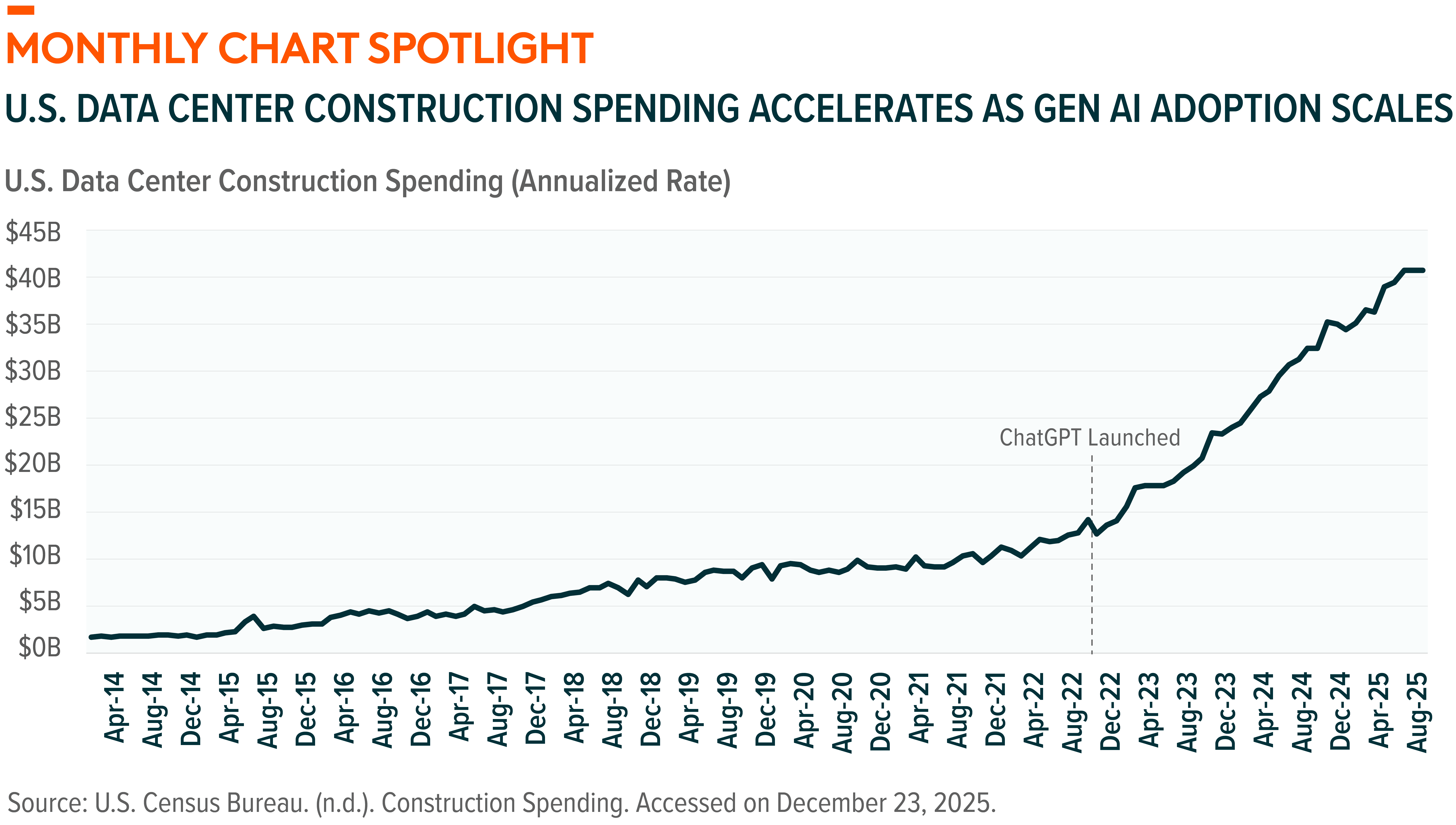
At the center of the 2026 thematic pivot sits the enterprise data center. Over the past 24 months, Tier-1 cloud providers committed hundreds of billions of dollars to accelerated computing clusters. Yet, the governing constraint on cloud compute architecture is no longer the availability of high-bandwidth memory or advanced silicon wafers; it is the physical grid connection. Substation backlogs across North America, Western Europe, and key Asian manufacturing hubs like Thailand have stretched interconnect lead times to between four and seven years.
This dynamic has elevated power and cooling to boardroom-level balance sheet considerations. As 100-megawatt-plus clusters become standard, traditional air-cooling architectures have proven mathematically incapable of handling the thermal dissipation density of modern tensor-processing units. The result is a surging demand for liquid cooling and localized industrial utility infrastructure.
This reality explains the strategic re-rating of themes previously siloed under environmental banners. Clean water infrastructure (targeted by thematic instruments like AQWA) has re-emerged as an essential operational prerequisite for high-performance computing. Hyperscale operators are deploying closed-loop liquid and direct-to-chip water cooling facilities that demand vast, highly purified, and reliable hydrological management systems. Simultaneously, local water rights disputes have transformed water optimization and wastewater recycling from ESG check-boxes into existential regulatory compliance risks for enterprise operators.
To bypass congested regional distribution utilities, hyperscalers are increasingly acting as independent merchant energy developers. The search for uninterrupted, 24/7 baseload power has triggered a direct pipeline into behind-the-meter generation, combining small modular reactors (SMRs), utility-scale battery energy storage systems (BESS), and green hydrogen configurations (such as those tracked in HYDR). In 2026, hydrogen is no longer evaluated purely on speculative retail mobility; it is being priced as a high-density, dispatchable peaker power source capable of providing zero-emission emergency redundancy to 500-megawatt computational hubs.
Defense Technology: The Sovereign Industrial Mandate

Concurrently, the geopolitical landscape of early 2026 has obliterated the traditional division between commercial enterprise software and defense procurement. The continuation of high-intensity regional conflicts, coupled with escalating maritime tensions across the Indo-Pacific, has accelerated a structural supercycle in defense technology.
Historically, legacy defense primes dominated institutional allocations via multi-decade, cost-plus procurement contracts. However, the modernization mandate of 2026 prioritizes speed, edge-compute autonomy, and consumable hardware. Dual-use software, autonomous counter-drone swarms, and decentralized command-and-control (C2) systems are securing multi-billion-dollar line items in both sovereign defense budgets and private capital deployment.
Institutional managers are underwriting defense tech not as a cyclical hedge against global instability, but as a secular growth theme with multi-year visibility. With NATO members systematically raising defense expenditures toward 2.5%–3.0% of GDP and Southeast Asian economies realigning their national manufacturing strategies through 2028, defense technology has evolved into an indispensable component of sovereign industrial policy. The integration of AI onto the battlefield has compressed the procurement cycle, shifting capital toward agile software-defined defense contractors capable of rolling out continuous algorithmic upgrades at the tactical edge.
The Industrial Electrification Supercycle
Beyond server farms and military installations, broader industrial electrification is entering a capital-intensive execution phase. As the United States and international partners onshore advanced manufacturing—ranging from semiconductor packaging to automotive battery cells—domestic power demand is growing at rates unseen since the post-war industrial expansion.
Four interconnected sub-industries are capturing outsized enterprise spending in early 2026:
- High-Voltage Direct Current (HVDC) Transmission: Expanding the long-distance transfer capacity required to move remote renewable and nuclear power to urban industrial load centers.
- Grid Modernization Hardware: Smart switchgear, advanced transformers, and solid-state power electronics engineered to mitigate intermittent power spikes and harmonic distortion.
- Microgrid Deployment: On-site generation assets designed for commercial facilities seeking insulation from escalating retail electricity tariffs and utility brownouts.
- Hydrogen and Clean Fuels: Decarbonizing industrial heat applications—including steel fabrication, chemical processing, and heavy transport—where direct battery electrification remains economically unviable.
CleanTech is no longer framed merely as a transition toward decarbonization; it is increasingly underwritten as an engine of national energy security. By securing decentralized, domestically sourced power, sovereign nations and enterprise conglomerates are actively de-risking their long-term supply chains against volatile international commodity shocks.
FinTech and Commerce: The Arrival of Agentic Liquidity
While the physical world struggles with resource capacity, digital commerce and financial technology are undergoing a parallel paradigm shift. Entering 2026, the narrative surrounding digital marketplaces and FinTech has departed from the payment-aggregation models that dominated the previous decade. The focus has moved toward programmatic, autonomous commerce and cross-border settlement rails.
As autonomous AI agents begin executing consumer and B2B purchases independently, financial infrastructure is evolving to accommodate high-velocity, low-latency micro-transactions. The convergence of clicks-and-mortar operations requires real-time reconciliation across global treasury systems, turning specialized FinTech platforms into mission-critical software for enterprise cash-flow optimization. Marketplaces that fail to integrate agentic-ready APIs or maintain fragmented inventory systems are facing steep customer defection, whereas specialized infrastructure platforms providing deep enterprise liquidity integration are achieving premium valuation multiples.
Thematic Valuation & Infrastructure Matrix: January 2026
The table below breaks down the structural investment themes defining early 2026, comparing their primary operational catalysts, capital intensity, critical bottlenecks, and asset-class footprints:
| Investment Theme | Primary 2026 Catalyst | CapEx / TAM Trajectory | Critical Structural Bottleneck | Strategic Proxy Allocations |
|---|---|---|---|---|
| AI Infrastructure & Data Centers | Hyperscale cluster scaling; shift to multi-modal reasoning models | Global CapEx projected >$260B annualized through 2027 | Substation interconnection backlogs; power transformer shortages | Specialized Data Center REITs, Liquid Cooling Providers, Semiconductor Equities |
| Grid Electrification & CleanTech | Industrial onshoring; enterprise baseload decarbonization | $1.3T cumulative global grid modernization pipeline | Copper and raw material supply deficits; regulatory transmission permits | CleanTech ETFs, Grid Engineering Services, High-Voltage Equipment Makers |
| Hydrogen & Alternative Baseload (HYDR) | Behind-the-meter peaker generation for isolated data campuses | Compound annual growth rate (CAGR) exceeding 28% through 2030 | Electrolyzer efficiency curves; transport pipeline infrastructure | Hydrogen Fuel Cell Developers, Industrial Gas Conglomerates |
| Industrial Clean Water (AQWA) | Extreme cooling requirements for 100MW+ compute facilities | Municipal & industrial water CapEx accelerating 12% YoY | Regional hydrological depletion; strict environmental discharge limits | Advanced Membrane Filtration Specialists, Industrial Water Utilities |
| Sovereign Defense Tech | Geopolitical realignments; mass adoption of autonomous drone systems | NATO and allied sovereign budgets expanding to 2.5%+ of GDP | Supply-chain chokepoints in optical sensors and aerospace-grade alloys | Dual-Use Autonomous Tech, Electronic Warfare Primes, Edge-Compute Integrators |
| Agentic FinTech & Commerce | Autonomous algorithmic payments; real-time B2B clearing integration | Digital commerce TAM expanding past $8.1T globally | Cross-jurisdictional compliance, fraud mitigation, settlement latency | Core Banking Infrastructure Providers, B2B Cross-Border Settlement Rails |
Industry & Market Implications: Structural Winners and Losers
The recalibration of global thematic capital establishes stark divisions between enterprise balance sheets capable of delivering physical capacity and those burdened by commoditized business models.
The Winners
- Power Equipment Manufacturers & Grid Contractors: Firms producing high-voltage switchgear, step-down transformers, and advanced cabling possess multi-year backlogs with massive pricing power, driving sustained margin expansion.
- Independent Power Producers (IPPs) with Nuclear/Clean Fleets: Utilities controlling non-intermittent, zero-carbon generating capacity are commanding unprecedented premiums on long-term Power Purchase Agreements (PPAs) signed directly with mega-cap hyperscalers.
- Mission-Critical Resource Specialists (Water & Cooling): Specialized chemical and membrane filtration suppliers capable of retrofitting data centers with closed-loop fluid cooling solutions hold defensible intellectual property moats.
- Sovereign-Aligned Software-First Defense Firms: Agile defense technology startups with flight-proven, autonomous dual-use systems are bypassing legacy multi-decade R&D cycles, directly winning multi-hundred-million-dollar production contracts.
The Losers
- Pure-Play Application SaaS: Thin enterprise software layers lacking proprietary data moats face acute multiple contraction as hyperscale foundation models commoditize basic workflow tools.
- Legacy Payment Aggregators: Financial intermediaries reliant on high interchange fees and multi-day settlement windows are being marginalized by modern, low-fee real-time payment rails optimized for automated AI agents.
- Under-Capitalized Clean Energy Pure-Plays: Capital-intensive renewable developers burdened by high debt costs and unable to secure immediate transmission interconnection agreements face persistent balance-sheet stress and dilutive capital raises.
Frequently Asked Questions (People Also Ask)
Why are industrial water (AQWA) and hydrogen (HYDR) increasingly viewed as AI infrastructure assets in 2026?
Modern hyperscale computing clusters generate extreme thermal loads that traditional air-cooling cannot mitigate. Liquid and direct-to-chip water cooling have become operational mandates, requiring industrial water purification, continuous delivery, and advanced recycling infrastructure. Concurrently, data center operators face multi-year waits for public utility hookups, compelling them to invest in behind-the-meter generation. Clean hydrogen provides high-density, zero-emission dispatchable power capable of serving as reliable peaker and backup capacity, decoupling hyperscalers from volatile and congested municipal electric grids.
What is causing the severe grid interconnection bottleneck for modern data centers?
The bottleneck stems from a profound mismatch between digital deployment velocity and physical utility expansion. While a state-of-the-art AI data cluster can be constructed and filled with servers in 12 to 18 months, permitting, engineering, and commissioning a high-voltage substation or long-distance transmission line regularly requires 4 to 7 years. Additionally, global supply-chain shortages for physical components like high-voltage transformers and high-capacity switchgear have driven manufacturing lead times past 150 weeks in several regional markets.
How does the 2026 defense technology market differ from traditional aerospace defense investing?
Historically, defense investing centered on legacy prime contractors producing a small number of multi-million-dollar platforms (e.g., naval destroyers, fourth- and fifth-generation fighter jets) governed by cost-plus, multi-decade contracts. In 2026, the sector has shifted toward decentralized, consumable autonomous hardware, drone swarms, tactical edge computing, and real-time electronic warfare systems. Capital allocation now favors software velocity, rapid iteration, and dual-use commercial technologies that can be deployed at scale under fixed-price or commercial-off-the-shelf procurement frameworks.
Why are FinTech and digital commerce infrastructure re-rating together in early 2026?
Digital commerce and financial settlement have converged due to the rise of autonomous AI purchasing agents and the requirement for real-time, global treasury reconciliation. Retail and B2B platforms are overhauling their payment stacks to handle machine-driven, micro-transaction volumes without manual human intervention. This has shifted enterprise capital away from legacy merchant processors and into unified platforms that seamlessly integrate inventory management, instant multi-currency settlement, and automated fraud prevention.
Future Outlook: Strategic Milestones to Watch (2026–2028)
As the first quarter of 2026 sets the tone for this multi-year cycle, institutional allocators should monitor three critical inflection points:
1. SMR and Off-Grid Baseload Approvals (Late 2026): Regulatory bodies, including the U.S. Nuclear Regulatory Commission (NRC) and international peers, are scheduled to review fast-tracked small modular reactor and dedicated hydrogen-microgrid permits for privately powered compute campuses. Expedited approvals will cement behind-the-meter self-generation as the standard operating model for hyperscalers.
2. NATO and Indo-Pacific Defense Procurement Overhauls: Key allied defense ministries are expected to publish formal procurement mandates integrating dual-use commercial artificial intelligence directly into military branch supply chains. The institutional winners will be the firms that transition from technology-demonstration pilots to formal, recurring line-item programs of record.
3. Transmission Permitting Reform Legislation: In both North America and Europe, pending legislative battles over right-of-way approvals and grid modernization funding will determine the deployment speed of renewable energy and industrial transmission pipelines. If permitting lead times are compressed, capital expenditure across the CleanTech and electrification ecosystem will accelerate sharply through 2028, solidifying physical infrastructure as the premier macroeconomic asset class of the late 2020s.