The Great Market Cleaving: How Nvidia and a Handful of Tech Giants Are Masking Wall Street’s Broad-Based Retreat
Test Our Free AI & Tech Utilities Suite
Calculate LLM API token costs, analyze article dwell-time, or simulate tech DCA returns.
Executive Takeaways
- Narrowing Market Breadth: While headline indices appear resilient, market liquidity is increasingly concentrated in a handful of mega-cap AI beneficiaries, leaving the broader S&P 500 and Russell 2000 exposed to severe valuation corrections.
- The Apple Factor: Cupertino faces mounting headwinds from regulatory compliance costs, softening hardware replacement cycles, and intensifying enterprise competition in Asian markets, dragging down its market capitalization.
- Infrastructure Scalability Demand: Nvidia’s relentless pricing power and enterprise ROI dominance continue to drive cloud compute architecture spending, decoupling hardware-adjacent tech from traditional macroeconomic indicators.
- Capital Allocation Paradigm Shift: Institutional investors are rapidly shifting capital allocation strategies away from defensive sectors toward high-beta technology infrastructure, raising systemic risk and volatility metrics across Wall Street.
NEW YORK — In the trading pits of lower Manhattan and the algorithmic trading desks of Stamford, a quiet structural fracture is reshaping the American equity landscape. A daily examination of benchmark indices suggests a stable, if uninspired, trading environment. Yet beneath this tranquil surface lies a profound divergence: a ferocious bifurcation where an elite cohort of artificial intelligence infrastructure providers, anchored by Nvidia Corp., is single-handedly propping up the United States stock market while the vast majority of Wall Street equities—including iconic bellwether Apple Inc.—suffer a grinding, persistent retrenchment.
This phenomenon, characterized by institutional analysts as the "Great Market Cleaving," exposes the extreme vulnerability of contemporary capital markets. When an entire global economy relies on a narrow constellation of mega-cap technology firms to sustain positive valuation multiples, systemic risk is amplified. As central bank monetary policy pivots, corporate debt refinancing costs mount, and consumer discretionary spending shows localized fatigue, the divergence between the artificial intelligence vanguard and the rest of the corporate universe has reached a critical juncture.
Anatomy of a Divergence: The AI Super-Cycle Versus Main Street Realities
To understand the mechanics of the current market structure, one must examine the capital expenditure (CapEx) budgets of hyperscale cloud providers. Alphabet, Microsoft, Amazon, and Meta Platforms have committed hundreds of billions of dollars to cloud compute architecture scalability, transforming their balance sheets into captive markets for Nvidia’s advanced graphics processing units (GPUs) and specialized networking hardware.
Nvidia’s pricing power remains virtually unchecked. Enterprise clients are not merely buying silicon; they are purchasing the essential infrastructure required to secure their future market share in generative artificial intelligence. This dynamic has insulated Nvidia from the broader compression of valuation multiples affecting cyclical industrials, regional banks, and consumer staples.
However, the rest of Wall Street is grappling with a far less forgiving macroeconomic reality. High interest rates, quantitative tightening, and persistent wage inflation have compressed corporate margins. While elite semiconductor designers reap windfall profits, small- and mid-cap companies—represented by the Russell 2000 Index—face crippling debt-servicing costs. As refinancing walls approach over the next twenty-four months, these firms are shedding valuations, dragging down the median stock even as headline indices like the S&P 500 hover near historical highs.
The Apple Retrenchment: headwinds in Cupertino
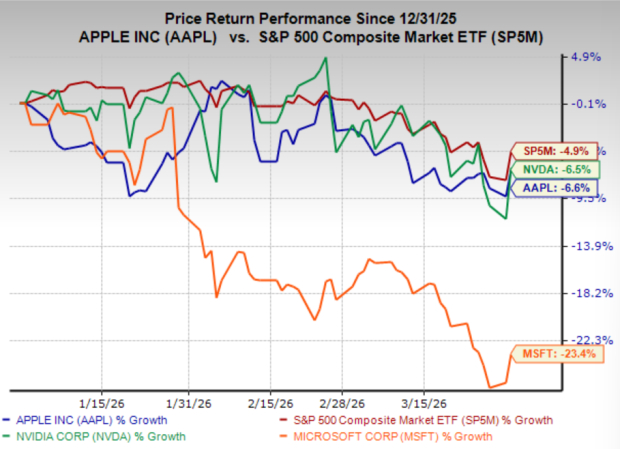
The severity of the broader market correction is nowhere more evident than in the fortunes of Apple Inc. Long considered the undisputed fortress of American corporate cash generation, Apple has encountered a confluence of structural headwinds that have weighed heavily on its stock price.
Regulatory compliance costs have escalated exponentially across both the European Union and domestic jurisdictions, directly threatening the lucrative services revenue model anchored by the App Store. Simultaneously, hardware replacement cycles for the iPhone have lengthened as global consumers navigate persistent inflationary pressures. Furthermore, intensifying competition in the Greater China region—historically a primary engine of unit growth—has resulted in localized market share erosion against domestic competitors.
Apple’s recent struggles serve as a warning sign for the broader technology sector: even titans with fortress balance sheets are not immune to saturation, regulatory intervention, and shifting consumer behavior. Yet, unlike past market cycles where weakness in Apple signaled a generalized tech slump, capital is no longer fleeing the technology sector altogether; instead, it is rotating with ruthless efficiency away from consumer hardware and toward enterprise AI infrastructure.
Comparative Market Metrics & Valuation Dynamics
A rigorous examination of current market data reveals the profound divergence in valuation multiples, operational margins, and year-to-date performance across the equity spectrum.
| Company / Index | Primary Catalyst / Sector Focus | Valuation Multiple (NTM P/E) | YTD Price Performance | Market Sentiment & Risk Profile |
|---|---|---|---|---|
| Nvidia (NVDA) | AI Infrastructure & GPU Hardware | ~35.4x | + Outperforming | High Growth / Extreme Momentum |
| Apple (AAPL) | Consumer Hardware & Services | ~28.1x | - Underperforming | Defensive Growth / Regulatory Risk |
| S&P 500 Index | Broad Market Benchmark | ~21.5x | + Moderately Positive | Skewed by Mega-Cap Concentration |
| Russell 2000 Index | Small-Cap U.S. Equities | ~24.2x (Operating) | - Sluggish / Flat | High Interest Rate Sensitivity |
Industry & Market Implications: Winners, Losers, and Systemic Risk
The concentration of market liquidity into a handful of mega-cap stocks carries profound implications for institutional portfolio management, retail investors, and the macroeconomic landscape.
The Winners
- Enterprise AI & Semiconductor Pure-Plays: Firms providing foundational hardware, electrical grid infrastructure, liquid cooling systems, and specialized software continue to attract aggressive institutional capital inflows.
- Hyperscale Cloud Providers: Despite massive capital expenditures, companies with dominant cloud infrastructure are successfully monetizing AI services, driving incremental enterprise ROI.
The Losers
- Traditional Consumer Brands: Companies exposed to discretionary spending are finding it difficult to pass rising costs onto consumers, resulting in compressed operating margins.
- Debt-Heavy Small-Caps: Businesses reliant on floating-rate debt face escalating interest expense burdens that directly threaten their equity valuation models.
- Passive Index Investors: While retail and institutional investors utilizing cap-weighted index funds believe they are diversified, their exposure is heavily concentrated in the top five technology holdings, masking underlying portfolio volatility.
Frequently Asked Questions (People Also Ask)
Why are Nvidia and Big Tech rising while the rest of the market falls?
The divergence is driven by structural growth in artificial intelligence adoption and massive enterprise capital expenditures on cloud infrastructure. While cyclical industries and consumer-facing firms grapple with high interest rates and slowing demand, companies like Nvidia command unmatched pricing power and profit margins derived from the global AI hardware super-cycle.
What is causing Apple’s stock drop relative to other technology giants?
Apple faces a unique combination of headwinds, including intensifying regulatory scrutiny regarding its App Store ecosystem, lengthened hardware replacement cycles for iPhones among cost-conscious consumers, and stiffening competition in key Asian markets such as China. These factors have led investors to reevaluate its near-term growth trajectory compared to enterprise-focused AI peers.
How does market concentration in a few mega-cap stocks impact overall portfolio risk?
High market concentration creates systemic vulnerability. When a small percentage of companies dictate the performance of benchmark indices like the S&P 500, passive investors lose the traditional diversification benefits of equities. Any adverse regulatory, supply chain, or earnings shock experienced by these few tech giants can trigger an outsized, market-wide correction.
Are current Big Tech valuations sustainable in a high-interest-rate environment?
While higher discount rates theoretically reduce the present value of future cash flows, elite AI hardware providers have justified their valuation multiples through explosive, tangible revenue growth and robust free cash flow generation. However, sustainability remains contingent upon enterprise clients achieving measurable ROI on their artificial intelligence investments.
Future Outlook: Milestones to Watch
As Wall Street navigates the remainder of the fiscal year, portfolio managers and macroeconomic strategists will monitor several critical milestones. First, the pace of enterprise AI monetization will determine whether the massive CapEx commitments made by hyperscalers translate into enduring earnings growth or result in overcapacity.
Second, upcoming monetary policy decisions by the Federal Reserve regarding interest rate trajectories will dictate whether relief finally reaches debt-burdened small-cap equities and consumer sectors. If borrowing costs remain elevated while tech concentration peaks, the risk of a disorderly market rotation increases significantly.
Ultimately, the current market dynamic is a testament to technological transformation operating in direct tension with macroeconomic gravity. Whether Nvidia and its peers can continue to defy broader market gravitation, or whether a broader economic reckoning forces a valuation reset across all of Wall Street, remains the defining investment question of our era.