Under a crisp, light-blue Texas sky, history was rewritten at Boca Chica. SpaceX has successfully launched Starship into orbit for the first time, marking a triumphant milestone for the largest and most powerful rocket ever constructed. The dramatic Flight 14 test flight represents a monumental shift for global aerospace, validating Elon Musk’s high-stakes gamble on fully reusable, ultra-heavy-lift spaceflight and bringing humanity’s return to the Moon—and eventual journey to Mars—decisively closer to reality.
For years, detractors characterized Starship as an ambitious but overly volatile science project. Today, those doubts were vaporized. The 400-foot-tall stainless-steel behemoth cleared its launchpad with all 33 Raptor engines burning in perfect unison, executed a flawless hot-staging separation, and successfully slipped into its designated orbital trajectory. The successful orbital insertion marks the end of Starship’s experimental infancy and the beginning of its commercial dominance.
Executive Takeaways: The Flight 14 Breakthrough
- Historical Milestone: Starship, the largest rocket ever built, successfully achieved orbital velocity and trajectory for the first time in its flight test history.
- Geopolitical Implications: The success secures the critical path for NASA’s Artemis III mission, which relies entirely on a modified Starship to land American astronauts back on the lunar surface.
- Wall Street Disruption: By proving orbital capability, SpaceX prepares to drastically lower the cost per kilogram to orbit, threatening to monopolize the global satellite launch market and accelerate Starlink’s next-generation deployment.
- NASA Endorsement: Following the launch, the NASA Chief issued a powerful statement of support, noting that the space agency is laser-focused on results—and SpaceX just delivered.
The Anatomy of Flight 14: How Orbit Was Won
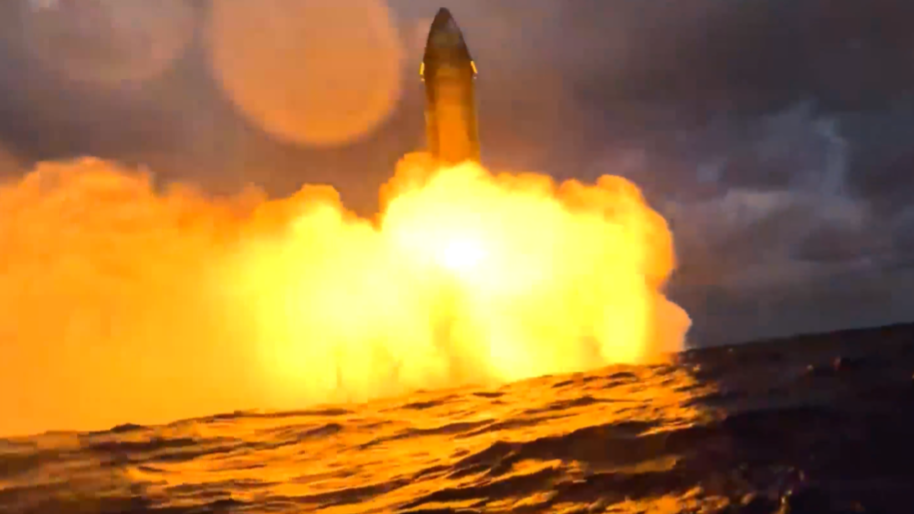
The Flight 14 profile was a masterclass in aerospace engineering, building upon the hard-earned telemetry of previous, fiery test flights. At T-minus zero, the Super Heavy booster ignited, generating a staggering 16.7 million pounds of thrust—nearly double that of NASA’s legendary Saturn V. The rocket ascended smoothly through Max-Q (maximum aerodynamic pressure), where structural integrity is tested to its absolute limits.
The critical phase of the launch came during the "hot-staging" maneuver. As the Super Heavy booster throttled down, the Starship upper stage ignited its engines while still attached, cleanly separating from the booster. While previous flights saw premature vehicle loss during or shortly after this violent transition, Flight 14 executed the handoff flawlessly. Super Heavy initiated its boostback burn, while Starship’s six Raptor engines propelled the spacecraft into a sustained orbital insertion.
Unlike previous flights that targeted suborbital trajectories with high-speed ocean splashdowns, Flight 14 successfully demonstrated attitude control in the vacuum of space, payload bay door operations, and a controlled de-orbit burn preparation. The sheer scale of the vehicle orbiting Earth was a stark visual testament to how far SpaceX’s rapid prototyping methodology has come.
The Financial & Geopolitical Stakes: Why This Launch Matters
From a market perspective, Starship’s orbital success is a massive shot across the bow for traditional defense contractors and sovereign space programs. Currently, the global launch market is constrained by capacity. Starship is designed to carry up to 150 metric tons to low-Earth orbit in its fully reusable configuration. Once fully operational, it is projected to slash launch costs to under $10 million per flight—an order of magnitude cheaper than any competitor on Earth.
This economic disruption has profound implications for Wall Street. Analysts expect SpaceX's valuation—recently pegged near $180 billion—to surge as the company begins utilizing Starship to launch its larger, heavier Starlink V3 satellites. These next-gen satellites will offer direct-to-cell capabilities, effectively turning Starlink into a global telecommunications monopoly.
For Washington, the successful launch is a sigh of relief. NASA has invested nearly $3 billion in Starship as the Human Landing System (HLS) for the Artemis program. Amid mounting geopolitical pressure to beat China’s space program back to the south pole of the Moon, NASA Chief Bill Nelson reacted with praise. "I'm only interested in results," Nelson remarked in the wake of the launch, "and today, SpaceX delivered a massive milestone."
Starship Flight 14: Key Mission Specifications
| Parameter / Metric | Flight 14 Verified Data | Significance / Impact |
|---|---|---|
| Total Thrust at Launch | 16.7 Million lbs (33 Raptor Engines) | Most powerful rocket in human history, doubling Saturn V thrust. |
| Orbital Velocity Achieved | ~26,200 km/h (16,280 mph) | Validates Starship's ability to reach stable, sustainable Earth orbit. |
| Payload Capacity (Target) | 100 - 150 Metric Tons (Fully Reusable) | Enables mass-deployment of Starlink V3 and heavy deep-space payloads. |
| Key Mission Objective | Orbital Insertion & Controlled Re-entry | Unlocks the path for commercial operations and NASA Artemis landings. |
The Road Ahead: The Path to Rapid Reusability
While achieving orbit is a monumental milestone, SpaceX’s ultimate goal remains "rapid, complete reusability." The company’s near-term focus will now pivot from merely reaching space to successfully recovering both stages of the vehicle consistently. Future tests, starting as early as Flight 15, will look to refine the dramatic "chopstick" catch of the Super Heavy booster back at the launch tower and perfect the extreme thermal protection tiles on Starship as it braves the fiery hell of atmospheric re-entry.
With this launch, SpaceX has moved the conversation from "if" Starship can fly, to "how fast" it can scale. For the broader global economy, the barriers to space have just been permanently lowered.
Frequently Asked Questions (FAQ)
1. Why is Starship reaching orbit considered a historic turning point for the space industry?
Starship is the first launch vehicle designed to be fully and rapidly reusable while carrying unprecedented payload weights (up to 150 metric tons). Reaching orbit proves that a rocket of this immense size can survive the climb to space, paving the way to dramatically lower the cost of launching satellites, scientific payloads, and humans by an estimated 90% compared to traditional expendable rockets.
2. How does the success of Flight 14 impact NASA's Artemis Moon missions?
NASA has selected Starship as the exclusive lander to transport astronauts from lunar orbit down to the surface of the Moon for the Artemis III and IV missions. Flight 14’s orbital success mitigates major technical risks, keeping the current schedule on track and giving NASA a highly reliable, high-capacity vehicle capable of building permanent infrastructure on the lunar surface.