Executive Takeaways
Status Quo Maintained: OPEC+ delegates have officially voted to keep December oil output targets steady, resisting immediate pressure from sliding spot prices and broader macro uncertainty.
The 2027 Horizon: While near-term barrels remain anchored, the cartel’s long-term risk mitigation framework points to an increasingly fraught structural imbalance heading into 2027.
Capital Allocation Dilemma: Upstream supermajors and national oil companies face conflicting mandates between short-term cash flow generation and long-term infrastructure scalability.
Market Liquidity Friction: Traders and algorithmic funds are recalibrating valuation multiples as regulatory compliance and voluntary cuts obscure true supply-demand fundamentals.
VIENNA & LONDON — In a high-stakes ministerial gathering that underscored the fragility of global energy markets, the Organization of the Petroleum Exporting Countries and its allies (OPEC+) have opted to hold production targets steady for December. Eschewing any aggressive pivot that might trigger a disorderly price shock, the cartel’s leadership has instead chosen to kick the structural can down the road, setting the stage for what energy economists are calling the most contentious policy showdown in recent memory: the looming architectural overhaul of quotas for 2027.
For months, institutional investors, hedge fund managers, and corporate treasurers have monitored the delicate dance between Saudi Arabia’s Ministry of Energy and its reluctant compliance partners. With global market liquidity under pressure from erratic macroeconomic indicators, high interest rate environments, and shifting industrial demand in Asia, the decision to maintain the status quo reflects a profound desire for near-term stability. Yet, beneath the veneer of consensus lies a simmering debate over market share, baseline quotas, and the harsh economic realities of long-term capital allocation.
The Catalytic Events Behind the December Standstill
Test Our Free AI & Tech Utilities Suite
Calculate LLM API token costs, analyze article dwell-time, or simulate tech DCA returns.
The path to the December freeze was paved with intense backchannel negotiations among core members. As non-OPEC supply—most notably from the United States Permian Basin, Guyana, and Brazil—continues to outpace historical projections, the cartel’s traditional mechanism of unilateral supply restraint has faced diminishing marginal returns. Traders evaluating enterprise risk and valuation multiples across the energy sector have noted that every barrel withheld by Riyadh and its Gulf allies is rapidly backfilled by non-aligned producers.
Compounding this dynamic is the uneven enforcement of voluntary cuts. Several member states, battling domestic fiscal deficits and desperate for hard currency, have consistently produced above their allocated caps. This internal friction made a major policy adjustment for December politically unfeasible. Instead, energy ministers prioritized risk mitigation, aiming to prevent a speculative downward spiral in futures markets while preserving ammunition for the existential policy decisions required as the decade draws closer to its twilight.
Industry analysts point out that the December decision is less a sign of strength and more a tactical retreat into observation mode. By preserving current output levels, OPEC+ is buying time to assess the winter heating season's impact on inventory draws, the velocity of central bank monetary easing, and the trajectory of industrial demand across emerging markets.
Quantitative Breakdown: Supply Metrics and Benchmark Projections
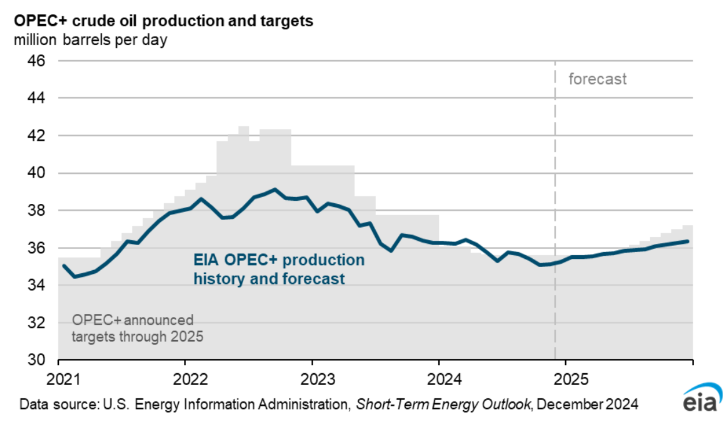
To fully grasp the magnitude of the upcoming 2027 policy cliff, market participants must examine the quantitative parameters governing current production realities versus forecasted demand horizons.
| Metric / Parameter | Current Status (Q4) | December Target | 2027 Structural Outlook |
|---|---|---|---|
| OPEC+ Total Output Cap | ~39.7 Million bpd (incl. voluntary) | Unchanged | Subject to baseline resets |
| Global Demand Growth | ~1.0 - 1.2 Mbpd YoY | Stable | Plateauing / Electrification drag |
| Non-OPEC Supply Growth | ~1.4 Mbpd (US, Guyana, Brazil) | Steady expansion | Maturing shale plays |
| Effective Spare Capacity | ~5.0 - 5.5 Mbpd | Held in reserve | Critical valuation leverage |
Industry & Market Implications: Winners, Losers, and Capital Flows
The decision to maintain the status quo while deferring structural debates has immediate repercussions across global financial markets. Different segments of the energy ecosystem will feel the effects of this policy stasis in distinct ways:
- Upstream Supermajors & Independent Producers: Western operators focused on capital discipline and return on capital employed (ROCE) view the steady December targets as a mild positive. It removes the immediate threat of a sudden volume dump that could crash Brent crude into the $50s. However, uncertainty surrounding 2027 complicates long-term capital expenditure models.
- National Oil Companies (NOCs): Gulf producers face a persistent dilemma. While holding barrels offline protects short-term price stability, it forces national budgets to absorb lower export volumes. Furthermore, maintaining massive spare capacity requires continuous, high-cost infrastructure scalability that yields zero immediate revenue.
- Commodity Trading Houses & Hedge Funds: Macro funds navigating shifting market liquidity have found themselves range-bound. Without a decisive directional breakout from OPEC+, algorithmic trading strategies have leaned heavily on mean-reversion models, dampening realized volatility and reducing speculative trading volume.
- Global Consumers & Industrial Manufacturers: Energy-intensive sectors—ranging from European chemical manufacturers to Asian airlines—receive a temporary reprieve from surging input costs. Yet, the underlying risk of a severe supply crunch heading into 2027 remains an unhedged operational liability.
Frequently Asked Questions (People Also Ask)
Why did OPEC+ decide to keep December output targets steady?
OPEC+ chose to maintain its output targets for December to prevent further downward pressure on oil prices amidst sluggish global demand growth and rising non-OPEC production. By keeping barrels offline, the cartel aims to stabilize market liquidity and avoid aggressive price wars while preserving flexibility for more complex structural policy reviews ahead.
What makes the upcoming 2027 policy decision so difficult for OPEC+?
The 2027 horizon represents a major inflection point due to expiring voluntary production cuts, disputes over baseline production capacities for individual member states, and accelerating structural shifts toward electrification. Balancing member quotas while defending market share against non-OPEC suppliers creates an exceptionally complex game theory scenario.
How do voluntary production cuts impact market liquidity and price discovery?
Voluntary cuts obfuscate true supply-demand fundamentals, making it harder for independent analysts and algorithmic trading models to accurately price forward contracts. This dynamic often leads to compressed volatility in the near term, followed by sudden, sharp repricing events when policy stances inevitably shift.
What role does non-OPEC supply play in current OPEC+ strategy?
Non-OPEC producers—particularly in the Americas—have rapidly absorbed market share relinquished by OPEC+ restraint. This structural shift forces the cartel to weigh the short-term benefits of price defense against the long-term cost of ceding permanent market share to shale and offshore competitors.
Future Outlook: The Road to 2027 and Key Milestones to Watch
As the market digests the reality of steady December output, institutional focus is shifting rapidly toward the medium-term horizon. The core challenge facing OPEC+ leadership is no longer merely managing cyclical inventory fluctuations, but rather navigating a secular transition in global energy architecture.
Key milestones to monitor over the next twelve to twenty-four months include:
- Compliance Audits and Baseline Revisions: Watch for official announcements regarding independent audits of member production capacities, which will serve as the mathematical foundation for any 2027 quota restructuring.
- Non-OPEC Capex Velocity: Monitor capital expenditure trends in the US Permian Basin and offshore Guyana. Any deceleration in non-OPEC growth will grant OPEC+ newfound pricing power.
- Macroeconomic Monetary Policy: Central bank interest rate trajectories in G7 economies will dictate industrial demand elasticity, directly influencing whether the cartel is forced to defend prices or reclaim market volume.
Ultimately, the decision to leave December targets untouched is a classic exercise in buying time. But as the clock ticks closer to 2027, the structural contradictions within the alliance will demand definitive resolution, reshaping the economics of global energy for the next decade.