In a high-stakes, multi-hour orbital operation 250 miles above Earth, spacewalking astronauts have successfully positioned and deployed the final Roll-Out Solar Array (iROSA), completing a comprehensive, multi-year power grid overhaul of the International Space Station (ISS). This milestone restores the orbiting laboratory’s energy generation profile to peak capacity, extending the operational viability of the $150 billion asset through its planned 2030 sunset while unlocking crucial power infrastructure for next-generation commercial payloads.
The mission represents the culmination of a strategic infrastructure modernization effort managed by NASA and prime contractor Boeing, featuring advanced flexible-blanket solar technology developed by Redwire Corporation. By overlaying state-of-the-art solar arrays across legacy rigid arrays that had suffered decades of natural degradation, the joint program has bolstered the station's total power budget by more than 30 percent, establishing the foundational power architecture needed for incoming commercial space station modules and high-draw microgravity research.
Executive Takeaways
Test Our Free AI & Tech Utilities Suite
Calculate LLM API token costs, analyze article dwell-time, or simulate tech DCA returns.
- Power Capacity Restored: The installation of the sixth and final iROSA unit raises total station electrical generation from a degraded baseline of ~160 kilowatts to more than 215 continuous kilowatts (with peak surge capacity reaching 300 kW).
- Asset Life Extension: Mitigates over 20 years of solar cell degradation caused by atomic oxygen, solar radiation, and micrometeoroid impacts, ensuring full infrastructure capability through the ISS’s scheduled 2030 retirement.
- Commercial LEO Catalyst: Unlocks essential power allocations for private enterprise modules, including Axiom Space’s commercial segment, as well as energy-intensive industrial experiments in protein crystallization, semiconductor manufacturing, and orbital edge compute.
- Market & Industrial Leadership: Highlights the commercial viability of Redwire Space’s (NYSE: RDW) roll-out array architecture, solidifying its adoption for future deep-space exploration platforms, including NASA’s Lunar Gateway and next-generation Commercial Low-Earth Orbit Destinations (CLDs).
The Engineering Imperative: Revitalizing aging Orbital Infrastructure
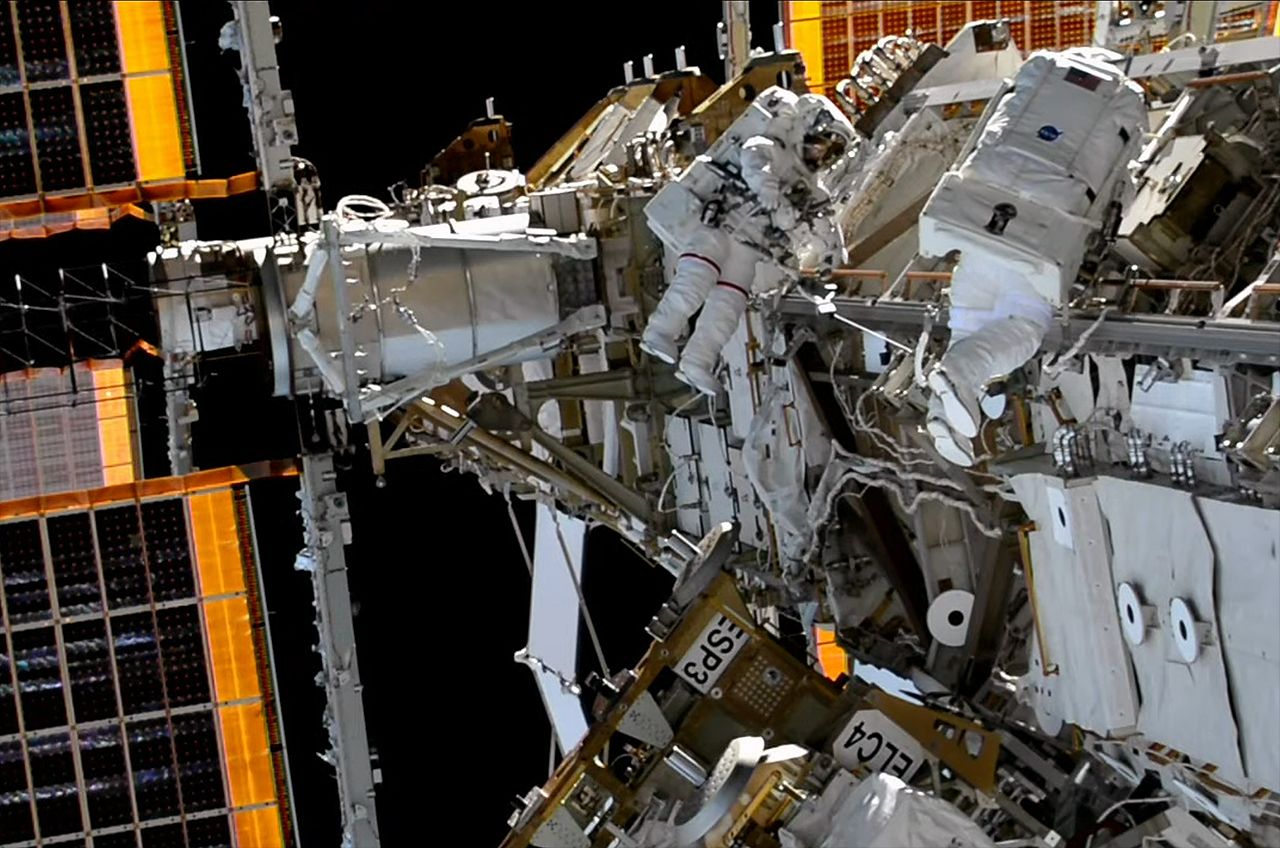
The original solar array wings of the International Space Station—installed across four primary truss structures (P6, P4, S4, and S6) between December 2000 and March 2009—were designed with a 15-year operational life expectancies. Constructed using traditional rigid silicon cell architecture, these legacy arrays generated approximately 240 kilowatts of total direct-current (DC) power at launch. Over two decades of continuous orbital exposure, environmental attrition degraded performance by roughly 30 to 35 percent.
Atomic oxygen eroded outer protective coatings, high-energy solar radiation diminished cell efficiency, and micro-debris impacts damaged individual traces. As NASA expanded the station's scientific utilization and integrated complex life-support, communication, and commercial operational racks, electrical demand began to outpace real-time generation capacity. Without a capital intervention, the station faced power rationing protocols that would have restricted operational enterprise ROI and compromised high-yield microgravity commercial programs.
To overcome the massive logistical and budgetary hurdles of removing and replacing the existing multi-ton array structures, NASA and Boeing selected an innovative, non-invasive overlay strategy. The solution: install smaller, vastly more efficient roll-out arrays directly in front of the existing legacy arrays using custom-engineered structural modification brackets during Extravehicular Activities (EVAs).
The iROSA Architecture: Mass Efficiency and Deployment Kinematics
Developed by Deployable Space Systems (acquired by Redwire Corporation) and integrated by Boeing, the Roll-Out Solar Array (iROSA) represents a paradigm shift in space platform solar dynamics. Traditional arrays rely on complex motor-driven accordion scissor mechanisms and heavy structural trusses. In contrast, iROSA utilizes stored strain energy within composite carbon-fiber tailorable booms to unroll a flexible substrate embedded with high-efficiency solar cells.
Each iROSA roll measures approximately 60 feet by 20 feet when fully unrolled—roughly half the length and one-third the width of an original legacy wing. However, because the new arrays utilize advanced SolAero (now Rocket Lab) NeXt-Generation Triple-Junction (XTJ+) gallium arsenide solar cells featuring over 30 percent efficiency (compared to ~14 percent efficiency in the legacy silicon cells), each iROSA delivers roughly the same electrical power output as the legacy wing it partially shadows.
The system operates without heavy electric deployment motors. Upon releasing primary structural launch restraints via extravehicular torque tools, the internal strain energy stored within the rolled carbon booms provides the mechanical force required to unspool the array blanket smoothly. This simplified kinematic model drastically mitigates failure modes, lowers total structural mass, and delivers an enterprise-grade reduction in payload deployment volume inside cargo launch fairings.
Operational Execution: The Final Spacewalk and Integration
The final installation spacewalk marked the conclusion of a complex series of EVAs requiring precise spatial maneuvering and real-time structural integration. Working on the far-starboard S6 truss segment, the astronaut team managed the physical extraction, positioning, and locking of the 700-pound folded iROSA package onto its mounting bracket, which had been installed during a precursor spacewalk.
The operational sequence involved three critical high-risk maneuvers:
- Mechanical Docking & Alignment: Using the station’s 57-foot Canadarm2 robotic arm as a maneuvering platform, spacewalkers physically bolted the folded array assembly onto the primary modification kit mounted at the base of the legacy 1B power channel array.
- Electrical Utility Integration: Astronauts completed high-voltage electrical cable connections, integrating the new iROSA array directly into the station’s main 160-volt DC power bus architecture. This hybrid wiring configuration allows the station's sequential shunt units (SSUs) to aggregate power seamlessly from both the un-shadowed sections of the legacy arrays and the high-output iROSA unit.
- Thermal Equalization & Unfurling: After locking structural latches and verifying electrical continuity with Mission Control in Houston, astronauts released the final mechanical deployment pins. Using passive thermal expansion combined with internal composite boom tension, the dual carbon booms unfurled the solar blanket across a 60-foot span over approximately six minutes.
Following successful dynamic stabilization tests and electrical telemetry verification, flight controllers confirmed that the final power channel was fully active and supplying power directly into the station’s main utility grid.
Verified Technical Specifications & Upgrade Metrics
The completion of the iROSA deployment program significantly enhances every core benchmark of the orbital power grid. The table below details the performance operational shift achieved through this structural upgrade:
| Technical Parameter | Legacy Array Baseline (2000-2009) | Degraded Baseline (Pre-iROSA) | Final Upgrade State (6 iROSAs Active) | Operational Delta / Performance Gain |
|---|---|---|---|---|
| Total System Power (Peak Output) | ~240 kW DC | ~160 kW DC | ~300 kW DC (Total Generation) | +87.5% increase over degraded state |
| Continuous Available Payload Power | ~80 kW DC | ~45 kW DC | ~120 kW DC | +166% increase in dedicated scientific capacity |
| Solar Cell Architecture | Single-crystal Silicon (14% efficiency) | Degraded Silicon (<10% effective) | Triple-Junction GaAs (>30% efficiency) | >2x step-function increase in cell efficiency |
| Structural Deployment Mechanism | Motorized scissor-truss assembly | Static / Aging Mechanical | Stored strain composite carbon-fiber boom | 4x reduction in deployment mechanism mass |
| Payload Delivery Logistics | Space Shuttle Cargo Bay (Dedicated) | N/A | SpaceX Dragon Trunk (Unpressurized) | Significant reduction in launch vehicle logistics costs |
Financial and Strategic Market Implications: The LEO Commercialization Economy
The completion of the ISS power grid upgrade goes beyond a pure technical milestone; it serves as a crucial financial tailwind for the growing commercial low-Earth orbit (LEO) economy. NASA’s overarching strategy involves transitioning from primary station owner-operator to a key anchor tenant of commercial space platforms by 2030. Maintaining full operational utility of the ISS throughout this decade is essential for lowering commercialization risks, proving out orbital business models, and preserving institutional capability.
1. Valuation and Contract Tailwinds for Aerospace Suppliers
The flawless execution of the iROSA program acts as a commercial proof-of-concept for Redwire Corporation (NYSE: RDW), proving out the operational reliability of its patented deployable structures. As prime aerospace integrators contend with launch volume constraints on current medium- and heavy-lift vehicles, high-density deployable structures that optimize payload envelope economics command premium margins. Redwire’s iROSA technology has already been integrated into NASA’s Artemis Lunar Gateway architecture and selected for various national security space payloads, securing a resilient backlog of higher-margin enterprise work.
For prime contractor Boeing (NYSE: BA), the successful execution mitigates performance risk on its long-term ISS Vehicle Sustaining Contract, demonstrating effective capital allocation and maintenance execution on legacy orbital assets while supporting broader transition targets.
2. Enabling Enterprise Payload Bandwidth
Power availability is the primary bottleneck for complex microgravity experiments. High-value enterprise initiatives—including in-space processing of advanced optical fibers (ZBLAN), edge-compute server arrays for real-time Earth observation analytics, and automated high-throughput bioreactors for pharmaceutical research—require persistent high-wattage power feeds. The additional ~75 kilowatts of continuous payload power unlocks bandwidth for high-margin, private-sector R&D contracts, driving measurable corporate return on investment for commercial research tenants.
3. Seamless Infrastructure Bridge for Axiom Space
Perhaps the most strategically sensitive requirement for increased power generation is the impending integration of Axiom Space’s commercial modules. Scheduled to begin attaching to the station’s Forward Node 2 port in the mid-2020s, the first Axiom module will temporarily rely on the ISS primary power grid for environmental control, thermal management, and orbital station-keeping until its own proprietary solar arrays are brought online. The iROSA upgrade provides the power margin needed to operate both baseline ISS hardware and Axiom's expanding infrastructure simultaneously without compromising scientific output or operational safety margins.
Frequently Asked Questions (People Also Ask)
How does the iROSA upgrade increase total power capacity without replacing the original solar panels?
The six iROSA arrays do not completely replace the legacy panels; rather, they are installed on custom mounting arms directly in front of the older, larger arrays. Because iROSA utilizes triple-junction solar cells that operate at more than double the conversion efficiency of original silicon cells, the smaller iROSA unit generates equivalent power while covering only a portion of the original array. The un-shadowed residual portions of the original panels continue to generate electricity, sending combined power into the station's main distribution grid for a net 30%+ system capacity gain.
Why was this solar array upgrade necessary before the ISS is retired in 2030?
Without this power upgrade, severe natural cell degradation would have forced flight controllers to implement mandatory power rationing across scientific payload racks, high-definition communications arrays, and commercial research facilities. Furthermore, essential commercial expansion steps—such as powering incoming commercial modules developed by Axiom Space and conducting high-yield pilot processing of advanced materials—require higher baseline energy outputs than the degraded system could deliver.
Which companies manufactured and delivered the final iROSA solar arrays?
The iROSA system was designed and manufactured by Redwire Corporation (specifically through its subsidiary Deployable Space Systems) using high-efficiency solar cells produced by SolAero Technologies (a Rocket Lab company). Boeing served as the prime integration contractor for NASA, overseeing system architecture, safety, and operational integration. The array units were delivered to orbit packed tightly inside the unpressurized trunk of SpaceX Cargo Dragon spacecraft.
How does the deployment of flexible roll-out arrays compare to traditional space solar panels?
Traditional solar arrays utilize rigid rectangular frames connected by mechanical hinges and deployed via complex, motor-driven scissor-trusses. This design results in high structural mass, high volume inside rocket launch shrouds, and a larger count of potential mechanical failure points. Flexible roll-out arrays like iROSA use flexible composite booms that store structural energy when rolled tightly around a central mandrel. Upon deployment, stored mechanical tension smoothly unrolls the array blanket, achieving up to a 4x reduction in deployment mass and payload launch volume.
Future Outlook: Strategic Milestones to Watch (2024–2030)
With the ISS power grid upgrade complete, the orbital laboratory enters its final, most productive operational phase. Flight controllers and aerospace stakeholders turn their attention to several key technological and financial milestones across the low-Earth orbit horizon:
- Commercial Payload Expansion (2024–2025): Utilization of unlocked power capacity to onboard high-draw industrial manufacturing payloads, automated crystal-growth racks, and edge-computing server arrays.
- Axiom Station Segment Integration (2026): Physical attachment of Axiom’s first commercial module (Ax-1) to Node 2, drawing baseline infrastructure support directly from the augmented iROSA power grid.
- Commercial LEO Destinations (CLD) Downselect (2026–2027): Transition of NASA capital expenditure allocations from ISS maintenance toward service-contract funding for private commercial stations, such as Starlab, Orbital Reef, and Axiom Station.
- ISS De-orbit Operations Planning (2028–2030): Execution of end-of-life protocols, including controlled de-orbit trajectory contracts, asset hardware salvage operations, and complete operational transition to commercial LEO habitats.
The successful installation of the final iROSA unit demonstrates how focused capital investment and agile public-private partnerships can extend the lifespan of complex orbital assets. By deploying modern composite dynamics to overcome natural hardware degradation, NASA, Boeing, and Redwire have fortified the world's premier microgravity platform—ensuring industrial leadership, scientific yield, and operational continuity through the end of the decade.