Executive Takeaways
- Infrastructure Scale: An ambitious deep-tech startup is advancing plans to deploy a constellation of 50,000 orbital mirrors, designed to redirect solar radiation toward Earth's surface long after sunset.
- Capital Allocation & Valuation: Backed by venture capital and strategic aerospace defense funds, the initiative is navigating complex capital expenditure cycles, targeting early-stage valuation multiples akin to next-generation satellite broadband networks.
- The Night Economy: The primary commercial rationale centers on extending operational hours for terrestrial solar farms, municipal infrastructure, and remote industrial sites, fundamentally altering energy market liquidity.
- Regulatory Friction: The project faces unprecedented scrutiny from international space agencies, astronomical societies, and environmental regulators regarding light pollution, orbital debris, and sovereignty over the night sky.
For centuries, human enterprise has been bounded by the binary cycle of Earth’s rotation: day for labor and commerce, night for rest and recovery. That fundamental macroeconomic constraint is now under direct assault. A heavily backed aerospace and energy startup is quietly accelerating development on one of the most audacious infrastructure plays of the 21st century: a commercial constellation of 50,000 ultra-lightweight mirrors stationed in low-Earth orbit (LEO), engineered to bounce sunlight onto designated terrestrial coordinates long after dusk.
As institutional investors chase high-yield climate tech and sovereign wealth funds redeploy capital into space-based assets, this venture promises to blur the line between day and night. Yet, beneath the slick renderings of orbital reflection arrays lies a labyrinth of physical, economic, and geopolitical hazards. This investigative report examines the financial mechanics, technological hurdles, and systemic market implications of a project that could permanently rewrite the rhythm of the global economy.
The Genesis of Orbital Illumination: From Sci-Fi Concept to CapEx Reality
Test Our Free AI & Tech Utilities Suite
Calculate LLM API token costs, analyze article dwell-time, or simulate tech DCA returns.
The theoretical foundation of space-based solar reflection is not new. In the late 1990s, Russian scientists executed the Znamya experiments, successfully unfurling a small, 20-meter mirror from a Progress resupply vehicle to flash a fleeting beam of light across the European night sky. While those early iterations were technologically primitive and politically constrained, today’s renewed push is fueled by exponential advancements in commercial launch economics, materials science, and cloud-native satellite telemetry.
Driven by the precipitous drop in per-kilogram payload costs pioneered by companies like SpaceX, deploying thousands of spacecraft is no longer the exclusive domain of superpowers. The startup at the center of this movement—operating under strict non-disclosure agreements with primary launch providers—has designed a proprietary class of membrane reflectors. These mirrors are constructed from ultra-thin, highly reflective polymer films measuring mere microns in thickness, packed tightly inside standard CubeSat or ESPA-class dispensers before unfolding autonomously in orbit.
From a financial engineering perspective, the initial capital expenditure (CapEx) required to build, test, and launch a 50,000-unit constellation is staggering, projected well into the tens of billions of dollars over the decade. To achieve a viable enterprise ROI, the startup is pursuing a hybrid funding model combining private equity tranches, government research grants, and pre-sales of nighttime illumination rights to major utility operators and remote industrial conglomerates.
Deconstructing the Technology: Optics, Orbitals, and Energy Arbitrage
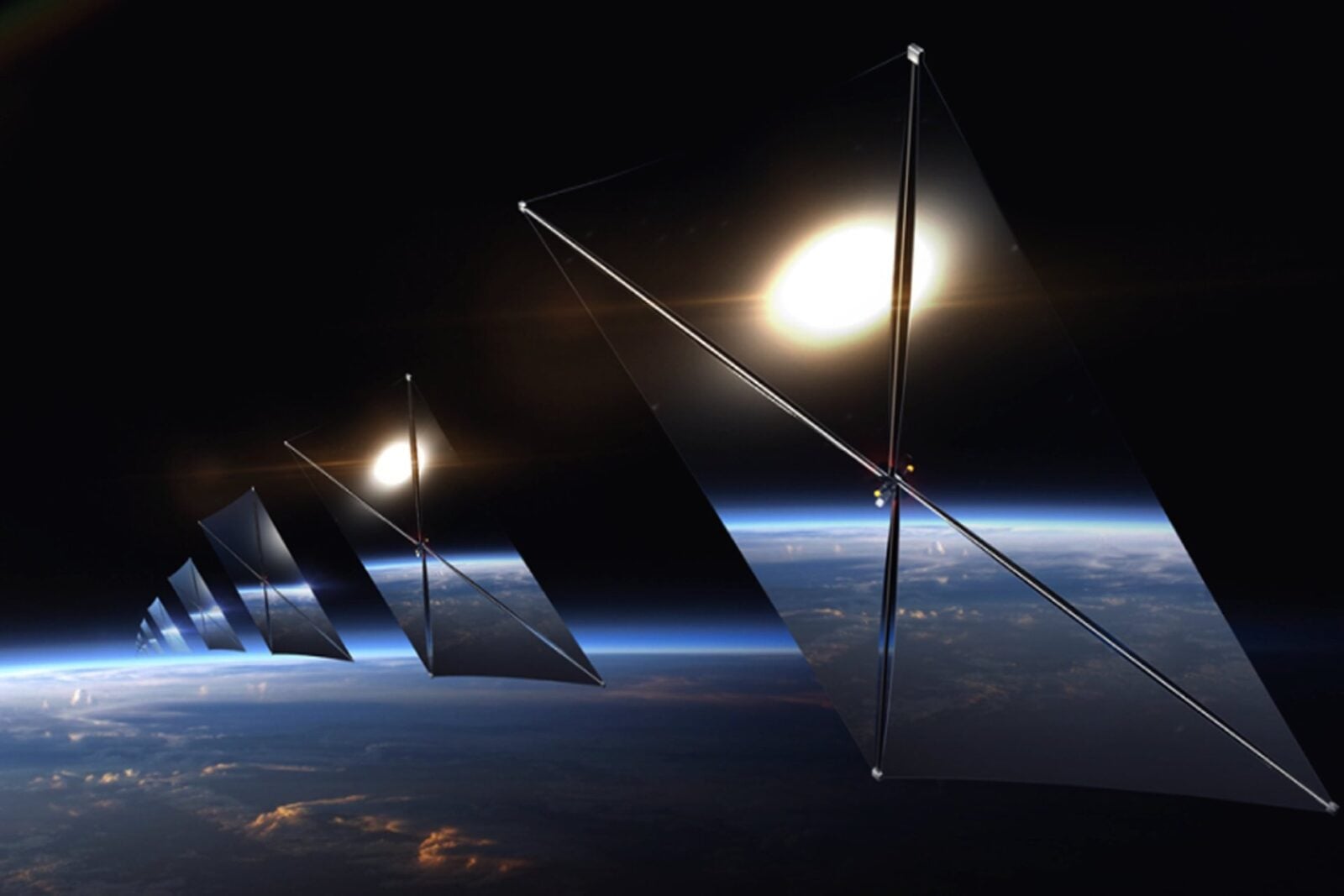
Operating a constellation of 50,000 mirrors requires sophisticated cloud compute architecture to manage orbital mechanics in real time. Unlike traditional communication satellites that maintain fixed ground footprints or broad global coverage, reflecting sunlight onto a precise coordinate—such as a remote mining operation in the Chilean Atacama Desert or a municipal solar farm in Germany—requires sub-millimeter precision.
Key Technical Architecture Metrics
- Altitude: Designed for Sun-synchronous or high-inclination Low-Earth Orbits (LEO) ranging from 600 to 1,000 kilometers.
- Reflector Material: Vapor-deposited aluminum on polyimide film, offering high reflectivity with minimal mass penalty.
- Attitude Control: Reaction wheels and magnetic torquers driven by autonomous onboard AI algorithms to continuously adjust mirror angles relative to the Sun and Earth.
- Illumination Footprint: Capable of focusing diffused beams measuring several kilometers across, raising ambient night lux levels equivalent to early twilight or a full moon on steroids.
The economic engine driving this technology is energy arbitrage. Terrestrial solar photovoltaic (PV) installations currently suffer from a structural utilization flaw: they generate peak power when demand is often moderate, and zero power when the sun goes down, necessitating expensive battery storage arrays or fossil-fuel peaker plants. By angling orbital mirrors to beam sunlight directly onto solar farms during peak evening demand hours, the startup argues it can artificially extend the operational window of green energy assets, dramatically improving their financial yield and accelerating infrastructure scalability.
| Metric / Parameter | Traditional Solar + Battery | Space-Based Mirror Constellation |
|---|---|---|
| Generation Window | Daylight hours only (~4 to 8 hours peak) | Extendable into nighttime hours via orbital redirection |
| Storage Dependency | High reliance on lithium-ion or flow batteries | Reduced reliance; direct photon-to-grid conversion |
| Initial CapEx Risk | Moderate, mature supply chain | Extreme, unproven at 50,000-unit scale |
| Regulatory Compliance | Local land use, environmental impact reports | International space law, ITU, FCC, orbital debris mandates |
Industry & Market Implications: Who Wins, Who Loses
The introduction of commercial space mirrors creates profound shifts across multiple sectors, establishing clear beneficiaries and endangered business models.
The Winners
- Next-Gen Aerospace Manufacturers: Specialized companies fabricating lightweight composite structures, attitude control actuators, and radiation-hardened microchips stand to capture massive supply chain contracts.
- Utility-Scale Solar Developers: Asset owners who can monetize generation capacity across a 16-to-24-hour cycle will see valuation multiples expand as capacity factors surge.
- Remote Industrial Operators: Mining conglomerates operating in polar or remote regions can slash diesel generator expenditures by leveraging continuous artificial daylight.
The Losers
- Traditional Energy Storage Providers: Battery manufacturers and grid-scale storage developers could face a direct competitive threat if orbital redirection proves more cost-effective than chemical battery buildouts.
- Optical & Radio Astronomy: Professional and amateur astronomers face an existential threat. A constellation of 50,000 highly reflective surfaces crossing the night sky will further degrade astronomical observations, streaking data with unwanted light pollution.
- Nighttime Ecosystems: Environmental biologists warn of catastrophic disruptions to nocturnal wildlife, migratory bird patterns, and circadian rhythms across flora and fauna.
Frequently Asked Questions (People Also Answered)
How do space mirrors actually provide light at night?
Space mirrors operate by positioning themselves in low-Earth orbit to catch direct solar radiation on their reflective polymer surfaces and angling that light downward toward specific geographic targets on Earth's dark side. Because these satellites travel at high speeds, they continually adjust their pitch and yaw to maintain a focused beam on a target area as they pass overhead.
What are the main regulatory and legal hurdles facing this project?
The project must navigate complex international frameworks, including the Outer Space Treaty overseen by the United Nations, authorizations from the Federal Communications Commission (FCC), and coordination with national space agencies. Key concerns include orbital debris mitigation, radio frequency interference, and liability for environmental or economic damages caused by unintended light dispersion.
Will these mirrors be visible to the naked eye from Earth?
Yes. Depending on their orbital altitude and reflectivity, constellations of this scale will appear as moving stars or bright flashes across the night sky, drawing intense criticism from astronomers who argue it will ruin ground-based observation of deep space.
Future Outlook: Milestones and Risk Mitigation to Watch
As this venture transitions from theoretical design to hardware prototyping, institutional analysts and risk management professionals are closely monitoring several critical milestones over the next 24 to 36 months.
First, the startup must successfully execute its pathfinder mission—launching a small cohort of demonstrator mirrors to prove attitude control, deployment reliability, and beam-focusing accuracy under real-world orbital conditions. Second, regulatory compliance will be the ultimate bottleneck. Securing operational licenses from the FCC and international bodies will require unprecedented environmental impact disclosures regarding light pollution and orbital congestion.
Ultimately, whether space-based illumination becomes a cornerstone of the future global energy grid or an over-hyped footnote in commercial space history depends on risk mitigation. If the startup can navigate regulatory pushback, prove financial viability at scale, and address the legitimate grievances of the scientific community, it may permanently alter human civilization's relationship with the sun and the stars. If it fails, it will serve as a stark reminder of the gravity—both literal and economic—that keeps even the boldest ambitions tethered to Earth.