Executive Takeaways
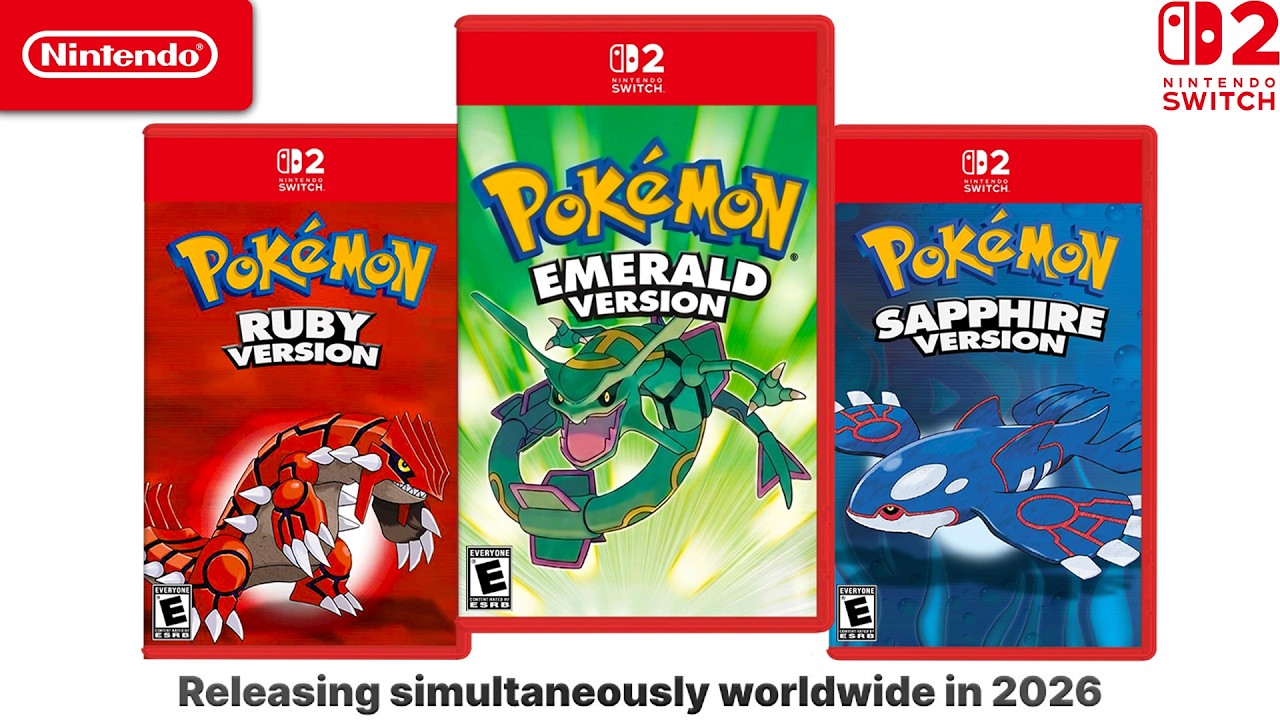
- Late Q3/Early Q4 Launch Window: Coinciding datamining markers and corroborating industry leaks indicate that Game Boy Advance flagships Pokémon Ruby, Sapphire, and Emerald are positioned for release on the Nintendo Switch ecosystem between late September and October.
- Subscription Engine vs. Standalone Unit Sales: Nintendo faces a critical capital allocation decision: deploy the titles as high-margin $19.99 standalone eShop SKUs or utilize them as an aggressive customer-acquisition and churn-mitigation lever for the $49.99/year Nintendo Switch Online (NSO) + Expansion Pack tier.
- Hardware Sunset Hedging: Facing decelerating hardware shipments for the aging 143-million-unit Switch install base, legacy Pokémon intellectual property (IP) monetization serves as an ultra-low-CapEx buffer to sustain software attach rates and digital net sales ahead of the fiscal 2025 "Switch 2" rollout.
- Cloud Integration Hurdles: Technical implementation hinges on whether the emulated builds will bridge to the Pokémon HOME cloud infrastructure, a move requiring proprietary save-data validation to prevent unauthorized arbitrary code execution and illegitimately cloned assets.
The Anatomy of a Leak: Datamining, Sloop Architecture, and the September Window

In the high-stakes theater of global interactive entertainment, legacy intellectual property is increasingly deployed with the precision of a central bank liquidity injection. Over the past seventy-two hours, cross-platform leaks originating from insider dispatches—most notably amplified by industry insider Nick Baker—alongside concurrent datamining findings within Nintendo’s proprietary emulation packages, have ignited capital and consumer markets alike. The target: Generation III of Game Freak’s marquee franchise, comprising Pokémon Ruby, Pokémon Sapphire (2002), and the critically revered definitive edition, Pokémon Emerald (2004).
The reported timeline—targeting an operational deployment window between late September and mid-October—aligns neatly with Nintendo’s historical cadence of late-summer Nintendo Direct broadcasts. Dataminers interrogating the codebases of Nintendo Switch Online’s Game Boy Advance emulator, internally codified as "Sloop," have repeatedly surfaced structural hooks and configuration parameters designed to accommodate titles utilizing specialized real-time clock (RTC) mechanics and internal battery-dependent event loops. Ruby, Sapphire, and Emerald were among the earliest commercial cartridges to integrate RTC functionality on the GBA architecture, governing everything from the growth cycles of in-game Berries to the tidal shifts within the Shoal Cave game space.
Market observers note that the timing carries sharp strategic intentionality. Historically, late September represents the closure of Nintendo's second fiscal quarter, a critical junction where digital recurring revenues are audited and showcased to institutional investors. By injecting high-velocity, nostalgia-driven IP into the ecosystem at this precise interval, Nintendo actively insulates its mid-year earnings report against the structural headwinds of an aging hardware cycle.
Capital Allocation & Platform Economics: Standalone SKU vs. NSO Expansion Pack
From an enterprise finance perspective, the central strategic inquiry is not merely if the Hoenn-region titles will land on the hardware, but how Nintendo intends to monetize them. Corporate management faces two primary commercial vectors, each offering vastly different risk-reward profiles and enterprise valuation impacts.
1. The Pure Subscription Lever (NSO + Expansion Pack)
Under this distribution framework, Nintendo would fold the Generation III mainline titles directly into the premium $49.99/year Nintendo Switch Online + Expansion Pack tier. This approach prioritizes Annual Recurring Revenue (ARR), customer lifetime value (LTV), and churn mitigation over upfront gross margins. For an install base currently exceeding 143 million hardware units globally, driving subscription conversion remains paramount. The deployment of a culturally monumental title like Pokémon Emerald serves as an unrivaled retention mechanism, preventing churn during the fall quarter when cross-platform competitors are deploying heavyweight modern releases.
2. The Premium Legacy Standalone Model
Alternatively, Nintendo could depart from its standard NSO GBA catalog methodology, electing to distribute the titles as discrete, standalone digital purchases via the Nintendo eShop for $19.99 to $29.99 each—mirroring the Game Boy Red, Blue, and Yellow releases on the Nintendo 3DS Virtual Console in 2016. Given that original, authenticated cartridges of Pokémon Emerald routinely trade on the secondary collector market for upwards of $180 to $250 due to severe supply constraints, unmitigated pricing power sits firmly in Nintendo’s favor. A standalone commercial release represents near-100% gross margin software income, requiring virtually zero incremental physical supply chain expenditures or silicon allocation.
Comparative Operational Metrics: The Generation III Footprint
To contextualize the commercial weight of the rumored catalog injection, the historical baseline metrics and potential deployment mechanisms are outlined below:
| Software Title | Original Launch Year (GBA) | Lifetime Global Unit Sales | Targeted Distribution Channel | Key Technical Infrastructure Dependency |
|---|---|---|---|---|
| Pokémon Ruby | 2002 (JP) / 2003 (NA) | ~8.10 Million (Joint) | NSO + Expansion Pack / eShop | RTC emulation, Wireless Adapter API integration |
| Pokémon Sapphire | 2002 (JP) / 2003 (NA) | ~8.10 Million (Joint) | NSO + Expansion Pack / eShop | RTC emulation, Multi-system local transport |
| Pokémon Emerald | 2004 (JP) / 2005 (NA) | ~7.06 Million | NSO + Expansion Pack / eShop | Battle Frontier PRNG tracking, RTC infrastructure |
| Omega Ruby / Alpha Sapphire (3DS Remakes) | 2014 | 14.60 Million | Legacy Hardware Only (3DS eShop closed) | 3D Engine, Custom StreetPass architectures |
Technical Architecture: Emulation, Pokémon HOME, and Security Protocol
The enterprise friction of porting legacy Game Boy Advance titles to a modern connected console extends far beyond rendering 240×160 native pixel frames onto an internal 720p or docked 1080p display. The primary hurdle confronting Game Freak, The Pokémon Company, and platform engineer NERD (Nintendo European Research & Development) resides within the ecosystem's network transport layer.
Historically, mainline Pokémon games are structurally distinct from conventional retro titles because their in-game assets possess long-tail liquidity. Players expect captured Pokémon to move bidirectionally or unidirectionally up the generational ladder. Integrating Ruby, Sapphire, and Emerald into modern workflows requires establishing a direct pipeline into Pokémon HOME, the franchise's cloud-based storage infrastructure operating on Amazon Web Services (AWS).
This technical pipeline introduces acute cybersecurity vulnerabilities:
- Save-State Manipulation and Cloned Assets: Standard NSO emulators feature integrated rewind mechanics and persistent save states. If applied indiscriminately to Generation III, malicious actors could instantly duplicate rare inventory and competitive assets, undermining the integrity of the ecosystem's competitive balance.
- Arbitrary Code Execution (ACE) Mitigation: Early Pokémon titles, particularly Emerald, are notorious within white-hat research communities for memory leaks and PRNG (Pseudorandom Number Generator) manipulation that permit execution of custom payloads within the console’s memory space. Releasing these ROMs on the modern Switch architecture without rigorous sandboxing presents attack vectors that Nintendo’s platform security teams must thoroughly insulate.
Industry & Market Implications: Who Wins, Who Loses?
The realization of these ports creates clear structural ripples across the broader gaming market:
The Winners:
- Nintendo Co., Ltd. (7974.T): Extracts massive enterprise value from fully amortized R&D investments dating back twenty-two years, boosting high-margin digital software revenues at the precise tail-end of a hardware cycle.
- The Consumer Base: Bypasses predatory pricing, rampant counterfeit reproduction cartridges, and degrading battery hardware on secondary platforms like eBay and Mercari to experience the defining golden era of Game Freak’s 2D sprite-art mastery.
- The Pokémon Company Joint Venture: Revitalizes consumer engagement for the Hoenn region ahead of prospective licensing agreements, merchandise waves, and card game expansions focused on classic motifs.
The Losers:
- The Unregulated Secondary Retro Market: Independent retro game dealers and high-end speculative collectors hoarding raw physical carts of Emerald will inevitably see market liquidity compress as the barrier to legal, high-fidelity entry drops to near-zero.
- Next-Gen Impatience: Consumers demanding immediate reveals of Nintendo’s next-generation platform may perceive retro GBA deployments as an operational stalling tactic to extend the fiscal life of current hardware through calendar year 2024.
Frequently Asked Questions (People Also Ask)
Will Pokémon Ruby, Sapphire, and Emerald be released on Nintendo Switch Online or as standalone eShop games?
While standard Game Boy Advance releases are traditionally packaged into the Nintendo Switch Online + Expansion Pack subscription tier, industry analysts note that The Pokémon Company frequently negotiates bespoke commercial agreements. The titles could arrive either exclusively as subscription-drivers or as individual digital purchases priced between $19.99 and $29.99 to capture maximum standalone gross margins, mirroring the 3DS Virtual Console historical precedent.
Can Pokémon caught in the Switch versions of Ruby, Sapphire, and Emerald transfer to Pokémon HOME?
Technical viability depends on cloud compatibility updates pushed to the Pokémon HOME backend. For the ports to retain parity with previous releases, Game Freak must implement an encryption handshake that reads local Switch save files, extracts character data, and transfers assets to modern titles while disabling the standard emulator's "rewind" functions to prevent asset cloning.
Why are these Pokémon GBA games coming to the Switch so late in its lifecycle?
This follows Nintendo’s structural playbook for hardware transitions. With total Nintendo Switch hardware sales slowing past the 143-million mark and production transitioning toward its successor, first-party software development pipelines pivot to next-generation launches. Re-releasing high-demand, fully amortized catalog titles delivers crucial software attach rates, digital net income, and engagement metrics with minimal engineering overhead.
How will time-based events like Berry growing and Mirage Island work without an original cartridge battery?
The modern Nintendo Switch operating system features an integrated hardware Real-Time Clock (RTC). The Nintendo European Research & Development (NERD) GBA emulation wrapper automatically maps the game’s internal temporal queries directly to the console’s system clock, rendering the hardware immune to the infamous "Dry Battery" error that permanently freezes time-based events in legacy physical cartridges.
Future Outlook: Strategic Milestones to Monitor
As the projected September–October deployment window approaches, institutional eyes remain fixed on Nintendo’s forthcoming corporate communications. If the Hoenn triumvirate arrives as an NSO Expansion Pack exclusive, expect an immediate inflection in Nintendo's digital services revenue within Q3 fiscal disclosures. Conversely, if distributed as standalone SKUs, software sales volume charts across Japan, Europe, and North America will visibly spike, demonstrating once more that for Nintendo, the past is not merely prologue—it is an immensely profitable, balance-sheet-stabilizing asset.