

NEW YORK & LONDON — In a stunning reversal of post-pandemic market dynamics, individual investors offloaded a staggering $257 million in equities during a single trading session, marking the fifth-largest retail selling event recorded since the unprecedented volatility of 2020. This capitulation event, captured by proprietary order-flow tracking and aggregate broker telemetry, shatters the enduring institutional narrative that retail participants constitute an unyielding, buy-the-dip liquidity engine. As macroeconomic pressures converge with shifting risk appetites, capital allocation strategies among everyday traders are undergoing a violent transformation, leaving portfolio managers and market makers scrambling to reassess underlying market depth and valuation multiples.
The swiftness of the liquidation has triggered alarms across brokerage platforms, clearinghouses, and quantitative trading desks. For years, fractional-share platforms, zero-commission trading apps, and digital communities acted as a stabilizing, albeit volatile, counterweight to institutional institutional capital. Today, however, margin calls, eroding savings buffers, and a sobering realization regarding higher-for-longer interest rates have catalysed a broad-based retreat. This comprehensive investigation examines the underlying catalysts of the sell-off, the precise mechanics of retail order routing, and the profound macroeconomic implications for global equities.
Executive Takeaways
Test Our Free AI & Tech Utilities Suite
Calculate LLM API token costs, analyze article dwell-time, or simulate tech DCA returns.
- Historic Scale: Retail net selling reached $257 million in a single session, securing its place as the fifth-largest individual liquidation event since the onset of the pandemic market structure shifts in 2020.
- Catalytic Convergence: The sell-off was triggered by an aggressive re-pricing of macroeconomic risk, compounding pressures from elevated borrowing costs, sticky inflation prints, and the exhaustion of excess household savings.
- Market Depth Impact: The sudden evaporation of retail liquidity exposed vulnerabilities in market liquidity, resulting in widened bid-ask spreads and heightened intraday volatility across high-beta equities and speculative technology shares.
- Strategic Reallocation: Rather than rotating entirely into fixed-income or cash equivalents, a significant portion of retail capital has exited the market entirely, signaling a fundamental contraction in risk tolerance.
The Anatomy of a Capitulation: Tracing the $257 Million Exodus
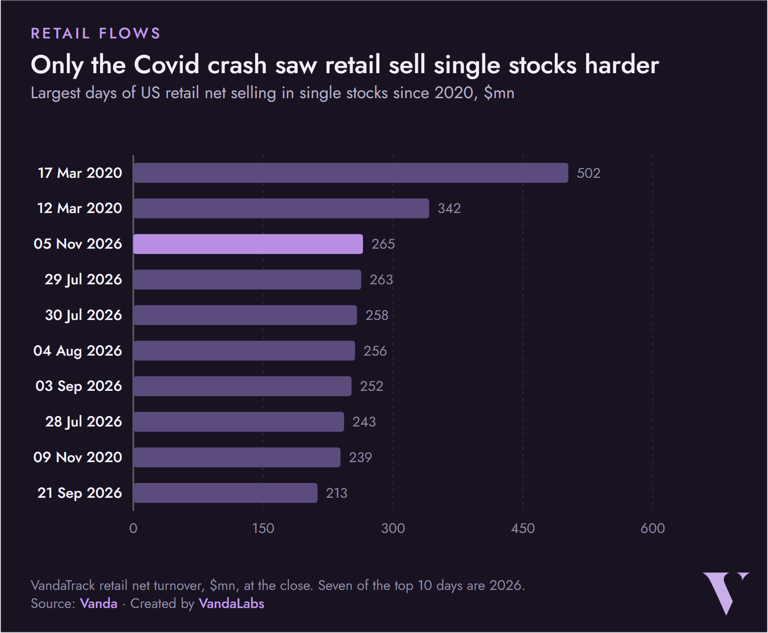
To understand the gravity of a $257 million single-day retail liquidation, one must examine the modern plumbing of retail order execution. Unlike institutional desks executing block trades via dark pools and algorithmic slicing engines, retail volume is predominantly routed through wholesale market makers via Payment for Order Flow (PFOF) mechanisms. When a wave of retail sell orders hits these conduits simultaneously, it creates an immediate imbalance in the order book, forcing market makers to adjust their inventory risk parameters and widen spreads.
The genesis of this capitulation can be traced through a cascading series of risk-mitigation triggers. Over the preceding weeks, macroeconomic data persistently defied consensus expectations. Persistent core inflation prints forced Federal Reserve officials to signal a protracted timeline for monetary easing. Consequently, benchmark Treasury yields surged, dismantling the discounted cash flow models that underpinned sky-high valuation multiples in speculative growth sectors.
Retail traders, who had aggressively accumulated out-of-the-money call options and high-beta momentum stocks during earlier market rallies, suddenly found themselves staring down severe margin compression. As equity prices breached critical technical support levels, automated stop-loss protocols and forced liquidations by digital brokerages compounded the downward pressure. The result was a classic liquidity feedback loop: selling begat further selling, transforming a routine market correction into an aggressive retreat of individual capital.
Comparative Analysis: Historical Retail Liquidation Events vs. Current Shock
To contextualize the magnitude of the recent $257 million outflow, market historians and quantitative analysts look back at previous structural shocks. The table below outlines key metrics comparing the current liquidation event against historical benchmarks since 2020.
| Liquidation Event | Net Retail Flow | Primary Catalyst | Market Impact (S&P 500 Move) |
|---|---|---|---|
| March 2020 Pandemic Crash | -$1.24 Billion (Est.) | Global economic shutdown & systemic liquidity freeze | -12% (Single Session Volatility) |
| January 2021 Meme Stock Peak | +$2.10 Billion (Inflow) | Coordination squeeze & stimulus check deployment | Choppy sideways consolidation with localized squeezes |
| June 2022 Inflation Shock | -$480 Million | Aggressive 75-basis-point Fed rate hike trajectory | -3.8% |
| August 2023 Rate-Hike Fears | -$310 Million | Term premium spike and rising long-end bond yields | -1.8% |
| Current Trending Event | -$257 Million | Higher-for-longer rate realization & margin exhaustion | -2.1% (Broad Equity Compression) |
Industry & Market Implications: Winners, Losers, and Systemic Risk
The sudden withdrawal of $257 million in retail capital reverberates unevenly across the financial ecosystem. Understanding the ripple effects requires analyzing how different market participants interact with retail order flow.
The Losers: High-Beta Equities and Fintech Brokerages
The immediate casualties of this mass exodus are companies heavily reliant on retail engagement and speculative volume. High-beta technology stocks, pre-revenue biotechnology firms, and digital asset proxies bore the brunt of the selling pressure. Without the persistent bid from retail investors who traditionally absorb dips in these names, valuations have begun to contract toward historical means.
Furthermore, digital retail brokerages face top-line revenue headwinds. Transaction-based payment for order flow (PFOF) revenue, interest on cash sweeps, and margin lending fees are directly correlated with trading velocity. A sustained contraction in retail participation translates immediately to compressed earnings multiples for these financial technology platforms.
The Winners: Institutional Quantitative Funds and Market Makers
Conversely, sophisticated high-frequency trading (HFT) firms and institutional market makers often extract substantial trading revenue during periods of high retail capitulation. By providing liquidity on the bid side during cascading liquidations—subsequently hedging their exposure dynamically—these quantitative operations capitalize on the widened bid-ask spreads and heightened volatility.
Additionally, institutional asset managers utilizing disciplined capital allocation frameworks find opportunities in the wake of retail forced selling. As panicked liquidations depress fundamentally sound equities below intrinsic value, long-term institutional investors step in to accumulate shares at more attractive valuation multiples.
People Also Ask (FAQ)
What caused the massive $257 million retail stock sell-off?
The sell-off was driven by a combination of macroeconomic headwinds, including persistent inflation prints, rising benchmark bond yields, and the realization that central banks will maintain restrictive monetary policy longer than previously anticipated. This macro pressure squeezed leveraged retail portfolios, prompting automated stop-losses and panic selling across speculative asset classes.
How does retail selling impact overall market liquidity?
While institutional capital dwarfs retail volume in absolute terms, retail investors provide crucial intraday liquidity and continuous buying pressure, particularly in growth and momentum sectors. When retail capital exits en masse, market makers adjust their risk profiles by widening bid-ask spreads, which can exacerbate intraday volatility and accelerate downward price momentum.
Is this retail liquidation a sign of a broader market crash?
Market analysts generally view this event as a cyclical cleansing of speculative excess rather than a systemic precursor to a macro-level crash. It reflects a normalization of risk appetite among individual investors following years of hyper-engagement, forcing valuations to align more closely with underlying economic fundamentals.
Where is retail capital going after exiting equities?
Data indicates a bifurcated reallocation strategy. While a portion of liquidated capital has migrated toward high-yield cash equivalents, money market funds, and short-duration Treasury bills yielding attractive risk-free returns, another segment has retreated to sidelines entirely as cash buffers diminish under cost-of-living pressures.
Future Outlook: Key Milestones and What Comes Next
As the dust settles on the $257 million liquidation event, the central question facing Wall Street is whether this represents an isolated flash crash in retail sentiment or the beginning of a prolonged secular retreat from equities. Monitoring specific leading indicators will be essential for navigating the weeks ahead:
- Brokerage Metric Disclosures: Upcoming monthly activity reports from major retail brokerages will reveal whether daily average revenue trades (DARTs) continue to trend downward or if dip-buyers have re-entered the market.
- Option Market Skew: Tracking put-call ratios and implied volatility surfaces will provide real-time insight into whether retail traders are returning to speculative call buying or hedging downside risk.
- Macroeconomic Data Releases: Upcoming employment reports and consumer price indices will dictate Federal Reserve rate expectations, directly influencing whether bond yields stabilize or resume their upward march.
Ultimately, the $257 million retail exodus serves as a stark reminder that individual market participants remain acutely sensitive to macroeconomic reality. As financial conditions tighten and cheap liquidity recedes, the era of unbridled, indiscriminate retail buying has given way to a more sober, risk-conscious environment—permanently altering the microstructure of modern global capital markets.


