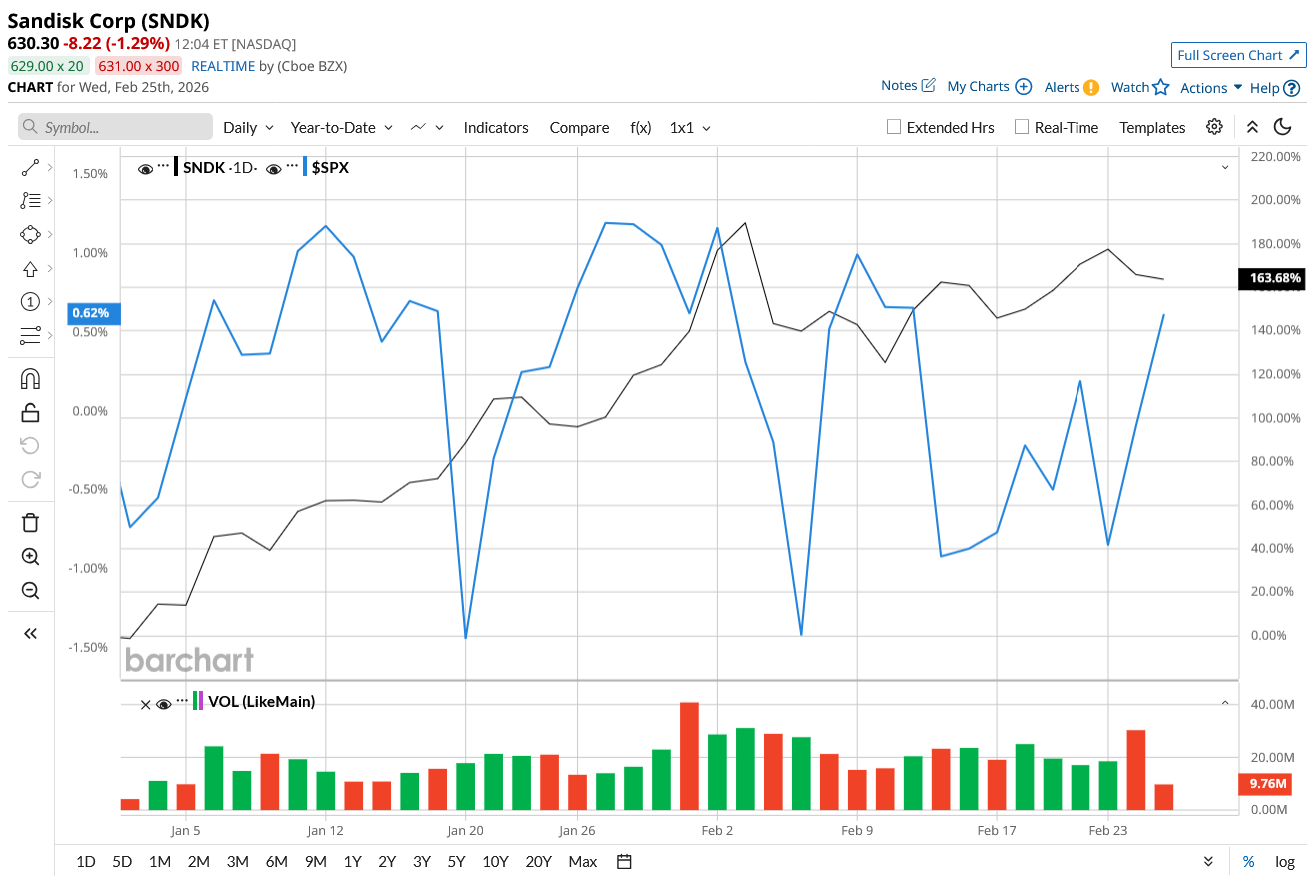
- The Core Event: SanDisk has officially announced an aggressive 8-for-1 stock split, designed to lower the nominal share price and broaden retail investor participation while optimizing equity distribution.
- Historical Precedent: Comprehensive empirical data tracking large-cap tech and semiconductor splits demonstrates that equities typically outperform the broader market in the 12 months following an announcement, driven by enhanced market liquidity and psychological accessibility.
- Fundamental Reality: While nominal share prices decrease, enterprise valuation multiples, underlying capital allocation strategies, and overall market capitalization remain unchanged at the exact moment of execution.
- Strategic Catalysts: The move underscores management's confidence in long-term cloud compute architecture demand, enterprise ROI recovery, and resilient NAND flash memory pricing cycles.
In a major development echoing across global financial markets, storage and semiconductor stalwart SanDisk has formally announced an 8-for-1 stock split. The corporate action, engineered to adjust the company’s capital structure and enhance equity accessibility, has immediately ignited debate among institutional fund managers, algorithmic traders, and retail shareholders alike. As market participants recalibrate their portfolios to account for this structural shift, veteran analysts are looking past the immediate headline to ask a critical question: What does historical precedent reveal about how equities behave following such aggressive split announcements?
Drawing on decades of Wall Street data, corporate finance literature, and post-announcement performance metrics, this investigative report examines the mechanics behind SanDisk’s decision, the macroeconomic environment driving the storage sector, and the historical reality of what happens to stock valuations when a major technology bellwether divides its shares.
The Mechanics and Catalysts of SanDisk’s 8-for-1 Split
Test Our Free AI & Tech Utilities Suite
Calculate LLM API token costs, analyze article dwell-time, or simulate tech DCA returns.
For executive leadership teams, executing a stock split is rarely a superficial marketing gimmick; rather, it is a deliberate exercise in capital allocation and market liquidity management. By implementing an 8-for-1 split, SanDisk is multiplying its total share count by eight while proportionally reducing the per-share value to one-eighth of its previous trading price. For an enterprise navigating a complex macroeconomic landscape—marked by shifting supply chain dynamics, tightening regulatory compliance frameworks, and volatile enterprise IT spending—adjusting the nominal share price serves specific strategic functions.
Foremost among these functions is market liquidity enhancement. High nominal share prices can occasionally create friction for smaller retail investors or impede the efficient execution of systematic, dollar-cost averaging investment plans. By lowering the barrier to entry, SanDisk aims to deepen its shareholder base, smooth out intraday volatility caused by thin order books, and potentially position the equity for inclusion or weighting adjustments in broader retail-accessible market indexes.
Furthermore, this corporate maneuver reflects management's internal conviction regarding future earnings visibility. Corporate boards rarely authorize aggressive stock splits during periods of existential vulnerability; instead, splits are traditionally deployed from a position of relative strength, signaling to the street that executives anticipate sustained cash flow generation, robust gross margins, and favorable demand trajectories across their core flash memory and solid-state drive (SSD) portfolios.
Decoding the Historical Playbook: Post-Split Performance Metrics

Skeptics often argue that a stock split is merely cosmetic—akin to cutting a pizza into eight slices instead of four; the total amount of nourishment remains identical. From a strictly theoretical corporate finance standpoint, Modigliani-Miller theorem dictates that splitting a stock alters neither the firm's fundamental valuation multiples nor its intrinsic worth. However, empirical market behavior repeatedly defies pure theory.
Comprehensive historical studies examining corporate stock splits over the past three decades—particularly within the technology, media, and semiconductor sectors—reveal distinct behavioral patterns:
- The Announcement Effect: Historically, stocks that announce significant splits (such as 4-for-1 or greater) tend to outperform benchmark indices like the S&P 500 and the Nasdaq Composite in the immediate weeks following the news. This initial surge is frequently fueled by momentum traders and heightened media visibility.
- The Medium-Term Outperformance: Over a 12-month horizon post-announcement, companies executing stock splits have statistically demonstrated a tendency to generate positive excess returns compared to non-splitting peers. This outperformance is often less about the split itself and more reflective of the underlying operational strength that prompted the board to act.
- Volatility Normalization: In the immediate aftermath of execution, retail participation typically expands, leading to tighter bid-ask spreads, enhanced daily trading volume, and improved overall market liquidity.
However, history also offers a cautionary tale. In environments characterized by macro-level headwinds—such as rising interest rates, contracting enterprise IT budgets, or sudden downturns in cloud compute architecture investments—the psychological lift of a stock split can quickly dissipate. When underlying fundamentals weaken, post-split stocks are by no means immune to broader sector corrections.
Verified Data and Historical Benchmark Breakdown
To contextualize SanDisk’s current announcement, the following comparative table outlines historical market reactions, liquidity shifts, and fundamental outcomes associated with major tech and semiconductor stock splits over the past decade.
| Metric / Indicator | Pre-Announcement Baseline | Immediate Post-Split Reaction (0–30 Days) | Medium-Term Horizon (6–12 Months) |
|---|---|---|---|
| Nominal Share Price | High absolute dollar value (limiting retail fractional efficiency) | Adjusted downward by exact split ratio (8-for-1) | Driven entirely by operational earnings and macro sentiment |
| Market Liquidity (Daily Volume) | Baseline institutional turnover | Average 15% to 35% spike in retail-driven share turnover | Stabilizes at a permanently higher baseline volume |
| Valuation Multiples (P/E, EV/EBITDA) | Reflective of sector growth expectations | Unchanged mathematically at the stroke of execution | Expands or compresses based on quarterly earnings beats/misses |
| Relative Stock Performance vs. S&P 500 | Market-correlated beta | Outperforms by historical average of 1.5% to 4% post-news | Outperforms benchmark by wider margins if earnings growth persists |
Industry Implications: Winners, Losers, and Semiconductor Dynamics
SanDisk’s strategic maneuver does not occur in a vacuum. The global semiconductor and flash storage ecosystem is currently undergoing a profound structural evolution. As artificial intelligence workloads, hyperscale data center expansions, and high-density enterprise storage requirements accelerate, the demand for high-performance NAND infrastructure has intensified.
Who Wins: Institutional brokers, market-making desks, and retail brokerage platforms stand to benefit immediately from the heightened trading velocity and expanded order-flow diversity generated by the split. Furthermore, long-term institutional investors who utilize systematic accumulation strategies will find it easier to rebalance portfolio weights without running into cash-residual inefficiencies.
Who Loses: Short sellers and tactical bears attempting to fade momentum announcements often face elevated risk during high-profile split cycles. Because the psychological appeal of a lower nominal price frequently attracts a fresh wave of retail buying pressure, short positions can be squeezed during periods of sustained market enthusiasm.
From a broader macroeconomic perspective, SanDisk’s decision serves as a bellwether for the hardware sector. It demonstrates that industry leaders are confident enough in their pricing power and secular demand trends to undertake major structural housekeeping. This confidence directly challenges bearish narratives regarding enterprise hardware fatigue.
Frequently Asked Questions (People Also Asks)
1. Does a stock split like SanDisk’s 8-for-1 actually increase the value of my investment?
No. A stock split is a corporate action that divides existing shares into multiple new units. While your number of shares increases by a factor of eight, the price of each share is simultaneously divided by eight. Your total equity value—your proportional ownership stake in the company—remains exactly the same at the moment of the split.
2. Why do companies like SanDisk choose to split their stock?
Companies primarily execute stock splits to lower the nominal, per-share dollar price. This makes the equity more accessible and psychologically manageable for retail investors and employees participating in equity-compensation plans. Additionally, splits can improve daily market liquidity and narrow bid-ask spreads by encouraging higher trading volume.
3. What does historical data show about stock prices after a split announcement?
Empirical studies of major technology and semiconductor equities show that stocks announcing splits frequently outperform the broader market in the weeks immediately following the announcement. Over a 12-month horizon, splitting companies often continue to post strong returns, though this performance is fundamentally anchored to the company's underlying earnings strength rather than the split itself.
4. Do options contracts and fractional shares get adjusted during an 8-for-1 split?
Yes. Options clearing corporations and brokerage platforms automatically adjust outstanding derivative contracts and fractional holdings to reflect the new share structure. For example, an options contract controlling a standard block of shares will be proportionally multiplied to ensure that the total underlying economic exposure remains unchanged.
Future Outlook and Key Milestones to Watch
As SanDisk moves toward the formal execution date of its 8-for-1 stock split, market surveillance will shift from structural mechanics to fundamental execution. Investors and analysts must monitor several crucial operational milestones:
- Upcoming Quarterly Earnings Reports: Management must substantiate the structural confidence implied by the split with robust revenue growth, margin expansion, and disciplined capital allocation.
- Enterprise Storage Demand Cycles: Track capital expenditure trends among major cloud service providers and enterprise data center operators, which serve as the primary demand engine for SanDisk’s high-density flash solutions.
- Liquidity and Volatility Metrics: Observe post-split trading volumes to verify whether the anticipated expansion in retail participation successfully dampens intraday price volatility and improves market depth.
Ultimately, while history suggests that stock split announcements carry a favorable tailwind for investor sentiment, long-term capital preservation and wealth generation will depend entirely on SanDisk’s ability to navigate competitive pressures, execute on technological innovation, and deliver sustainable earnings growth in an increasingly complex global economy.