Executive Takeaways
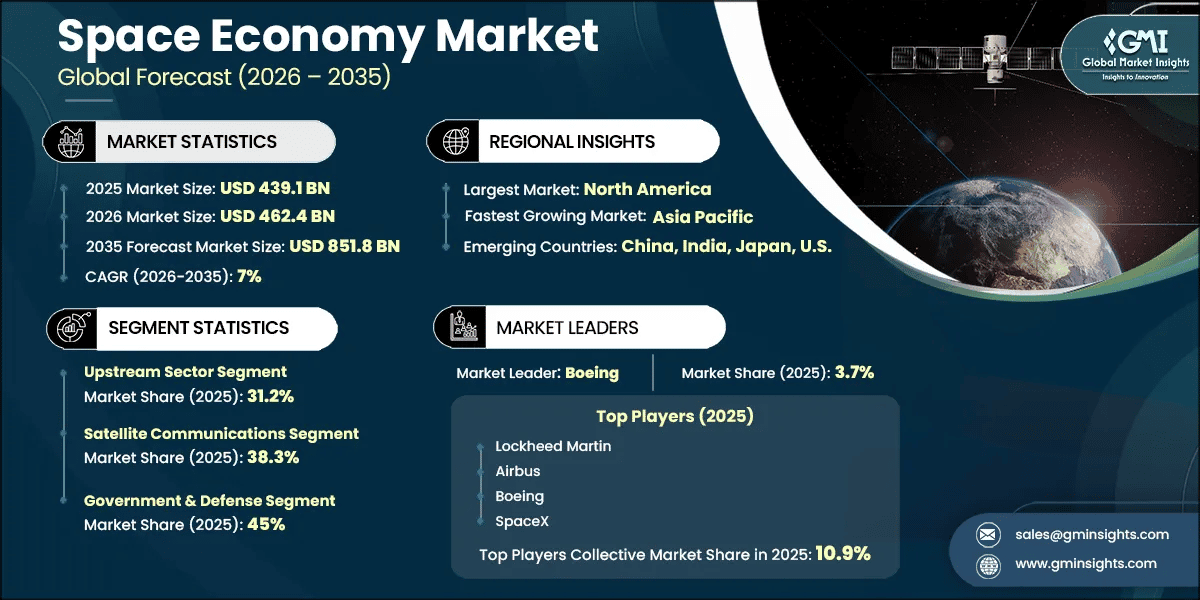
- Valuation Trajectory: According to the latest global market analysis released by Future Market Insights, the space economy is projected to scale from $449.8 billion in 2025 to $935.6 billion by 2035.
- Compound Annual Growth Rate: The sector will achieve a steady 7.6% CAGR over the forecast decade, driven by aggressive institutional capital allocation and commercial infrastructure scalability.
- Primary Growth Catalysts: Massive deployment of low Earth orbit (LEO) constellations, plummeting payload launch costs, and high-margin enterprise applications in Earth observation and secure orbital cloud compute architecture.
- Strategic Capital Shift: Venture capital and sovereign wealth funds are rotating away from speculative aerospace startups toward cash-flow-positive enterprise operators with proven regulatory compliance and enterprise ROI.
For decades, the final frontier was the exclusive domain of sovereign states, Cold War superpowers, and state-funded defense contractors operating on cost-plus budgets. Today, that paradigm has dissolved. As detailed in the comprehensive global market analysis published by Future Market Insights, the space economy is no longer a futuristic science experiment; it is an aggressively expanding multihundred-billion-dollar industrial complex undergoing a radical financialization.
By 2035, the global space economy market is on track to touch $935.6 billion, more than doubling its 2025 baseline of $449.8 billion. Operating at a compound annual growth rate (CAGR) of 7.6%, this expansion reflects a profound structural transformation. Private equity firms, institutional asset managers, and corporate venture arms are recalibrating their portfolios to capture valuation multiples in a sector transitioning from heavy capital expenditure to high-yield commercial monetization.
The Macroeconomic Catalysts Fueling the 2025–2035 Surge
Test Our Free AI & Tech Utilities Suite
Calculate LLM API token costs, analyze article dwell-time, or simulate tech DCA returns.
The acceleration of the space economy from a boutique sector into a mainstream asset class is underpinned by three foundational pillars: dramatic reductions in launch costs, advancements in miniaturized satellite technology, and surging enterprise demand for real-time geospatial intelligence.
Historically, the prohibitive cost of escaping Earth's gravity well placed a hard ceiling on commercial viability. Reusable rocket architectures pioneered over the last decade have systematically compressed cost-per-kilogram metrics to low Earth orbit (LEO). This infrastructure scalability has lowered the barrier to entry for commercial operators, enabling venture-backed startups and legacy aerospace giants alike to deploy constellations of micro-satellites with unprecedented frequency.
Concurrently, enterprise requirements for high-bandwidth global connectivity, climate risk mitigation data, and secure encrypted communications have created a self-sustaining demand loop. Corporations across maritime shipping, precision agriculture, logistics, and telecommunications are embedding space-derived data directly into their core operational workflows, driving predictable, recurring software-as-a-service (SaaS) revenues for upstream satellite operators.
Financial Architecture, Risk Mitigation, and Capital Allocation

As the market matures toward the mid-2030s, the criteria for capital allocation within the space sector are tightening. Investment committees are no longer swayed by technological novelty alone; instead, rigorous risk mitigation, regulatory compliance, and near-term cash-flow visibility dictate valuation multiples.
Regulatory frameworks—overseen by bodies such as the FCC, the FAA, and international counterparts managing orbital debris and spectrum allocation—have become critical variables in enterprise valuation. Companies that demonstrate robust compliance protocols and secure long-term spectrum rights enjoy premium pricing power and preferential access to institutional credit facilities.
Furthermore, the integration of advanced cloud compute architecture into orbital platforms represents the next frontier of high-margin corporate earnings. By processing raw telemetry and optical data directly on-board spacecraft using edge computing, operators eliminate bandwidth bottlenecks down to terrestrial stations, delivering actionable intelligence to enterprise clients in fractions of a second.
Global Market Metrics: 2025 vs. 2035 Projections
To quantify the trajectory of this industrial renaissance, the following comparative breakdown illustrates the foundational growth vectors driving the Future Market Insights projections across key segments:
| Market Segment / Metric | 2025 Baseline Valuation | 2035 Projected Valuation | Key Growth Drivers & Financial Impact |
|---|---|---|---|
| Total Space Economy | $449.8 Billion | $935.6 Billion | Overall 7.6% CAGR driven by commercialization and institutional capital inflow. |
| Satellite Communications & Broadband | $195.0 Billion | $410.0 Billion | Direct-to-device connectivity, maritime/aviation demand, and rural broadband expansion. |
| Earth Observation & Geospatial Analytics | $75.0 Billion | $180.0 Billion | Enterprise ESG tracking, supply chain monitoring, and real-time defense intelligence. |
| Launch Services & Infrastructure | $25.0 Billion | $65.0 Billion | Reusable heavy-lift architectures, orbital manufacturing facilities, and spaceport scaling. |
Industry Implications: Winners, Losers, and Economic Restructuring
The maturation of the space economy is precipitating a profound divergence in corporate fortunes. Legacy aerospace contractors slow to adopt agile, software-defined manufacturing processes risk margin erosion as nimble, vertically integrated new-space entrants capture market share.
Conversely, winners in this ecosystem will be firms that master dual-use applications—seamlessly serving both lucrative defense procurement contracts and high-volume commercial markets. Financial institutions that develop sophisticated underwriting models for space assets, including bespoke satellite orbital insurance policies and asset-backed debt facilities, stand to capture lucrative fee streams.
On the macroeconomic front, countries with proactive legislative frameworks—such as streamlined licensing for commercial spaceports and favorable tax treatments for space-tech R&D—will attract outsized foreign direct investment, cementing their status as the geopolitical hubs of the 21st-century orbital economy.
Frequently Asked Questions (People Also Ask)
What is the projected size and growth rate of the global space economy market?
According to market analysis from Future Market Insights, the global space economy is valued at $449.8 billion in 2025 and is projected to reach $935.6 billion by 2035, expanding at a robust compound annual growth rate (CAGR) of 7.6% over the ten-year forecast period.
What are the primary sectors driving revenue within the space economy?
The primary revenue generators include satellite communications and broadband services, Earth observation and geospatial analytics, and advanced launch services. Enterprise adoption of real-time data analytics, direct-to-device cellular connectivity, and orbital infrastructure scalability are the leading catalysts.
How are investors evaluating risk and return in the space technology sector?
Institutional investors and private equity firms are shifting focus from speculative R&D toward companies with proven enterprise ROI, regulatory compliance, strong intellectual property portfolios, and predictable cash-flow generation. Risk mitigation strategies now heavily incorporate orbital debris management and robust spectrum licensing rights.
What role do government agencies play in the modern commercial space economy?
While private commercial enterprises now drive the majority of market growth, government agencies (such as NASA and the ESA) act as vital anchor tenants, primary research funders, and regulatory arbiters. Public-private partnerships continue to de-risk capital-intensive deep-space exploration and next-generation launch infrastructure.
Future Outlook: Milestones to Watch Through 2035
As the industry marches toward the nearly trillion-dollar threshold by 2035, several critical milestones will dictate the pace and shape of market evolution. Analysts will be closely monitoring the commercial viability of in-space manufacturing—specifically semiconductor production and fiber-optic cable fabrication in microgravity—which promises superior material properties unavailable on Earth.
Furthermore, consolidation among LEO constellation operators is anticipated as smaller players face capital constraints, leading to a mature oligopoly of dominant infrastructure providers. For institutional investors and corporate strategists, maintaining disciplined capital allocation while tracking regulatory shifts in orbital traffic management will be the ultimate differentiator between market leaders and stranded assets.