Executive Takeaways
- First-Hand Genesis: Founders Mike Murchison and David Hariri spent months embedding themselves as front-line customer service agents to decode operational bottlenecks before writing a single line of code.
- The Copilot Architecture: Ada’s proprietary deployment focuses on delivering real-time, context-aware reply suggestions designed to fundamentally augment human agent productivity and slash handle times.
- Capital & Infrastructure Scaling: Backed by premier venture institutions like Bessemer Venture Partners, Ada is architecting self-improving "CX loops" that turn customer interactions into automated training data for autonomous AI agents.
- Enterprise ROI & Risk Mitigation: The platform addresses ballooning enterprise support costs by shifting ticket resolution from manual labor to low-latency neural architectures while safeguarding strict regulatory compliance.
NEW YORK — In the high-stakes arena of enterprise software, customer experience (CX) has long been viewed as a necessary cost center—an expensive, human-heavy operational burden subject to high employee churn, fluctuating volume spikes, and razor-thin margin efficiency. Today, that paradigm is undergoing a violent structural inversion. According to recent market analysis and strategic deployments highlighted by Bessemer Venture Partners, platforms like Ada are no longer merely automating simple FAQs; they are architecting self-sustaining "CX loops" that fundamentally power autonomous AI agents.
For corporate balance sheets navigating macro-economic headwinds, compressed valuation multiples, and escalating cloud compute architectures, the financial imperative is absolute. Enterprises are aggressively reallocating capital toward generative AI frameworks that promise immediate capital efficiency without degrading brand equity. At the center of this transformation is Ada, a company whose foundational DNA was forged not in a sterile venture capital incubator, but in the chaotic, high-pressure trenches of live customer support queues.
From the Support Trenches to Enterprise Infrastructure
The origin story of Ada diverges sharply from the typical Silicon Valley playbook. Before securing institutional backing or scaling out global enterprise sales pipelines, co-founders Mike Murchison and David Hariri took a radically immersive approach. For months, they sat shoulder-to-shoulder with support agents, answering live tickets, managing irate consumers, and mapping out the labyrinthine workflows that dictate modern customer operations.
This ground-level reconnaissance revealed a glaring market inefficiency: legacy customer relationship management (CRM) tools and early-generation chatbots were built strictly for containment, not resolution. They acted as rigid traffic cops, deflecting frustrated users to static knowledge bases and triggering widespread customer friction. Murchison and Hariri recognized that true automation required dynamic reasoning engines capable of executing complex back-office workflows—issuing refunds, updating shipping manifests, and verifying identities—all within milliseconds.
By translating their frontline operational insights into software architecture, the founders engineered a platform designed to bridge the chasm between raw Large Language Model (LLM) capabilities and enterprise-grade reliability. This philosophy ultimately attracted tier-1 institutional backing, most notably from Bessemer Venture Partners, whose ongoing thesis highlights Ada's unique ability to close the loop between automated deflection and continuous agent augmentation.
Anatomy of the Deployment: Deconstructing the Copilot and Autonomous Loops

A critical pillar of Ada’s market dominance lies in its nuanced deployment architecture. Rather than forcing a binary choice between total human replacement and legacy software, Ada’s ecosystem integrates deeply into existing enterprise workflows through sophisticated orchestration layers.
At the forefront of this deployment is Ada’s specialized Copilot infrastructure. Built to serve human agents in real-time, the Copilot analyzes incoming customer queries across omnichannel touchpoints—voice, chat, email, and social messaging—and synthesizes deep historical context from disparate enterprise databases. It then delivers real-time, context-aware reply suggestions and automated action pathways directly to the agent's workspace.
| System Dimension | Legacy Support Infrastructure | Ada AI Agent & Copilot Architecture |
|---|---|---|
| Primary Objective | Ticket deflection and static rule-based routing | Autonomous multi-step resolution and real-time agent augmentation |
| Data Integration | Siloed knowledge bases and manual CRM data entry | Real-time API orchestration across ERP, billing, and logistics stacks |
| Learning Mechanism | Static keyword mapping and manual script updates | Self-improving CX loops powered by continuous reinforcement learning |
| Enterprise ROI Metric | Cost containment at the expense of CSAT (Customer Satisfaction) | Accelerated Average Handle Time (AHT) and scale-adjusted margin expansion |
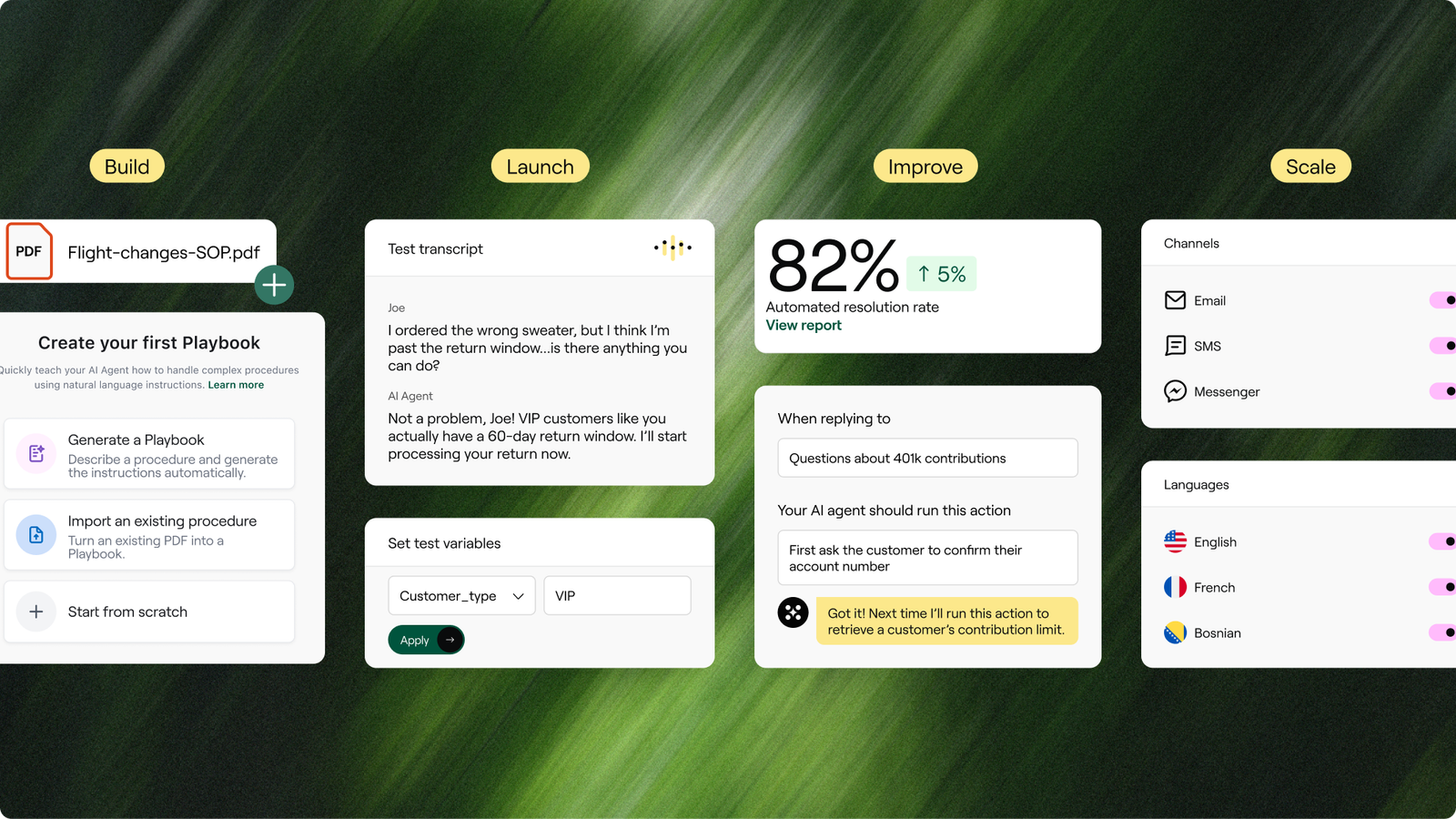
The true competitive moat, however, is the "fanatical CX loop." Every interaction handled by the Copilot or the autonomous agent feeds back into the foundational model architecture. When a human agent accepts, modifies, or rejects a suggested reply, that micro-decision serves as high-fidelity reinforcement learning data. Over time, this feedback loop compounds, drastically reducing hallucination rates, tightening enterprise compliance guardrails, and rendering the AI agent increasingly autonomous.
Industry & Market Implications: Who Wins, Who Loses
The broader macroeconomic implications of Ada’s technical trajectory are rippling across the enterprise software landscape. As Chief Financial Officers demand measurable ROI from every software line item, traditional business process outsourcing (BPO) firms and legacy helpdesk monolithic vendors face an existential reckoning.
- The Winners: Forward-thinking enterprises that embrace autonomous CX loops stand to realize dramatic operating margin expansions. By decoupling revenue growth from headcount scaling, these firms can absorb massive seasonal volume spikes without incurring linear cost increases. Furthermore, tech stack consolidators and venture capital firms backing modern orchestration layers are positioned to capture outsized market liquidity.
- The Losers: Legacy BPO providers relying strictly on labor arbitrage are under severe structural threat. As enterprise buyers migrate toward software-driven autonomy, low-margin, human-centric support models face terminal margin compression. Additionally, legacy SaaS vendors that failed to natively integrate generative reasoning capabilities risk rapid customer churn.
Regulatory compliance and risk mitigation remain top of mind for enterprise risk committees. Unlike generic consumer-facing models, Ada’s architecture incorporates robust data governance frameworks, ensuring that sensitive Personally Identifiable Information (PII) and financial records are walled off, encrypted, and handled in strict alignment with global standards such as GDPR, HIPAA, and SOC 2 Type II.
Frequently Asked Questions (People Also Ask)
How does Ada's Copilot differ from legacy customer service chatbots?
Legacy chatbots operate on rigid, pre-programmed decision trees and keyword matching, frequently leading to customer dead-ends. Ada’s Copilot and autonomous agents leverage advanced large language models combined with real-time API orchestration. This allows them to execute complex, multi-step actions—such as processing refunds or checking inventory across backend systems—while providing human agents with real-time, context-aware reply suggestions.
What is a "fanatical CX loop" in the context of enterprise AI?
A fanatical CX loop refers to Ada's closed-loop learning infrastructure where every customer interaction, human agent edit, and resolution metric is captured and fed back into the system. This continuous feedback loop acts as domain-specific training data, allowing the AI agents to self-improve, reduce hallucinations, and adapt dynamically to shifting enterprise policies over time.
Why did founders Mike Murchison and David Hariri spend months working as support agents?
By immersing themselves directly on the frontline of customer support, Murchison and Hariri sought to gain an unfiltered, ground-truth understanding of the operational pain points, friction bottlenecks, and technical limitations plaguing modern support teams. This firsthand experience ensured that Ada's software architecture was built to solve practical, high-value enterprise workflows rather than abstract theoretical use cases.
How does Ada ensure enterprise data security and regulatory compliance?
Ada employs rigorous enterprise-grade security protocols, including strict data isolation, encryption standards, and adherence to global regulatory frameworks such as GDPR, HIPAA, and SOC 2 Type II. This ensures that sensitive customer information and corporate data remain secure while powering autonomous workflows.
Future Outlook: The Road Ahead for Autonomous Enterprise Operations
As capital allocation shifts decisively toward operational efficiency and intelligent automation, the trajectory of platforms like Ada points toward a completely redefined enterprise landscape. The coming 12 to 36 months will serve as a crucial crucible for the AI agent economy. Key milestones to monitor include deeper multi-modal integrations (seamlessly blending voice, video, and text interaction), hyper-personalized proactive outreach triggered by predictive analytics, and even tighter integration with enterprise resource planning (ERP) systems.
For executive leadership teams, the mandate is clear: customer experience is no longer measured solely by polite human interactions, but by the speed, accuracy, and autonomy of digital orchestration. Companies that successfully implement self-improving CX loops will establish an unassailable competitive advantage, leaving legacy competitors scrambling to catch up in an increasingly automated world.