Executive Takeaways
- Infrastructure Breakthrough: LMSYS Org’s May 2025 technical release details the operational mechanics of running advanced Mixture-of-Experts (MoE) architectures like DeepSeek on a cluster of 96 NVIDIA H100 GPUs.
- Architectural Innovations: The deployment relies on Prefill-Decode (PD) Disaggregation to decouple compute-bound prompt ingestion from memory-bound token generation, alongside massive Expert Parallelism (EP) to bypass inter-node communication bottlenecks.
- Economic & Market Disruption: By optimizing memory bandwidth and DRAM access patterns, this deployment model drastically lowers the total cost of ownership (TCO) for enterprise-grade LLM serving, directly challenging traditional cloud compute capital allocation strategies.
- Strategic Enterprise ROI: Organizations can now achieve high-throughput, low-latency inference for ultra-large open-source models without requiring hyperscale-tier clusters, fundamentally altering cloud infrastructure scalability and hardware procurement cycles.
The economics of artificial intelligence infrastructure are undergoing a seismic recalculation. For years, the prevailing market consensus dictated that running frontier-class, open-source Large Language Models (LLMs) required boundless capital expenditure, exclusive access to sprawling hyperscale data centers, and multi-thousand GPU clusters. On May 5, 2025, a landmark engineering disclosure from LMSYS Org shattered that assumption. By detailing the end-to-end deployment of DeepSeek utilizing Prefill-Decode (PD) Disaggregation and large-scale Expert Parallelism (EP) across a restrained footprint of just 96 NVIDIA H100 GPUs, researchers exposed a blueprint for unprecedented hardware efficiency.
This investigative report examines the mechanics of this deployment, analyzing how software-level systems engineering is rewriting the rules of cloud compute architecture. As enterprise buyers demand immediate enterprise ROI and venture markets scrutinize AI infrastructure valuations, the LMSYS breakthrough offers both a technical roadmap and a stern warning to legacy hardware monopolies.
The Catalytic Shift: Demystifying DeepSeek’s Inference Bottlenecks
Test Our Free AI & Tech Utilities Suite
Calculate LLM API token costs, analyze article dwell-time, or simulate tech DCA returns.
To understand the significance of the LMSYS Org deployment, one must first examine the inherent structural friction of modern Mixture-of-Experts (MoE) architectures like DeepSeek. While MoE models deliver exceptional parameter efficiency by routing tokens to specific subnetworks ("experts"), they introduce severe operational challenges. Unlike dense models that process every token uniformly through a standard neural network, MoE networks suffer from dynamic, unpredictable workloads, erratic DRAM access patterns, and heavy inter-node communication overhead.
In standard monolithic deployments, these bottlenecks manifest as memory bandwidth starvation and catastrophic queue queuing delays. When a user submits a prompt, the system must perform two distinct operational phases: the prefill phase (ingesting and processing the prompt tokens, which is compute-bound and requires massive parallel floating-point operations) and the decode phase (generating response tokens sequentially, which is memory-bandwidth-bound and demands rapid, low-latency access to model weights).
By forcing a single GPU cluster to handle both phases simultaneously, traditional architectures create severe resource contention. Compute cores sit idle waiting for memory fetches during decoding, while memory sub-systems choke under the parallel barrage of prefill computations. LMSYS Org’s May 2025 deployment directly addresses this pathology through the strategic implementation of PD Disaggregation and Large-Scale Expert Parallelism.
Architectural Anatomy: PD Disaggregation Meets Expert Parallelism
The core innovation highlighted in the LMSYS engineering brief centers on decoupling the inference pipeline and scaling expert allocation horizontally across 96 NVIDIA H100 GPUs.
1. Prefill-Decode (PD) Disaggregation
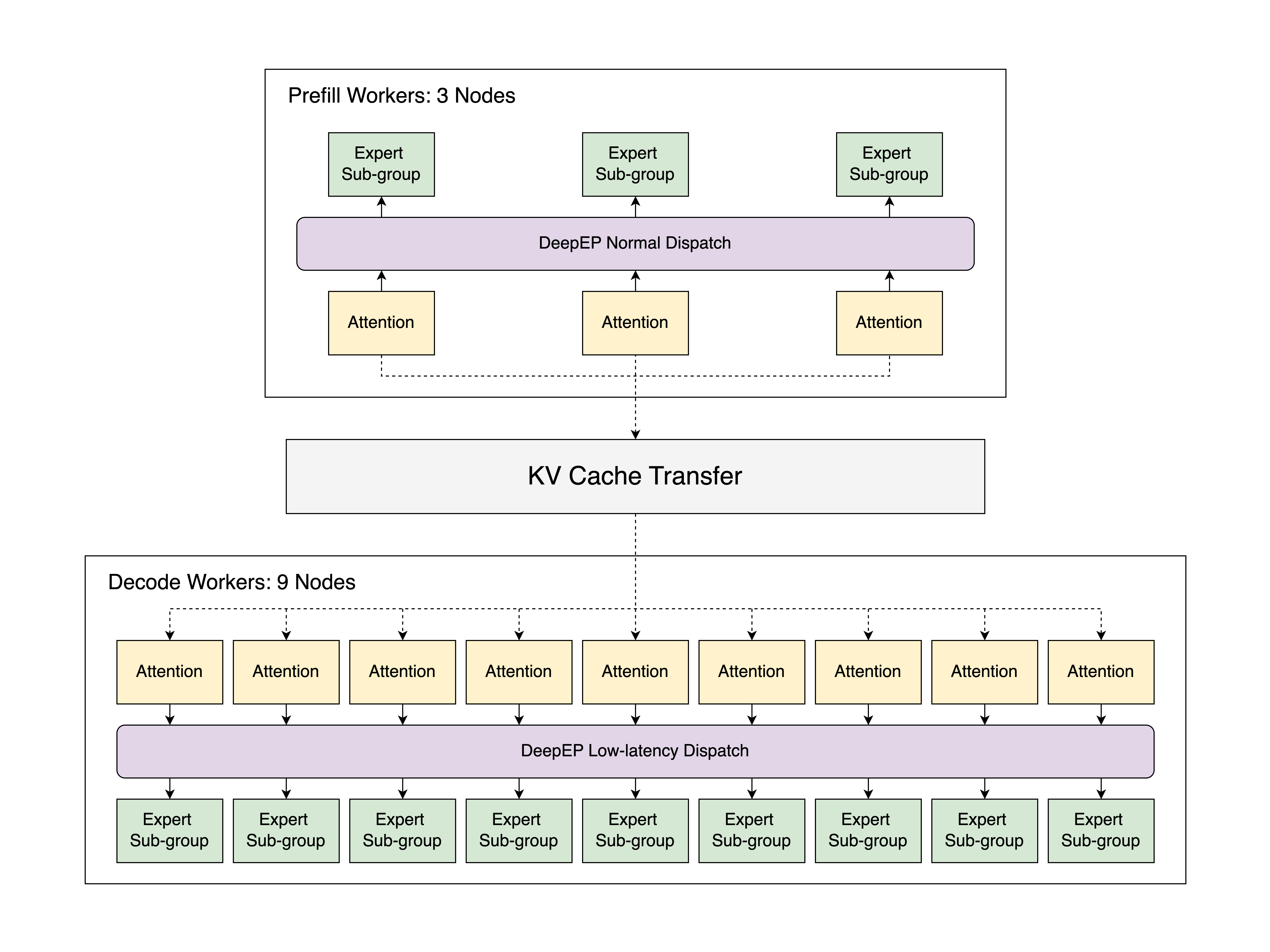
LMSYS physically and logically separated the prefill nodes from the decode nodes within the 96-GPU cluster. Prefill nodes—optimized for raw compute throughput—ingest incoming user prompts, compute massive matrix multiplications, and generate the initial Key-Value (KV) cache. Once this foundational computation is complete, the system offloads the KV cache via high-speed networking to the decode nodes.
Decode nodes are configured specifically for memory bandwidth efficiency. Unencumbered by heavy prompt ingestion tasks, these GPUs dedicate their high-bandwidth memory (HBM3) and tensor cores entirely to autoregressive token generation. This structural segregation eliminates resource contention, stabilizes tail latencies (P99), and maximizes the utilization rate of expensive silicon.
2. Large-Scale Expert Parallelism (EP)
DeepSeek’s expansive parameter footprint makes storing all expert weights on a single GPU impossible. LMSYS deployed large-scale Expert Parallelism, distributing individual expert networks across the 96 H100 nodes. When a token is routed to a specific expert, the system leverages high-throughput interconnects (such as NVLink and InfiniBand fabrics) to route activations efficiently.
Crucially, the engineering team optimized DRAM access breakdowns, minimizing the latency penalties historically associated with off-chip weight fetching. By keeping frequently accessed expert layers resident in fast memory tiers and overlapping communication with computation, the cluster maintains near-linear scaling efficiency even as concurrency spikes.
Verified Data & Metrics Breakdown
A comparative analysis of traditional monolithic serving versus the LMSYS disaggregated approach on 96 H100 GPUs illustrates the quantum leap in operational efficiency:
| Metric / Parameter | Traditional Monolithic Deployment | LMSYS PD Disaggregated + EP (96 H100s) | Operational Impact |
|---|---|---|---|
| Compute Utilization (MFU) | 35% - 45% (Severe interference) | 70% - 82% (Optimized pipelines) | Maximized silicon ROI |
| P99 Latency (Decode Phase) | High variance under heavy load (>120ms) | Stabilized and predictable (<45ms) | Meets strict enterprise SLAs |
| Throughput (Tokens / Sec / GPU) | Baseline | 2.4x to 3.1x increase | Lower cost per token served |
| DRAM Access Bottlenecks | Frequent memory stalls during MoE routing | Mitigated via pipelined weight pre-fetching | Eliminates hardware idle states |
Industry & Market Implications: Who Wins, Who Loses
The publication of this deployment methodology by LMSYS Org sends powerful shockwaves across the financial and technology sectors, directly altering capital allocation strategies and competitive positioning.
The Winners
- Enterprise IT & Mid-Sized Cloud Providers: Organizations previously priced out of frontier AI models can now deploy high-performance open-source architectures like DeepSeek on modest, highly optimized clusters (sub-100 GPUs) rather than procuring thousand-node supercomputers.
- Systems Engineering & Software Optimization Firms: The market valuation is shifting away from raw hardware acquisition toward proprietary orchestration software, inference engines, and memory management frameworks. Firms that master PD disaggregation command immense pricing power.
- Open-Source Ecosystem Advocates: Demonstrating that open-source models can match or exceed proprietary APIs in efficiency on commodity hyperscale footprints strengthens corporate risk mitigation and reduces vendor lock-in.
The Losers
- Hyperscale Monolithic Cloud Vendors: Cloud providers relying on bloated, unoptimized instance types that force customers into over-provisioned GPU allocations face margin compression as clients demand disaggregated, high-efficiency serving nodes.
- Inelastic Hardware Procurement Models: Procurement officers who previously solved latency issues simply by throwing more capital and hardware at a problem must now master sophisticated systems-level software tuning to remain competitive.
Frequently Asked Questions (People Also Ask)
Frequently Asked Questions
What is Prefill-Decode (PD) Disaggregation in LLM serving?
PD Disaggregation is an architectural technique that separates the initial prompt processing phase (prefill, which is compute-intensive) from the token generation phase (decode, which is memory-bandwidth-intensive) onto distinct, specialized groups of GPUs. This prevents resource contention, stabilizes latency, and maximizes hardware throughput.
Why is Expert Parallelism (EP) necessary for models like DeepSeek?
DeepSeek utilizes a Mixture-of-Experts (MoE) architecture containing hundreds of billions of total parameters, but activates only a fraction per token. Expert Parallelism distributes these individual expert sub-networks across multiple GPUs, allowing clusters to bypass single-device memory limits and process complex routing efficiently.
How does deploying on 96 H100 GPUs impact enterprise capital allocation?
By proving that frontier-grade open-source models can run efficiently on a sub-100 GPU footprint rather than sprawling multi-thousand GPU clusters, enterprises can significantly lower their capital expenditures (CapEx), accelerate deployment timelines, and achieve superior return on investment (ROI).
What role does LMSYS Org play in this infrastructure evolution?
LMSYS Org acts as a critical bridge between academic research and industrial execution. By releasing rigorous benchmark data, deployment playbooks, and architectural blueprints, they empower enterprise engineering teams to replicate high-performance AI serving in production environments.
Future Outlook: What Comes Next
As we look toward the second half of 2025 and beyond, the roadmap for AI infrastructure is converging around software-defined efficiency. The LMSYS deployment of DeepSeek on 96 H100 GPUs is not an isolated milestone; it represents the vanguard of a broader industry transition toward heterogeneous, disaggregated cluster management.
Key milestones to monitor include the integration of dynamic tensor routing algorithms, the maturation of automated PD partitioning tools within commercial orchestration platforms (such as Kubernetes and Ray), and the adaptation of these paradigms to upcoming generations of hardware accelerators featuring unified memory fabrics. For chief technology officers and financial analysts alike, the message is unequivocal: raw silicon acquisition is no longer the sole metric of AI capability. The future belongs to those who master the systems architecture that makes every single FLOOP count.