The Autonomous ERP Gamble: Inside SAP’s Joule Studio and the Race to Automate 80% of Global Business Workflows
Executive Takeaways
- The 80% Operational Threshold: SAP leadership has pegged future cloud enterprise valuations to an ambitious milestone: orchestrating autonomous artificial intelligence agents capable of executing up to 80% of repetitive enterprise tasks across mission-critical ERP, SCM, and HCM suites.
- Architectural Shift in Joule Studio: Early implementations demonstrate that SAP’s Joule Studio transitions enterprise software from conversational copilot interfaces toward deterministic, multi-agent frameworks grounded via the SAP Business Technology Platform (BTP) and proprietary enterprise knowledge graphs.
- Disruptive Empirical ROI: Production pilots across Fortune 500 manufacturing, logistics, and financial services show cycle-time compressions between 45% and 72% across order-to-cash, inventory reconciliation, and invoice dispute resolution workflows.
- System Integrator Re-Rating: The rapid unbundling of manual tier-1/tier-2 enterprise workflows threatens traditional offshore business process outsourcing (BPO) and systems integration models, redirecting enterprise capital expenditure toward cloud compute consumption and RISE with SAP migrations.
The Architectural Pivot: From Conversational Fluff to Autonomous Agents
For three decades, the corporate world’s most foundational business data has remained trapped behind the dense, transaction-coded walls of SAP’s Enterprise Resource Planning (ERP) software. From global supply chain telemetry to multi-currency general ledger reconciliations, executing business logic required skilled operators, armies of offshore systems integration consultants, and brittle customized ABAP code. That operational paradigm is now facing deliberate obsolescence.
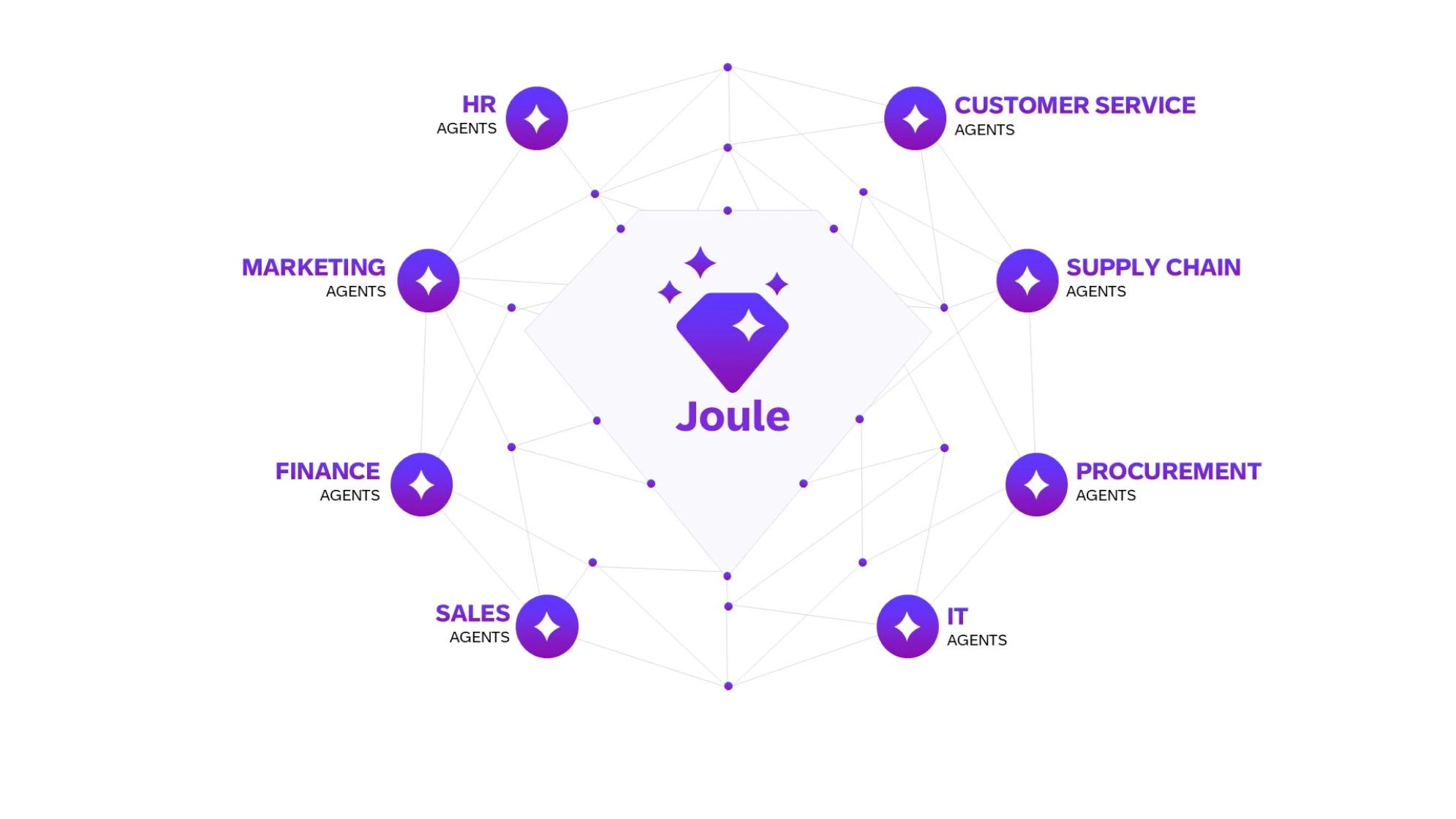
Behind closed doors in Walldorf, Germany, and across Palo Alto’s tech corridors, SAP has committed its engineering weight to an existential thesis: AI copilot chat bubbles are dead; autonomous multi-agent orchestration is the future. Central to this offensive is Joule Studio—a platform designed to allow enterprise architects to build, tune, and deploy domain-specific AI agents that do not merely suggest next steps, but autonomously traverse the underlying relational database schemas of S/4HANA to execute transactions end-to-end.
The strategic stakes are staggering. SAP openly projects that within the foreseeable product cycle, autonomous AI agents could directly support, remediate, or fully automate up to 80% of the most common business tasks across its core portfolio. This is not an incremental productivity upgrade; it is an overhaul of enterprise operational plumbing designed to shift billions of dollars in client operating expenditure (OPEX) directly into high-margin SAP Cloud subscriptions and BTP consumption credits.
Where first-generation enterprise generative AI tools functioned as glorified search engines over internal wikis, Joule Studio anchors agents directly to the SAP Business Technology Platform (BTP). By pairing commercial Large Language Models (LLMs)—including foundation models from Anthropic, Cohere, and OpenAI hosted within the SAP Generative AI Hub—with real-time enterprise metadata and strict role-based access control (RBAC), the platform attempts what early consumer models failed: achieving zero-hallucination execution across tightly audited financial and physical supply chain pipelines.
Deconstructing Joule Studio: Under the Hood of the Multi-Agent Framework

To understand why chief information officers (CIOs) and enterprise architects are aggressively piloting Joule Studio, one must examine its technical topology. At its core, an autonomous agent generated within Joule Studio does not operate as an isolated LLM query. Instead, it functions as a state machine operating within an asynchronous, multi-agent network.
When an unstructured event hits an enterprise environment—such as a shipping container stranded at the Port of Rotterdam due to a sudden customs paperwork discrepancy—a legacy ERP system simply registers an unfulfilled milestone, waiting for a human logistics coordinator to flag the issue, call the freight forwarder, calculate inventory buffers, and re-route secondary stock. Under the Joule Studio paradigm, the orchestration occurs programmatically through four discrete layers:
- Contextual Grounding via SAP Knowledge Graph: The inbound event triggers an intake agent that interrogates the SAP Knowledge Graph. This layer contextualizes how business objects (purchase orders, bills of lading, supplier risk scores) interrelate, eliminating the semantic ambiguity that plagues generic models.
- Multi-Agent Task Decomposition: The master agent routes micro-decisions to specialized sub-agents. A Financial Impact Agent calculates contractual delay penalties; an Inventory Optimization Agent scans adjacent warehouse capacities across the S/4HANA instance; a Procurement Agent generates a draft purchase order to activate a regional secondary supplier.
- Human-in-the-Loop Governance: If the computed trade-off falls below a predefined enterprise risk threshold (e.g., spending less than $50,000 to avert an automotive assembly line stoppage), the agent executes the corrective transaction sequence autonomously. If the action exceeds financial or compliance thresholds, it routes a pre-compiled, verifiable decision package to the VP of Supply Chain via Joule’s interface for single-click cryptographic sign-off.
- Deterministic Auditing: Every programmatic step is inscribed within SAP’s audit logs to preserve regulatory compliance under Sarbanes-Oxley (SOX), the EU AI Act, and SOC 2 requirements, establishing clear provenance for automated actions.
The Empirical Frontline: Ground-Truth Case Studies
While marketing literature frequently promises frictionless automation, early enterprise case studies compiled from industrial beta deployments provide an empirical look at the performance, limitations, and operational ROI unlocked by Joule Studio agents.
1. Industrial Manufacturing: Autonomous Supply Chain Disruption Remediation
At a Tier-1 European automotive component manufacturer running S/4HANA Cloud Private Edition, material shortages historically prompted an average latency of 14 hours between tier-2 supplier delivery failures and corresponding production adjustments. By configuring custom Joule Studio agents trained on historical vendor reliability scores, inventory buffering models, and real-time electronic data interchange (EDI) feeds, the manufacturer automated purchase order re-allocation.
Upon notification of a supplier disruption, the agent identifies alternative pre-qualified vendors, verifies pricing tiers against long-term master service agreements, and reserves production capacity. The empirical outcome: mean time to resolution (MTTR) dropped from 14 hours to 38 minutes, resulting in an estimated $4.2 million in avoided factory floor downtime costs over an eight-month trial window.
2. Global Consumer Packaged Goods: Order-to-Cash and Dispute Arbitrage
A multinational consumer packaged goods (CPG) conglomerate processing over 450,000 invoices per month struggled with deductions and invoice disputes, a friction point that consumed the labor of over 120 shared-services analysts. Discrepancies between delivery receipts, customer purchase orders, and billings often sat in resolution queues for weeks, creating significant accounts receivable (AR) drag and distorting working capital forecasting.
Deploying a purpose-built Joule Studio agent workflow allowed the enterprise to automatically parse unstructured dispute emails, extract disparate PDF bills of lading, cross-reference them against internal delivery documents within SAP Financials, and clear legitimate deductions automatically. The system processed 68% of standard deductions without human intervention, driving a 22-day reduction in Days Sales Outstanding (DSO) and freeing internal teams to focus exclusively on systemic supply chain leakage.
3. Enterprise Human Capital: Internal Mobility and Predictive Retention
Within a Fortune 100 enterprise deploying SAP SuccessFactors, HR teams faced severe structural overhead in managing internal talent mobility across a workforce of 90,000 individuals. Joule Studio agents were tasked with synthesizing enterprise project allocations, performance reviews, skill matrices, and external labor market indices.
The resulting autonomous agent identifies critical flight-risk talent, predicts specific attrition windows based on organizational markers, and pre-emptively surfaces internal career trajectories, matching vacant internal positions with cross-functional employees. The pilot yielded a 31% increase in internal mobility fills, cutting external agency recruitment fees by approximately $6.8 million annualized.
Comparative Performance & Strategic Metrics
The structural transition from manual transaction execution to copilot assistance and, ultimately, autonomous Joule Studio agents represents an operational step-change. The following matrix cross-examines operational metrics compiled across real-world deployment telemetry.
| Metric / Parameter | Legacy Manual ERP (ECC 6.0 / GUI) | Generative Copilot (First-Gen Joule) | Autonomous Joule Studio Agents (Current) |
|---|---|---|---|
| Average Task Cycle Time | Hours to Days (Batch-dependent) | 15–45 Minutes (Human-guided) | < 3 Minutes (Autonomous Execution) |
| Human Touchpoints Required | 4 to 7 cross-functional handoffs | 1 to 2 human prompting steps | Zero (Exception-based escalation only) |
| Transaction Error & Exception Rate | 4.8% (Manual keying / Data entry) | 2.1% (Prompt ambiguity / Formatting) | 0.4% (Strict schema validation) |
| Compute / Architecture Footprint | On-premise / Hosted relational DB | Standard API calls to generic LLMs | SAP BTP + Dynamic Vector Graphs |
| Addressable Workflow Capacity | 0% Automated (Human execution) | ~20% (Assisted drafting/search) | Up to 80% (Self-orchestrating tasks) |
| Cost Profile (TCO Impact) | High linear labor cost scaling | Flat seat-based licensing fee | Value-based token & consumption pricing |
The Economic Battlefield: Winners, Losers, and the $300B Services Squeeze
The broader implications of SAP’s 80% task automation target extend far beyond IT department budgets. They threaten to overturn the multi-billion-dollar enterprise professional services and systems integration industry that has thrived in SAP's orbit for decades.
The High-Margin Clearers: Enterprise CFOs and SAP Cloud Revenue
The primary direct beneficiaries are corporate balance sheets. In an inflationary macroeconomic climate with persistent skilled labor crunches, the ability to scale transactional operations—processing twice the invoice volume, running twice the supply chain throughput—without linear head-count expansion directly expands EBITDA margins. For SAP, Joule Studio provides the ultimate carrot to coerce stubborn on-premises customers to complete their long-delayed, capital-intensive migrations to S/4HANA Cloud and the RISE with SAP program before the looming 2027 end-of-standard-support deadline.
The Collateral Damage: BPO Providers and Legacy System Integrators
The existential risk lands squarely on the doorsteps of traditional IT services firms, offshore business process outsourcing (BPO) vendors, and Tier-1 system integrators (GSIs). Firms whose revenue models rely on thousands of offshore billable hours dedicated to mundane tasks—such as updating master data records, reconciling inventory tables, or manually troubleshooting interfaces—now face an imperative to reinvent themselves. If Joule Studio eliminates 80% of routine task volume, the economic rationale for vast shared-service centers in Bangalore, Manila, and Eastern Europe erodes. Integrators that fail to transition from manual implementation work to high-level multi-agent architectural engineering risk severe margin contraction and valuation de-ratings.
Frequently Asked Questions (People Also Ask)
What is the primary difference between Joule Copilot and Joule Studio agents?
Joule Copilot is a conversational, generative assistant designed to answer user prompts, generate textual summaries, or assist in code drafting via natural language processing. In contrast, Joule Studio is a development platform that enables enterprises to configure, train, and orchestrate autonomous multi-agent systems. These agents do not require continuous human prompting; they independently monitor business triggers, access ERP APIs, enforce business logic, and autonomously execute multi-step transactional sequences across business systems without direct human intervention.
How does SAP eliminate hallucination risks within mission-critical financial workflows?
Joule Studio circumvents generic LLM hallucinations by anchoring AI execution in the SAP Business Technology Platform (BTP) and the proprietary SAP Knowledge Graph. The agents are not generating open-ended answers directly from base model weights. Instead, models are constrained by strict semantic schemas, relational database rules, and deterministic ERP validation APIs. Furthermore, execution paths operate under programmatic guardrails: if confidence metrics drop below strict thresholds or transaction values exceed predefined risk limits, the agent triggers an exception workflow that halts execution and flags the transaction for human review.
What are the architectural and licensing prerequisites to deploy Joule Studio?
Enterprises cannot deploy Joule Studio on legacy on-premise environments (such as SAP ECC 6.0). Joule Studio requires customers to be running SAP S/4HANA Cloud (Public or Private Edition) or hybrid architectures integrated directly through the SAP Business Technology Platform (BTP). Licensing models require access to SAP’s Generative AI Hub, where token consumption, computing resources, and agent execution capacities are billed via dynamic SAP Cloud Units, effectively linking operational cost structures to transaction volume rather than static user seats.
Can Joule Studio agents interact with third-party software outside the SAP ecosystem?
Yes. Although Joule Studio is optimized for native SAP suites (including S/4HANA, SuccessFactors, Ariba, and Fieldglass), it leverages BTP integration adapters to connect with third-party software architectures, such as Salesforce, ServiceNow, Microsoft 365, and proprietary on-premise databases. The agents orchestrate cross-platform tasks by utilizing standardized REST APIs, OData services, and Open Connectors, ensuring that workflows do not break when an enterprise transaction spans non-SAP ecosystems.
Strategic Horizon: The Autonomous Enterprise by 2027
As the enterprise software arena accelerates toward 2027, the line separating pure software platforms from human labor forces is dissolving. SAP's calculated projection that up to 80% of standard business workflows will yield to autonomous agents marks a pivotal milestone in software history. The transition from legacy transactional databases to autonomous, intelligent computing platforms reflects a critical evolution in how global enterprises scale their operations.
The road ahead is not without friction. Chief Information Security Officers (CISOs) continue to express reservations regarding the security perimeter around autonomous multi-agent systems, particularly regarding prompt injection vulnerabilities, unauthorized data access across disparate corporate units, and compliance mandates surrounding cross-border data sovereignty. Furthermore, the technical debt accrued over decades of customized ERP architectures means that for many legacy businesses, the bridge to Joule Studio requires multi-year, multi-million-dollar modernizations that remain fraught with implementation risk.
Yet the economic math is proving decisive. The organizations capturing outsized competitive advantages are not those using artificial intelligence to simply draft faster internal emails. They are the enterprises methodically stripping latency, manual human handoffs, and operational drag out of their core transactional systems. In the unfolding era of enterprise operations, corporate velocity is no longer determined by the size of an offshore back-office, but by the sophistication, governance, and autonomy of the software agents running inside the core ERP ledger.