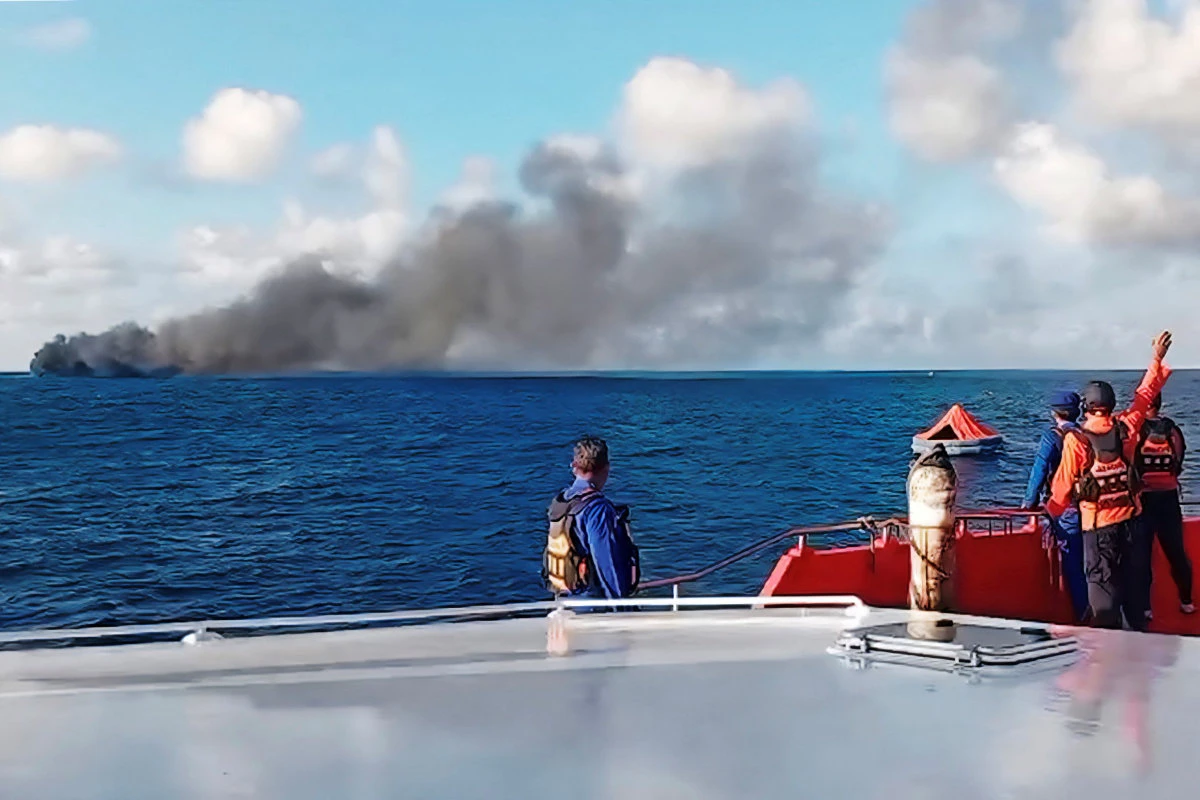
Desperate Search Underway in Indonesian Waters as Passenger Vessel Carrying Over 240 Vanishes
JAKARTA — Indonesian maritime authorities and naval forces have launched an expansive, high-stakes search-and-rescue operation across treacherous open waters after a passenger vessel carrying at least 240 people abruptly severed communications and failed to arrive at its scheduled destination, officials confirmed early today.
The sudden disappearance has triggered an emergency mobilization by Indonesia’s National Search and Rescue Agency (Basarnas), the Indonesian Navy (TNI AL), and local maritime police. Specialized deep-sea cutters, patrol aircraft, and rigid-inflatable boats have been scrambled to the vessel’s projected route, racing against worsening weather conditions and nightfall to locate the missing ship and potential survivors.
Executive Briefing: What We Know Right Now
- Disappearance: An inter-island passenger vessel carrying at least 240 passengers and crew lost all radio, transponder, and satellite contact mid-voyage.
- Emergency Mobilization: Basarnas deployed multi-tier search squads, supported by Indonesian Navy frigates, regional coastal patrol cutters, and local commercial flotillas.
- Environmental Hazards: Search teams in the operational quadrant report squalls, high swell waves reaching up to 3 meters, and poor visibility, severely impeding surface reconnaissance.
- Regulatory Scrutiny: The incident re-ignites immediate safety concerns over archipelagic transport oversight, vessel maintenance routines, and the persistent hazard of passenger manifest discrepancies in Southeast Asia's largest marine corridor.
The Disappearance: A Critical Mid-Sea Blackout

According to regional maritime tracking stations, the vessel was traversing its scheduled inter-island transit when automated identification transponders went dark without transmitting an automated distress signal or classic SOS call. Coastal stations attempted to hail the bridge via high-frequency VHF radio networks, but received static.
"We have deployed multiple search-and-rescue teams toward the last reported coordinates where contact dropped," a senior Basarnas operational commander said in an official briefing. "Our utmost priority is surface reconnaissance within the estimated drift perimeter. We are battling high sea swells and localized rain squalls, but deployment remains fully active around the clock."
Hundreds of frantic family members have converged on the departure and destination harbors, seeking manifests and official updates. Local port authorities caution that manifests on regional crossings often fluctuate, meaning the actual count of souls aboard could exceed initial baseline estimates—a recurring challenge during marine emergencies across developing maritime hubs.
Verified Operational Snapshot
| Parameter | Operational Status / Detail |
|---|---|
| Vessel Type | Inter-Island Domestic Passenger Ship |
| Souls Onboard | At least 240 (confirmed passengers & crew; audit underway) |
| Incident Type | Sudden Loss of Radio/Transponder Contact; Suspected Distress |
| Primary Responders | Basarnas, Indonesian Navy (TNI AL), Water Police, Local Fishermen |
| Prevailing Weather | Monsoonal squalls, 2.0 to 3.0-meter swell waves, variable visibility |
The Perils of the World’s Largest Archipelago
With more than 17,000 islands spanning three time zones, Indonesia relies on marine transport as the foundational bloodstream of its domestic trade and citizen mobility. Ferries and mid-sized motor vessels move millions of commuters, goods, and vehicles each week across complex straits and wide open seas.
However, safety enforcement across this sprawling aquatic network remains an uphill battle for regulators. Despite tightened oversight following high-profile disasters over the past decade, maritime infrastructure continues to face systemic vulnerabilities. Aging hulls, deferred engine maintenance, erratic equatorial weather fronts, and the frequent overloading of rural commuter vessels present perpetual operational risks.
Market observers and risk consultants note that marine incidents of this magnitude carry economic ramifications for regional supply chains. Disruptions along vital archipelago transit lanes throttle regional commerce, strand critical freight, and routinely trigger abrupt regulatory standstills while fleets undergo emergency seaworthiness inspections.
Rescue Obstacles: Drift Windows and Weather Deterioration
Oceanographers and maritime search strategists emphasize that the first 24 to 48 hours following a vessel’s disappearance are definitive. Oceanic currents in Indonesian straits are notoriously rapid and unpredictable, capable of sweeping floating debris or life rafts dozens of nautical miles away from the initial datum point in mere hours.
"When a vessel goes missing without a verified distress broadcast, rescue coordinators must reconstruct the drift model using wind vector algorithms, tidal patterns, and underwater bathymetry," said a maritime safety analyst based in Singapore. "If mechanical propulsion failed before a sudden electrical shutdown, the vessel could be drifting dead-in-the-water outside standard shipping channels."
Military reconnaissance aircraft equipped with forward-looking infrared (FLIR) sensors have been requested to sweep the search grid from above, while naval patrol vessels scan surface horizons for distress flares or emergency position-indicating radio beacons (EPIRBs).
Outlook and Institutional Accountability
Indonesia’s Ministry of Transportation confirmed that an emergency investigative committee has been formed in parallel with the ongoing search. Port clearance documentation, vessel inspection logs, and bridge certifications are currently being impounded for administrative review.
As daylight shifts across the search sector, rescue crews face mounting pressure. The coming hours will prove critical as naval assets and civilian vessels converge on the expanded search grid, determined to pierce through hostile waters and deliver definitive answers for the families of the 240 people unaccounted for.
Frequently Asked Questions
What could cause a modern passenger ship to lose contact without a distress call?
Catastrophic electrical failure, sudden flooding that compromises communication equipment before bridge crew can transmit, rapid capsizing triggered by rogue waves or shifting cargo, or fire disabling the vessel's primary and auxiliary power plants can all cause immediate operational blackouts.
Why are maritime search-and-rescue operations particularly difficult in Indonesia?
Indonesia's maritime territory is vast and geographically fractured. High-velocity strait currents rapidly widen the possible drift area, while tropical weather systems generate localized convective storms that severely limit radar efficacy and airborne visibility for rescue units.