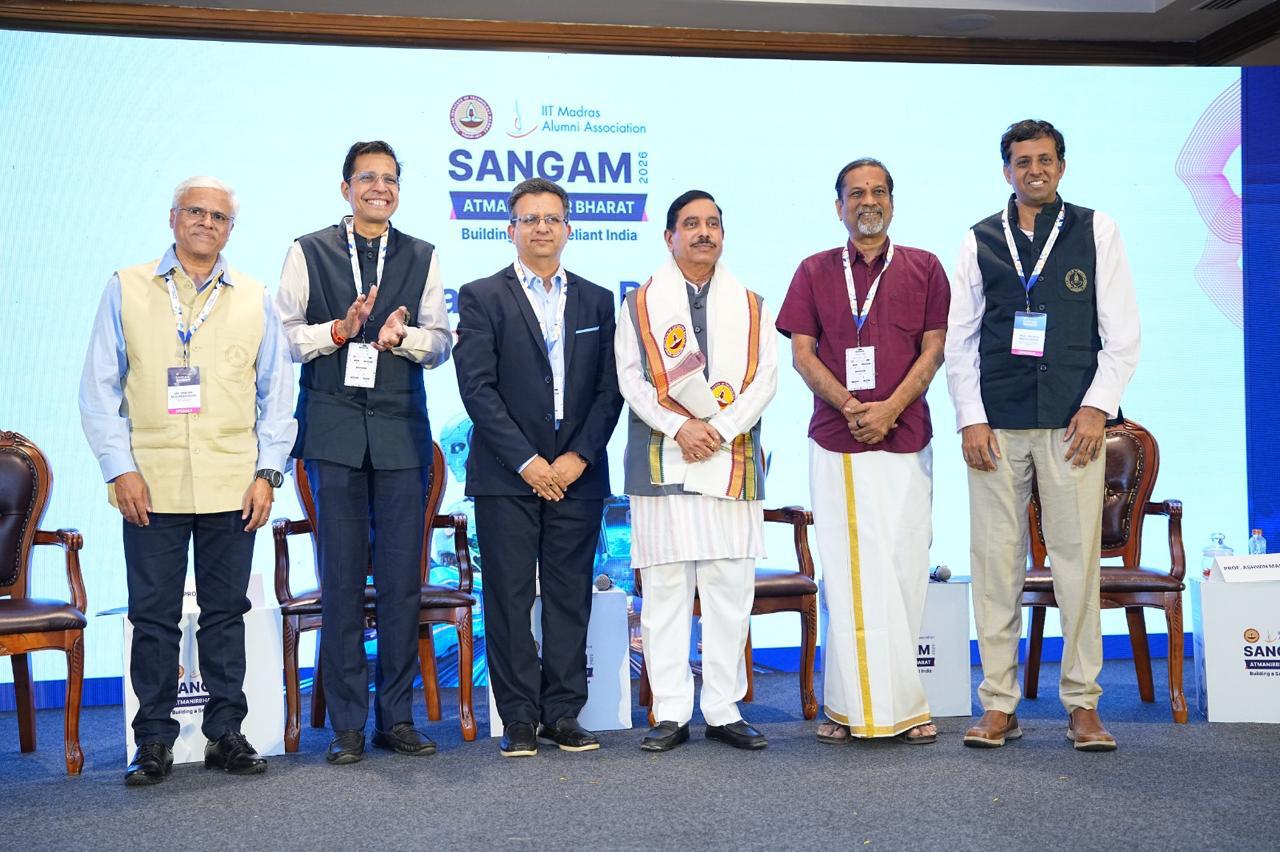
BENGALURU & NEW DELHI — As global supply chains fracture and geopolitical lines harden around advanced computing, India is making a definitive play for technological independence. At the epicenter of this push is the IIT Madras Alumni Association (IITMAA) Sangam 2026, a high-stakes summit drawing the country’s top policymakers, venture capitalists, and deep-tech pioneers to chart a roadmap for indigenous dominance in Artificial Intelligence, semiconductors, and next-generation engineering.
Held against the backdrop of India's rapid ascent as the world’s third-largest startup ecosystem, the flagship event—spearheaded by IITMAA President Mr. Sridhar Boovaraghavan—has shifted the narrative from mere software services to hardware sovereignty. With billions of dollars in government incentives now backing domestic semiconductor fabs and design centers, Sangam 2026 served as the operational launchpad for commercializing breakthroughs born inside premier research labs.
The New Trinity: AI, Semiconductors, and Deep Tech
For decades, India’s economic narrative was dominated by IT services and offshore software development. However, the discussions at IITMAA Sangam 2026 signaled a structural pivot. Speakers underscored that future economic security hinges on the "New Trinity" of foundational AI models, silicon fabrication, and hard-science deep tech.
Mr. Sridhar Boovaraghavan, addressing an audience of elite founders and industry titans, emphasized that India can no longer afford to be a mere consumer of frontier technologies. "The window for self-reliance is open now. Sangam 2026 is not just a networking forum; it is a mobilization of the global IIT diaspora to build the critical infrastructure of tomorrow—from homegrown silicon to sovereign large language models," Boovaraghavan noted during his opening keynote.
The summit focused heavily on bridging the notorious "valley of death" between academic research and commercial manufacturing. Historically, brilliant intellectual property generated within the Indian Institutes of Technology (IITs) struggled to find domestic venture capital willing to weather the long gestation periods required for deep-tech hardware.
Key Pillars of the Sangam 2026 Roadmap
- Silicon Independence: Accelerating domestic analog and digital chip design to feed upcoming semiconductor fabrication plants in Gujarat and Assam.
- Sovereign AI Infrastructure: Deploying localized computing clusters to train Indic-language models tailored to governance, healthcare, and agriculture.
- Venture Deep-Tech Synergy: Unlocking a targeted capital pool from the global IIT alumni network to fund high-risk, high-reward hardware startups.
- Strategic Defense Integration: Aligning dual-use deep tech innovations with India's defense modernization and Atmanirbhar Bharat (self-reliant India) mandates.
At a Glance: IITMAA Sangam 2026 Core Metrics

| Focus Area | Primary Objective | Strategic Impact |
|---|---|---|
| Semiconductors | Domestic chip design & fab integration | Securing hardware supply chains against geopolitical shocks |
| Artificial Intelligence | Sovereign Indic models & local compute | Data sovereignty and localized automation |
| Deep Tech Venture | Bridging lab research to market commercialization | Reducing import reliance on critical industrial machinery |
Overcoming the Capital and Manufacturing Chasm
Despite bold policy initiatives like the $10 billion Semicon India program, domestic stakeholders at Sangam 2026 admitted that execution hurdles remain steep. Building an advanced semiconductor ecosystem requires a complex symphony of ultra-pure chemicals, specialized gases, precision optical equipment, and an army of highly skilled material scientists.
Panelists during the semiconductor track highlighted that while India has captured a significant share of global chip *design* talent, capturing physical manufacturing remains an uphill battle. The discussions at Sangam 2026 aimed to solve this by creating localized consortia where IIT-incubated startups can plug directly into multinational supply chains.
Furthermore, venture capitalists at the summit pointed out that the risk appetite among domestic institutional investors is maturing. Rather than chasing consumer-internet cash-burn models, capital is rapidly migrating toward enterprise SaaS, quantum computing, photonics, and autonomous systems.
Outlook: Building the Next Silicon Valley
As the curtains drew on IITMAA Sangam 2026, the consensus among policymakers and industry leaders was clear: India’s ambition to become a $5 trillion economy is inextricably linked to its ability to innovate at the hardware and foundational software levels.
By leveraging the immense global clout of the IIT alumni network—a diaspora that commands leadership positions across Silicon Valley, Wall Street, and global research institutions—India is uniquely positioned to reverse-engineer the traditional path of technological development. If initiatives like Sangam successfully translate high-level strategy into factory floors and commercial deployment, India will no longer just participate in the global tech economy—it will write the rules for it.
Frequently Asked Questions
1. What is the primary objective of IITMAA Sangam 2026?
IITMAA Sangam 2026 aims to accelerate India's technological self-reliance by aligning government policy, industry leaders, and the global IIT diaspora around three critical pillars: Artificial Intelligence, semiconductor manufacturing, and deep-tech commercialization.
2. Who leads the IIT Madras Alumni Association (IITMAA) initiatives?
The initiatives are spearheaded by Mr. Sridhar Boovaraghavan, President of IITMAA, who has emphasized mobilizing alumni capital and expertise to bridge the gap between academic research and industrial manufacturing in India.