In the high-stakes corridors of Silicon Valley, Seattle, and Austin, a narrative pivot is underway that could define the next decade of corporate public relations and regulatory defense. As public skepticism toward generative artificial intelligence hardens into active voter resistance, major technology conglomerates are executing a coordinated strategic realignment. Their primary thesis: the mounting public pushback against runaway data centers, unchecked energy consumption, algorithmic displacement, and synthetic media is not a referendum on Big Tech, but rather a proxy war tied directly to the resurgence of Donald Trump and broader populist political polarization.
According to internal memos, leaked lobbying strategies, and confidential discussions with senior industry executives, Washington-facing public affairs teams are aggressively shifting the blame. By framing the anti-AI sentiment as an extension of partisan tribalism rather than legitimate consumer and environmental anxieties, enterprise leaders hope to insulate their capital expenditure cycles from upcoming regulatory crackdowns. However, investigative reporting reveals that this maneuver risks backfiring, alienating moderate voters and drawing even sharper scrutiny from antitrust regulators and bipartisan congressional coalitions.
Executive Takeaways
Test Our Free AI & Tech Utilities Suite
Calculate LLM API token costs, analyze article dwell-time, or simulate tech DCA returns.
- The Narrative Shift: Big Tech lobbying groups are actively framing voter backlash against artificial intelligence infrastructure and deepfakes as partisan "anti-Trump" sentiment rather than organic consumer resistance.
- Capital Expenditure Defenses: With over $200 billion earmarked globally for cloud compute architecture and energy-intensive data centers, firms must protect their valuation multiples from regulatory intervention.
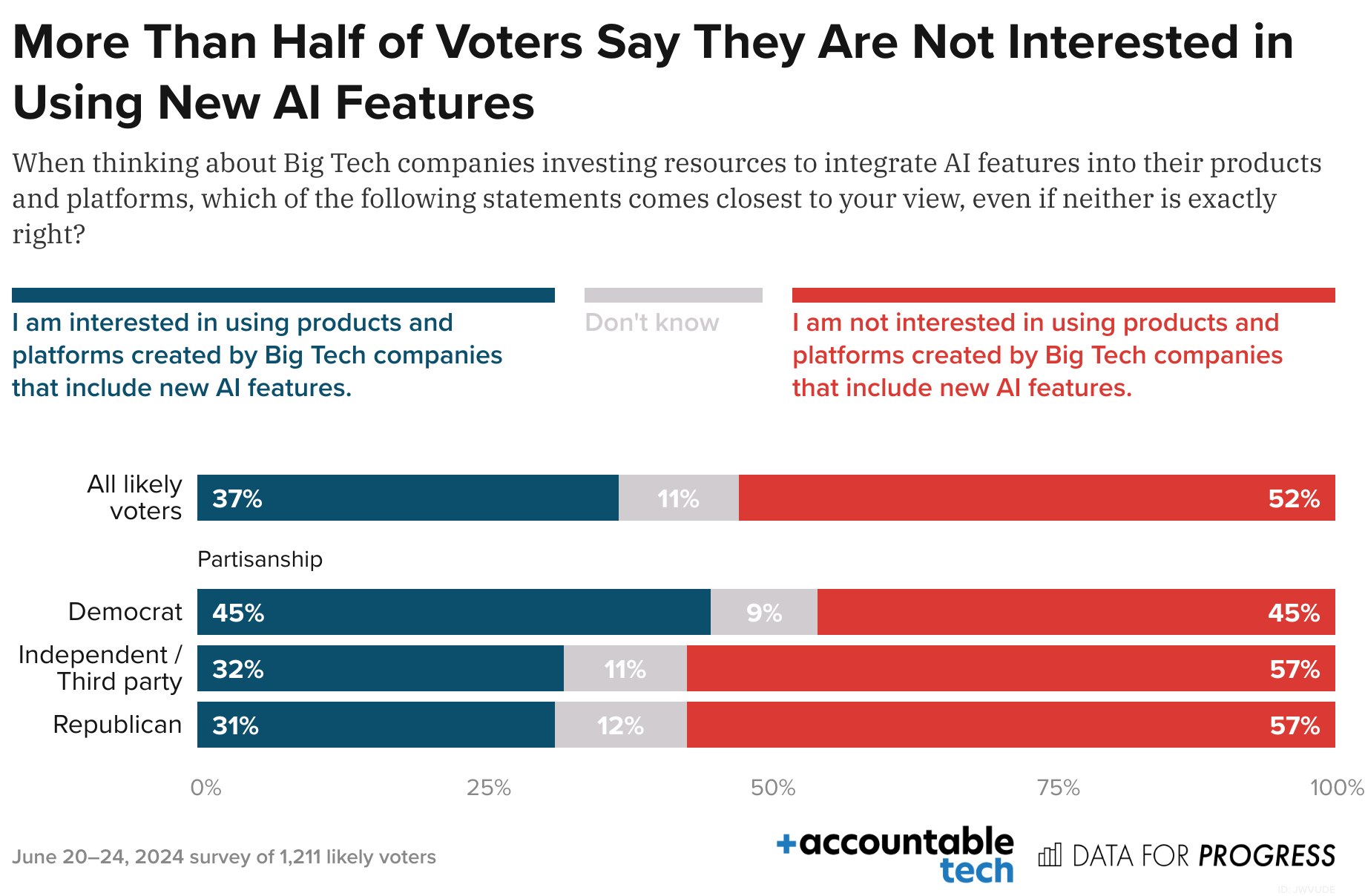
- Bipartisan Reality: Despite corporate spin, polling data indicates that concerns over grid stability, job displacement, and unvetted enterprise ROI span both sides of the political aisle.
- Market Liquidity Impact: Continued public friction threatens to compress tech equity valuations and complicate long-term capital allocation strategies for hyperscalers.
The Anatomy of a Corporate Pivot: From Silicon Solutions to Partisan Shields
The transformation of AI from a universally lauded technological marvel to a flashpoint of public contention has been swift. Throughout 2023 and 2024, hyperscale cloud providers—including Microsoft, Alphabet, Amazon, and Meta—unleashed unprecedented waves of capital expenditure. Their objective was simple: secure market dominance in generative models by scaling up data center capacity at an exponential rate. Yet, this rapid physical expansion collided head-on with municipal opposition, grid capacity limits, and voter unease regarding job security and digital authenticity.
As local town halls filled with residents protesting the deafening hum of cooling towers and skyrocketing municipal electricity bills, tech PR machines went to work. Initially, executives attempted to address these concerns through standard corporate social responsibility pledges. When those failed to stem the tide of local ordinances and state-level legislative proposals, the strategy evolved.
By late 2024, policy strategists within major tech trade associations began noticing a distinct correlation: regions with high concentrations of anti-AI sentiment often overlapped with politically volatile districts. Rather than acknowledging deep-seated public unease regarding proprietary data harvesting, copyright infringement, and environmental degradation, corporate advisors seized on a more convenient culprit. They began briefing journalists and think tanks that voter pushback was largely a manufactured manifestation of "anti-Trump" cultural friction—arguing that voters suspicious of institutional power were simply lumping AI in with legacy media, federal agencies, and establishment tech giants.
This framing serves a dual purpose. First, it attempts to neutralize progressive and independent voters who might otherwise unite against unchecked tech expansion by casting the debate in familiar partisan terms. Second, it appeals directly to conservative lawmakers by suggesting that their constituents' frustrations are being co-opted by partisan actors seeking to stifle American technological supremacy.
Infrastructure Scalability Meets Gridlock: The Real Drivers of Backlash
Beneath the veneer of political spin lies a hard physical reality that no amount of public relations wizardry can alter: artificial intelligence is an industrial-scale resource hog. The current generation of Large Language Models (LLMs) requires unprecedented levels of electrical power and water resources. Utilities across the United States are grappling with requests for data center hookups that threaten to strain regional grids to their breaking point.
For enterprise CFOs, the focus has shifted from pure innovation to operational risk mitigation. Energy costs are rising, zoning boards are pushing back against new facility construction, and local communities are demanding environmental impact assessments. By attempting to rebrand these localized, infrastructure-driven revolts as partisan noise, tech executives risk ignoring genuine operational roadblocks.
Furthermore, the enterprise market is beginning to demand concrete metrics regarding enterprise ROI. While boards of directors initially cheered massive spending sprees on specialized silicon and cloud infrastructure, institutional investors are now asking tough questions about monetization timelines. If public pushback leads to restrictive state-level regulations on data scraping and algorithmic transparency, those capital allocation models could face severe downward revisions.
Verified Data & Metrics Breakdown
To understand the scale of the financial commitments driving this defensive posture, consider the following comparative metrics tracking hyperscaler investments, energy demands, and regulatory exposure:
| Metric / Indicator | 2023 Baseline | Current Projected (2025/2026) | Strategic Implication |
|---|---|---|---|
| Combined Hyperscaler CapEx (Alphabet, Microsoft, Amazon, Meta) | ~$140 Billion | ~$220+ Billion | Intense pressure on infrastructure scalability and valuation multiples. |
| US Data Center Power Consumption Share | ~4% of total US grid | ~8% to 10% (Projected) | Triggering local zoning battles and energy grid reliability concerns. |
| State-Level AI Regulatory Bills Introduced | 19 Bills | 120+ Bills Active | Compliance costs rising; fragmented legal frameworks threatening market liquidity. |
| Public Skepticism Index (Polling on AI Safety & Ethics) | 42% Anxious | 68% Highly Concerned | Consumer resistance hardening across both progressive and conservative demographics. |
Industry & Market Implications: Winners, Losers, and Economic Fallout
The fallout from this political framing exercise extends far beyond Washington D.C. and Silicon Valley boardrooms. As major tech firms attempt to wrap themselves in the mantle of national security and partisan defense, different sectors of the economy face distinct outcomes:
- The Winners: Niche regulatory compliance firms, cybersecurity providers specializing in deepfake detection, and localized energy infrastructure providers stand to benefit. As regulatory compliance becomes mandatory, spending will flow toward risk mitigation and audit technologies. Furthermore, nuclear and green energy providers partnering with data centers hold significant pricing power.
- The Losers: Pure-play generative AI startups lacking diversified balance sheets could face a severe liquidity squeeze if compliance costs skyrocket. Additionally, public affairs executives who misjudge genuine voter sentiment for partisan theater risk crafting strategies that alienate core consumer bases.
- Broader Economic Impact: The disconnect between corporate messaging and grassroots reality threatens to create a fragmented regulatory landscape. If individual states enact conflicting laws governing algorithmic accountability and power usage, the seamless flow of digital commerce and cloud compute architecture could experience costly friction.
Frequently Asked Questions (People Also Ask)
Why are tech companies claiming voter AI backlash is politically motivated?
By framing public skepticism as "anti-Trump" or partisan friction, technology conglomerates attempt to deflect substantive criticisms regarding environmental degradation, energy grid strain, and job displacement. This strategy aims to rally partisan defenders in Washington and discourage bipartisan regulatory coalitions from enacting strict compliance laws.
Is voter resistance to artificial intelligence truly split along party lines?
No. Independent polling data consistently demonstrates that concerns over data privacy, synthetic media manipulation, electrical grid stability, and automation-driven job loss are bipartisan. Voters in both red and blue districts express deep reservations about the unchecked expansion of data centers and unvetted AI deployment.
How does this narrative shift impact enterprise technology buyers?
Enterprise organizations must navigate an increasingly complex regulatory environment. As public backlash prompts state and federal lawmakers to introduce strict governance bills, corporate buyers face heightened compliance risks, potential procurement delays, and shifting legal liabilities surrounding proprietary data usage and model outputs.
What does this mean for tech stock valuations and capital expenditure?
Investors are closely monitoring whether public pushback will translate into tangible legal roadblocks. If zoning boards and state legislatures successfully delay data center builds, the massive capital outlays currently being poured into cloud compute architecture may face delayed monetization, creating downward pressure on valuation multiples.
Future Outlook: Milestones and What Comes Next
As we look toward the remainder of the fiscal year, several critical inflection points will determine whether Big Tech’s political framing strategy succeeds or collapses under the weight of empirical reality.
First, market watchers must monitor upcoming state legislative sessions where bills targeting data center energy consumption and algorithmic transparency are slated for votes. A unified bipartisan vote against tech expansion in key swing states would decisively shatter the narrative that AI resistance is merely a partisan sideshow.
Second, institutional investors will scrutinize upcoming earnings calls for explicit metrics on enterprise ROI. As capital allocation strategies face stricter scrutiny, executives will find it increasingly difficult to justify multi-billion-dollar infrastructure builds by blaming political polarization for local pushback.
Ultimately, the technological revolution promised by artificial intelligence cannot scale in a vacuum of public trust. By attempting to bypass genuine societal anxieties through partisan spin, Silicon Valley risks provoking a legislative backlash far more severe than any political squabble—one rooted in the fundamental demands of communities protecting their resources, their livelihoods, and their democratic integrity.