The $1.5 Trillion Actuarial Squeeze: How Social Security’s Latest COLA Expansion Accelerates the 2033 Insolvency Cliff
Executive Takeaways
- Accelerated Depletion Horizon: The latest Cost-of-Living Adjustment (COLA), while expanding absolute nominal monthly distributions to over 72 million Americans, further strains the Old-Age and Survivors Insurance (OASI) Trust Fund, moving the terminal cash depletion window closer to the 2033–2034 inflection point.
- The Structural Mismatch: Calculation reliance on the Consumer Price Index for Urban Wage Earners and Clerical Workers (CPI-W)—rather than an elderly-weighted index (CPI-E)—continues to misalign real retiree expenditure inflation (notably healthcare and shelter) with statutory revenue replenishment rates.
- Imminent Benefit Cliffs: Under current statutory provisions without Congressional intervention, the depletion of accumulated asset reserves will trigger an automatic, across-the-board benefit cut of approximately 17% to 21%, forcing systemic shifts in private wealth management, dynamic capital allocation, and fixed-income portfolio construction.
- Fiscal Policy Gridlock: Bipartisan inertia deepens the gap between revenue generation (statutory payroll taxes capped at income limits) and compounding program liabilities, pressuring the Treasury market with long-term sovereign issuance and rollover risks.
The Actuarial Crossfire: Relief for Beneficiaries, Headwinds for Solvency
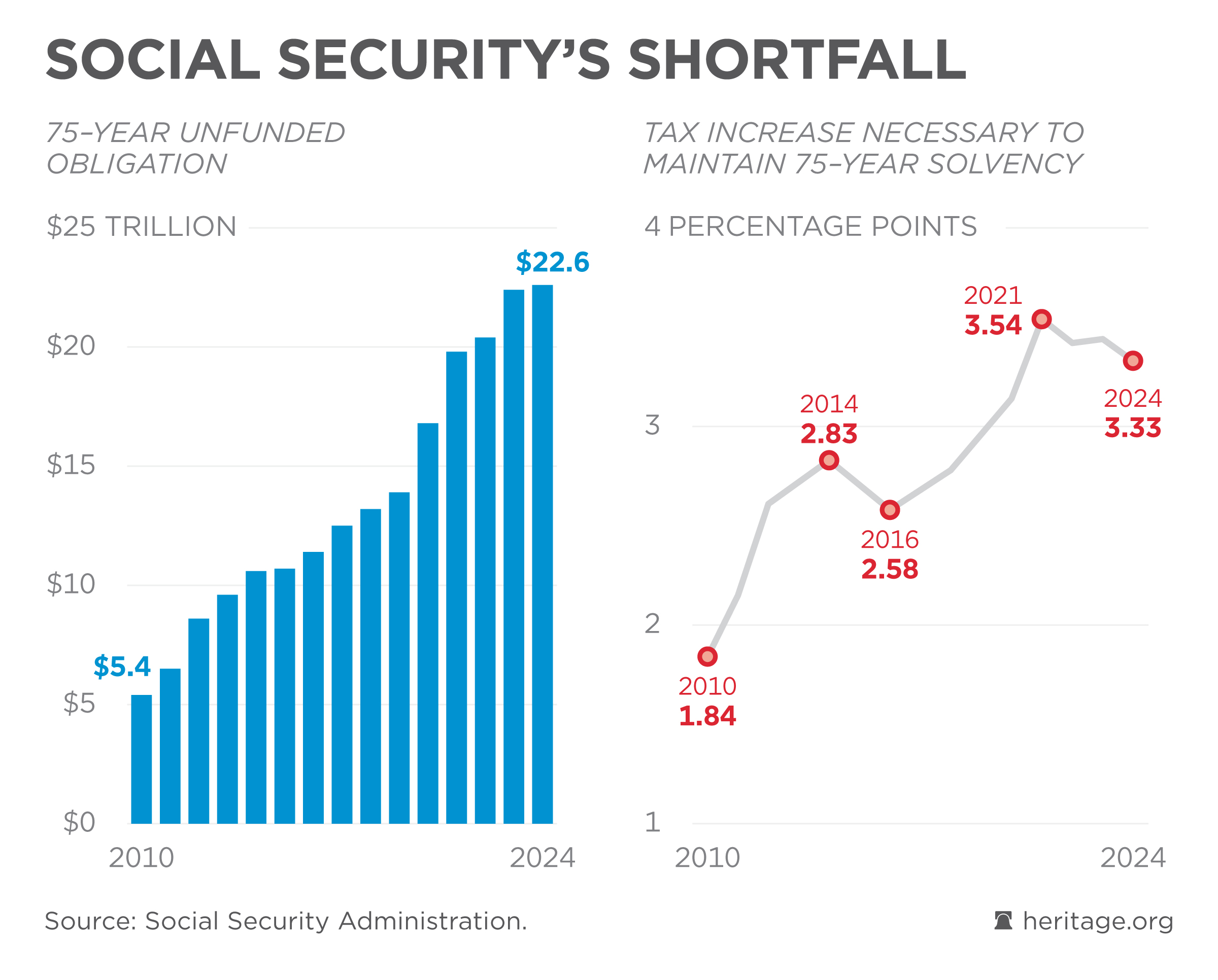
In the high-stakes intersection of monetary policy, demographic reality, and sovereign balance sheet management, the annual adjustment to the United States Social Security program has evolved from a standard technical index into a critical macroeconomic flashpoint. The announcement of the latest Cost-of-Living Adjustment directly expands monthly payouts for tens of millions of retired workers, disabled citizens, and survivors. Yet behind the immediate relief provided to household balance sheets sits an unforgiving actuarial dynamic: compounding baseline distributions are accelerating the exhaustion velocity of the program's primary trust reserve.
The core structural mechanism is the Old-Age and Survivors Insurance (OASI) Trust Fund, an entity that for decades absorbed surplus payroll tax revenues and converted them into non-marketable U.S. Treasury securities. Today, that accumulation dynamic has inverted completely. Net cash outflows have systematically outstripped dedicated tax receipts since 2021. Every marginal percentage-point increase in the annual COLA widens the structural cash deficit, requiring the Social Security Administration (SSA) to accelerate the redemption of its Treasury bond portfolio. This operational liquidity drawdown occurs against an unforgiving demographic backdrop marked by the peak retirement wave of the Baby Boom generation and an increasingly compressed ratio of active workers per beneficiary.
The CPI-W Dilemma: The Flawed Mechanics of Benefit Calculation
The statutory engine behind the COLA calculation remains one of Washington's most contentious econometric debates. Under the Social Security Act of 1972, adjustments are benchmarked against the third-quarter averages of the Consumer Price Index for Urban Wage Earners and Clerical Workers (CPI-W), compiled monthly by the Bureau of Labor Statistics (BLS). Financial analysts and retirement policy researchers point out a fundamental structural disconnect: the CPI-W reflects the spending habits of an urban workforce where transportation, apparel, and recreational technology are heavily weighted, while healthcare services, pharmaceuticals, and senior housing carry a disproportionately lower weight.
Conversely, experimental metrics such as the Consumer Price Index for the Elderly (CPI-E) assign nearly double the weighting to out-of-pocket medical expenditures and sustained long-term care services—categories characterized by structural, non-cyclical inflation. By relying on CPI-W during periods of transient disinflation in consumer goods, the COLA often underdelivers real purchasing power to elderly cohorts. Yet, paradoxically, when energy and supply-chain pressures elevate the headline CPI-W, the resulting across-the-board increase adds billions of dollars in permanent, compounding baseline obligations to an already destabilized trust architecture.
Compounding the problem is the net income erosion driven by rising Medicare Part B standard premiums. Because Medicare Part B premiums are routinely deducted directly from gross Social Security benefits, elevated healthcare services inflation frequently consumes a substantial portion of the calculated cost-of-living increment, leaving beneficiaries with marginal real liquidity gains despite top-line inflationary increases.
Actuarial Trajectories & Solvency Scenarios
The collision between escalating nominal commitments and finite trust fund assets is outlined below. The data synthesizes current metrics from the Social Security and Medicare Boards of Trustees alongside nonpartisan baseline projections from the Congressional Budget Office (CBO).
| Fiscal Variable / Metric | Current Baseline (2024–2025) | Mid-Term Projection (2028–2030) | Terminal Depletion Horizon (2033–2035) |
|---|---|---|---|
| OASI Trust Fund Asset Reserves | ~$2.6 Trillion (Declining) | ~$1.2 Trillion (Rapid Depletion) | $0.00 (Exhaustion of Reserves) |
| Covered Worker-to-Beneficiary Ratio | 2.7 : 1 | 2.4 : 1 | 2.1 : 1 |
| Projected Benefit Replacement Under Law | 100% of Statutory Benefits | 100% of Statutory Benefits | 79% to 83% (Payable via Tax Revenue) |
| Taxable Maximum Wage Base | $168,600 (Indexed Annually) | Projected >$195,000 | Subject to Legislative Overhaul |
| Combined Annual Payouts (OASI + DI) | ~$1.5 Trillion | >$1.9 Trillion | >$2.4 Trillion |
Industry & Capital Market Implications
The looming exhaustion date of the Social Security reserve assets carries systemic ramifications that extend far beyond public safety nets, directly altering market liquidity, enterprise risk mitigation strategies, and private-market wealth preservation frameworks.
1. Wealth Management and Asset Allocation Paradigms
As the probability of an unmitigated 2033 statutory cliff rises, institutional private wealth platforms and multi-family offices are actively restructuring assumptions around client retirement income models. Financial planners are increasingly de-risking financial independence calculations by modeling a baseline 20% to 25% reduction in public entitlement payments for cohorts retiring post-2030. This structural recalibration is accelerating institutional capital allocation toward guaranteed lifetime income vehicles, fixed-index annuities, private-credit high-yield debt platforms, and dynamic multi-asset dividend growth strategies to insulate against public-sector entitlement volatility.
2. Corporate Defined Contribution and Capital Re-Allocation
Corporate plan sponsors operating 401(k) and 403(b) defined contribution plans are under growing pressure to augment automated enrollment frameworks and enhance corporate matching incentives. Enterprise-scale employers are assessing corporate liquidity impacts as aging workforces defer retirement due to solvency fears. "Retirement lock-in"—the inability of senior labor to transition out of the workforce due to uncertainty surrounding public benefits—increases corporate healthcare cost structures and alters talent pipeline scalability.
3. Sovereign Debt and Treasury Market Pressures
The redemption mechanics of the OASI Trust Fund represent a technical headwind for sovereign debt issuance. Historically, the SSA was a structural, non-market buyer of federal debt. Today, the U.S. Treasury must issue new marketable debt to the public to fund the cash redemption of the Special Issue securities held within the Trust Fund. This ongoing liquidation dynamic removes a reliable intra-governmental source of demand at precisely the moment federal primary deficits are expanding, forcing the Treasury to maintain elevated issuance volumes across short-dated bills and benchmark coupon tenors, directly influencing real sovereign yields and term premiums.
Frequently Asked Questions (People Also Ask)
How is the annual Social Security COLA calculated, and why is it criticized?
The Social Security Cost-of-Living Adjustment is calculated based on the percentage increase in the average Consumer Price Index for Urban Wage Earners and Clerical Workers (CPI-W) from the third quarter (July, August, September) of the current year compared to the third quarter of the previous year. Critics point out that the CPI-W reflects consumption patterns of active, urban wage earners rather than retirees. It assigns lower weights to healthcare and housing—expenses that typically rise faster than general consumer goods—leading to a divergence between official adjustments and the true cost-of-living increases experienced by older Americans.
What happens if the Social Security Trust Fund is depleted in 2033 or 2034?
If the OASI Trust Fund balance reaches zero, the program does not shut down or terminate payments. Social Security would transition entirely to a pure "pay-as-you-go" funding model. In this state, the program can only distribute the cash volume it collects simultaneously through current payroll taxes. Under current projections, this ongoing revenue stream would cover approximately 79% to 83% of scheduled, statutory benefits, resulting in an automatic, immediate cut of roughly 17% to 21% across all beneficiaries unless Congress modifies existing statutes.
Can Congress resolve the funding shortfall simply by raising the payroll tax cap?
Raising or eliminating the payroll tax cap (which caps taxable earnings at $168,600 as of 2024) is a central pillar of several legislative proposals, but independent actuarial analyses indicate it cannot fully bridge the long-term deficit on its own. While subjecting earnings above the cap to the 12.4% combined FICA tax would generate significant new revenue and extend the depletion horizon by several years, closing the entire 75-year actuarial deficit would still require additional systemic measures, such as gradual adjustments to the full retirement age, changes to the indexation formula (e.g., Chained CPI), or broadened revenue sources.
Does a higher COLA trigger higher taxes on Social Security benefits?
Yes. Because the statutory income thresholds that trigger the taxation of Social Security benefits—known as provisional income thresholds ($25,000 for single filers, $32,000 for married couples filing jointly)—were established in 1983 and were never indexed to inflation, nominal increases in monthly checks routinely push more retirees across these tax thresholds. This phenomenon, known as "bracket creep," forces a higher percentage of beneficiaries to pay federal income taxes on up to 50% or 85% of their benefits, diluting the net economic value of the cost-of-living adjustment.
Future Outlook: Strategic Milestones and Policy Scenarios
The horizon between the current cycle of elevated inflation adjustments and the terminal exhaustion date of the Trust Fund is rapidly narrowing. Legislative decision-making will dictate whether the resolution is an organized, phased structural transition or a chaotic, eleventh-hour market shock.
Three primary scenarios frame the strategic runway over the next three to five years:
- The Fiscal Compromise Framework: A blended legislative reform combining a phased-in increase in the Full Retirement Age (FRA) toward age 69 for younger demographics, coupled with a hybrid application of payroll taxes on high-wage earners (such as re-imposing the FICA tax on earnings above $400,000, creating a "doughnut hole"). This approach balances expenditure restraint with structural revenue expansion.
- Chained CPI Adoption: A transition from the standard CPI-W to the Chained Consumer Price Index for All Urban Consumers (C-CPI-U). Because chained indexing accounts for consumer substitution behavior when specific goods rise in price, it typically lowers the calculated annual COLA rate by 0.2 to 0.3 percentage points, saving hundreds of billions in compounding baseline obligations over a 10-year budget window.
- General Revenue Backstops and Sovereign Deficit Expansion: In the absence of an entitlement compromise, Congress could vote to inject direct transfers from the Treasury's general fund to patch the OASI Trust Fund's deficit. While politically expedient, this path would structurally expand federal borrowing needs, putting sustained upward pressure on long-term Treasury yields and expanding the national debt-to-GDP ratio.
The mathematical trajectory of Social Security is no longer an abstract concern reserved for distant actuarial tables. With every annual COLA baseline adjustment, the timeline contracts. Institutional markets, enterprise retirement systems, and millions of future retirees are now forced to operate within an investment environment where public-sector guarantees must be matched by sophisticated, resilient private capital allocation strategies.
![GLM-5.2 vs DeepSeek V4 vs Kimi K2.6: 62% SWE Pro [2026]](https://oss-us.gptproto.com/growth/blog/af227c0d-dec5-4030-8afc-815d0ca9c6fb.png)