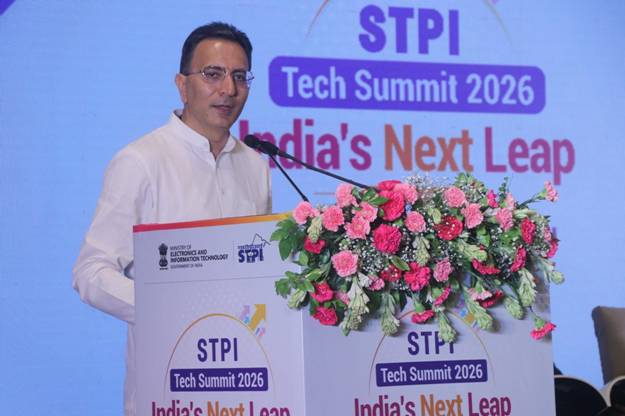
India’s Tech Gatekeeper Maps Out the Next $500B Leap: Key Takeaways From STPI’s Landmark 35th Foundation Day and Tech Summit 2026
NEW DELHI — Thirty-five years ago, amid the tectonic shifts of India’s 1991 economic liberalization, a quiet institution called the Software Technology Parks of India (STPI) was established. Its mandate was simple yet audacious: help a nascent, cash-strapped software sector export its services to the world. Today, that sector is a $250-billion powerhouse, and STPI has evolved from a simple infrastructure provider into the ultimate catalyst for India’s deep-tech ambitions.
On June 5, 2026, marking its 35th Foundation Day, STPI convened the high-profile Tech Summit 2026 in the national capital. The event did not just celebrate past milestones; it laid down a definitive blueprint for India's next massive technological transition—from a global back-office service provider to an intellectual property (IP)-led product nation.
Attended by top policymakers, venture capitalists, semiconductor pioneers, and founders of scaling unicorns, the summit served as a grand stage for several landmark announcements, multi-sectoral Memorandums of Understanding (MoUs), and a forward-looking vision for India’s sovereign tech stack.
Strategic Pivot: From Code-Writing to IP Creation
In his opening address, the Secretary of the Ministry of Electronics and Information Technology (MeitY) emphasized that India’s technology sector is entering its most critical decade. "The era of cost-arbitrage-led growth is behind us," he noted. "The next $250 billion in value will not come from writing code to manage other nations’ systems, but from building sovereign AI architectures, designing chips, and pioneering deep-tech solutions for the global south."
A central pillar of this strategy is the expansion of STPI’s specialized Centers of Excellence (CoEs). Moving away from traditional software services, these CoEs are hyper-focused on frontier fields, including:
- Generative AI & LLMs: Fine-tuning models optimized for regional Indian languages to democratize digital access.
- Semiconductor Design: Supporting fabless startups with electronic design automation (EDA) tools to align with India’s domestic chipmaking push.
- SpaceTech & Drone Technologies: Building software components for precision agriculture, defense, and climate-resilient logistics.
- Industry 4.0 & IoT: Merging hardware and software to digitize India’s massive manufacturing corridors.
The Deals That Matter: Key MoUs Exchanged
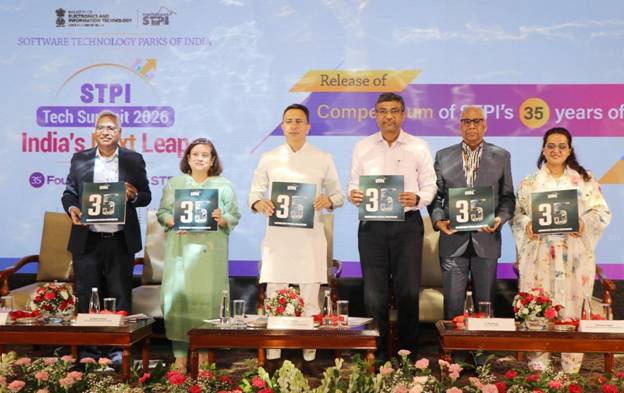
The centerpiece of the 35th Foundation Day was the formal exchange of several high-impact MoUs between STPI, academic institutions, and industry conglomerates. These partnerships are designed to bridge the gap between academic research and commercial market readiness.
Among the most notable agreements was a tripartite MoU involving STPI, premier Indian Institutes of Technology (IITs), and leading global venture funds. This initiative aims to establish a seed-capital runway for deep-tech startups emerging from Tier-2 and Tier-3 cities. A second major MoU focused on setting up unified testing and validation labs, allowing hardware and IoT startups to certify their products domestically, bypassing expensive overseas testing protocols.
These strategic alliances underscore STPI’s transition into a comprehensive incubation platform, offering critical regulatory navigation, cloud credits, and market access alongside traditional physical workspaces.
STPI’s 35-Year Evolution: By the Numbers
To appreciate the scale of STPI’s impact, one must look at its growth trajectory since its inception in 1991. The table below illustrates the dramatic evolution of India's tech landscape under STPI's stewardship:
| Metric / Era | 1991 (The Inception) | 2008 (The Outsourcing Boom) | 2026 (The Deep-Tech Era) |
|---|---|---|---|
| Core Focus Area | Basic Software Exports & Connectivity | IT Services, BPO, & Global Delivery Models | AI, Semiconductors, SaaS, & IP-led Products |
| Registered Units | Less than 50 | Over 8,000 | Over 15,000+ Active Startups & Units |
| Geographic Footprint | 3 Major Metros | 45+ Sub-centers | 65+ Centers (Focus on Tier-2 & Tier-3 Cities) |
| Primary Infrastructure | Early Satellite Earth Stations | High-speed Fiber & Tech Parks | GPU Clouds, Fabless Design Labs, & CoEs |
Unlocking the Potential of Bharat’s Micro-Markets
A key theme echoing throughout Tech Summit 2026 was the democratization of India's technology ecosystem. For decades, the wealth generated by the IT sector was heavily concentrated in tier-1 hubs like Bengaluru, Hyderabad, Pune, and Noida. STPI’s leadership made it clear that the next wave of growth must be distributed.
Under its revised mandate, STPI is aggressively scaling its presence in smaller urban centers. By providing world-class infrastructure and mentoring networks in cities like Indore, Guwahati, Hubli, and Patna, the agency is tapping into a vast pool of regional engineering talent. This shift reduces operational overheads for growing startups while curbing the brain-drain from smaller towns to overburdened metropolitan cities.
"Our next generation of tech founders will not come exclusively from elite metropolitan colleges," remarked an STPI regional director during a panel discussion. "They are building localized, highly efficient SaaS platforms in tier-2 cities today. STPI's role is to ensure they have the same access to compute power, capital, and global networks as their peers in Silicon Valley."
The Road Ahead: Vision 2030
As the summit concluded, the overriding sentiment was one of calculated optimism. While global tech markets grapple with macroeconomic shifts, funding recalibrations, and rapid disruption from generative AI, India's tech ecosystem is positioned defensively and offensively.
With a massive talent base, a robust digital public infrastructure (DPI) model that has become the envy of the world, and proactive policy frameworks like the India Semiconductor Mission, STPI is poised to guide the sector through its most complex transformation yet. The 35th Foundation Day was not merely a celebration of longevity; it was a firm declaration that India’s technology story is only just getting started.
Frequently Asked Questions (FAQ)
What is the significance of STPI's 35th Foundation Day?
Established in 1991 under MeitY, STPI has been pivotal in promoting, incubating, and facilitating software exports from India. Its 35th Foundation Day marks its transition from an infrastructure facilitator to a key driver of deep-tech, AI, and IP-led startup ecosystems across both metro and non-metro cities.
What were the main highlights of the Tech Summit 2026?
The summit focused on India's shift toward high-value technology segments like sovereign AI, semiconductor design, and SaaS. Key highlights included the signing of major MoUs with academia and venture capital firms to support deep-tech startups, and a strategic roadmap to expand specialized Centers of Excellence (CoEs) into Tier-2 and Tier-3 towns.