NEW YORK & LONDON — As enterprise attack surfaces expand across distributed multicloud architectures, global Chief Information Security Officers (CISOs) and enterprise risk committees are confronting a pivotal operational turning point. According to intelligence synthesized from recent wire disclosures by Zscaler and broader market data, cybersecurity is undergoing its most profound structural shift since the adoption of Zero Trust: the convergence of Generative AI (GenAI) and Agentic AI into defensive and offensive security stacks.
While Generative AI has spent the past two years acting as an interactive assistant—summarizing threat intelligence and accelerating log analysis—Agentic AI represents an evolutionary leap toward fully autonomous cyber defense. Operating with goal-oriented autonomy, agentic architectures move beyond prompt-response interaction to autonomously reason, plan, execute multi-step containment workflows, and self-correct in real time. This technical paradigm shift is rapidly altering enterprise capital allocation, re-evaluating software valuation multiples on Wall Street, and establishing a new operational baseline for enterprise risk mitigation.
Executive Takeaways
- The Architectural Divide: Generative AI acts as a intelligence amplifier by synthesizing vast datasets and drafting security policies, whereas Agentic AI operates as an autonomous actor capable of executing complex, multi-step threat mitigation workflows across cloud environments without continuous human intervention.
- Asymmetric Threat Velocity: Adversaries are increasingly leveraging large language models (LLMs) to execute automated dynamic evasion, dynamic social engineering, and rapid zero-day exploitation, reducing enterprise attack windows from days to milliseconds.
- Capital Allocation & SOC Economics: Enterprise technology budgets are pivoting toward integrated, AI-native security platforms. Early deployment telemetry indicates that coupling Agentic AI with Zero Trust architecture can reduce Mean Time to Respond (MTTR) by up to 85%, fundamentally lowering Security Operations Center (SOC) operational expenditures.
- Governance and Enterprise Risk: The deployment of autonomous agents introduces critical governance hurdles under evolving regulatory frameworks, including SEC breach disclosure mandates and the EU AI Act, requiring rigorous policy guardrails to prevent unintended automated actions.
Deconstructing the Paradigm: From Generative Intelligence to Agentic Execution
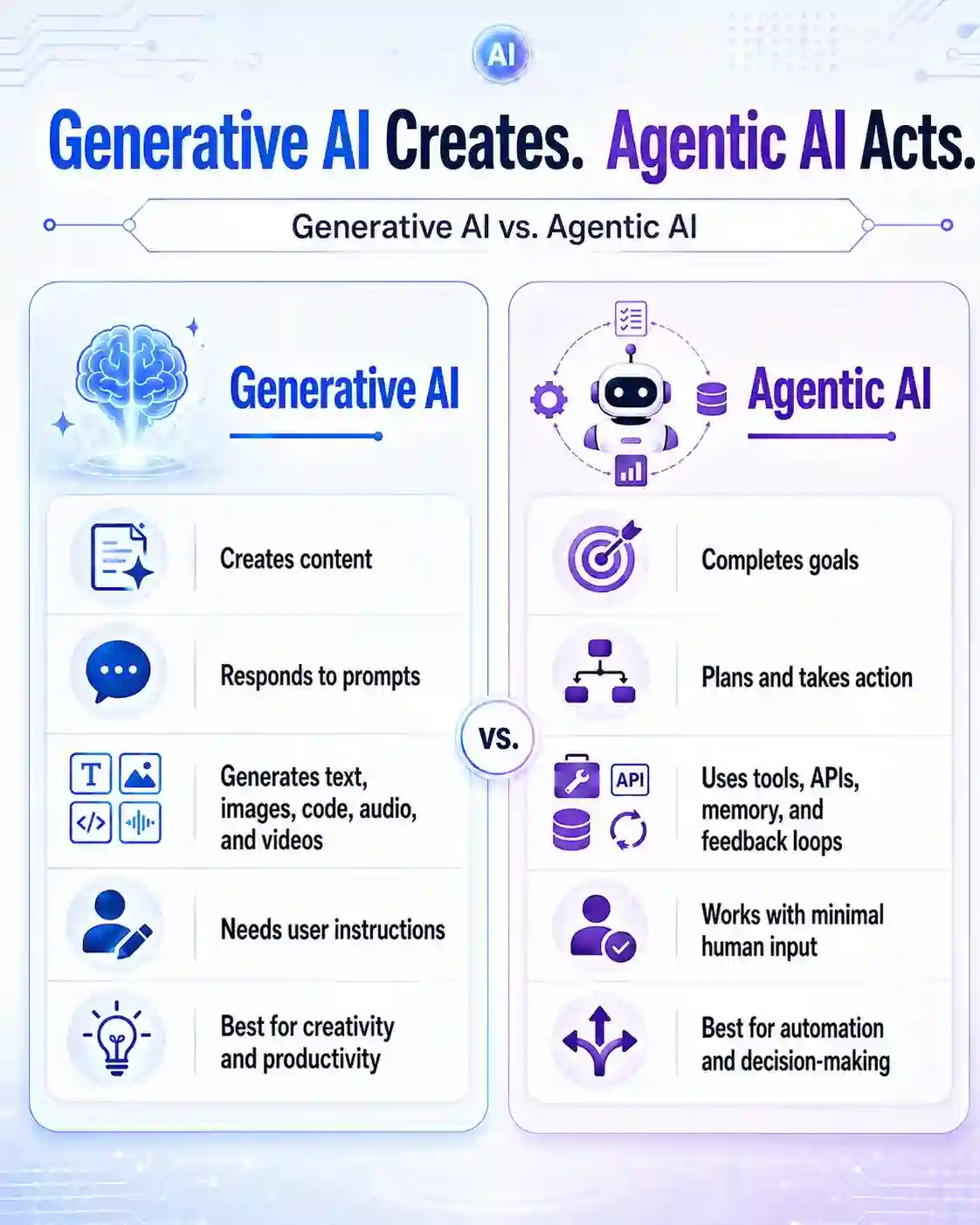
To understand the architectural pivot occurring within global SOCs, enterprise security leaders must distinguish between the technical foundations of Generative AI and Agentic AI. While both technologies rely on advanced machine learning pipelines, deep neural networks, and massive training corpora, their operational applications in risk management diverge significantly.
Generative AI: The Copilot Era of Threat Intelligence
Generative AI in cybersecurity relies primarily on Large Language Models (LLMs) fine-tuned on threat telemetry, security logs, vulnerability databases, and incident response playbooks. Its primary functional role is synthetic analysis and contextual ingestion. When an anomaly occurs within an enterprise network, a GenAI engine ingests structured and unstructured data—such as Syslog files, endpoint telemetry, and network packet captures—to produce natural language summaries for tier-1 and tier-2 SOC analysts.
Key applications of Generative AI include:
- Interactive Querying: Allowing security analysts to query complex vector databases and SIEM (Security Information and Event Management) platforms using natural language.
- Policy Synthesis: Automated drafting of firewall rules, identity and access management (IAM) roles, and Zero Trust access policies based on historical traffic patterns.
- Code Audit and Remediation: Analyzing application source code for static and dynamic vulnerabilities and proposing functional code patches to dev-sec-ops teams.
Despite these efficiencies, GenAI remains inherently passive and reactive. It relies on human-in-the-loop triggers to authorize action, creating a speed bottleneck when facing hyper-automated cyber attacks.
Agentic AI: Autonomous Reasoning and Closed-Loop Orchestration
Agentic AI removes human latent delays by integrating LLMs with reasoning frameworks—such as ReAct (Reasoning and Acting)—alongside memory modules and functional API toolkits. Rather than merely outputting text recommendations, an Agentic AI system receives high-level strategic objectives (e.g., "Identify, isolate, and remediate lateral movement within cloud environment B").
Upon receiving an objective, an Agentic AI framework autonomously executes a multi-stage cognitive lifecycle:
- Perception & Ingestion: Continuously monitors data streams, vector search spaces, and telemetry across endpoints, identity providers, and cloud workloads.
- Hypothesis Generation & Planning: Formulates a step-by-step remediation plan, evaluating vector similarity against historical attack patterns and active threat intelligence feeds.
- Execution & API Orchestration: Invokes programmatic commands via enterprise orchestration platforms (SOAR), directly modifying security groups, revoking compromise tokens, updating dynamic proxy configurations, and snapshotting affected virtual machines for forensics.
- Self-Correction & Verification: Evaluates the outcome of its actions. If an initial containment vector fails to halt the threat, the agent re-evaluates network state and executes alternative containment strategies without waiting for human intervention.
Systemic Comparison: Traditional, Generative, and Agentic Cyber Architectures
The enterprise shift from legacy automation to fully agentic systems represents an exponential leap in operational capability, infrastructure requirements, and risk dynamics. The following matrix illustrates the performance and operational trade-offs across these three technological paradigms:
| Metric / Dimension | Legacy Automation (SOAR) | Generative AI (GenAI) | Agentic AI Systems |
|---|---|---|---|
Wall Street & Enterprise Economics: Capital Allocation in the AI Era
The transition toward agentic cybersecurity architectures is triggering a re-allocation of capital across corporate IT budgets and institutional investment portfolios. For Chief Financial Officers and Chief Information Officers, cybersecurity expenditure is moving from a tactical insurance cost to a strategic investment in business continuity and cloud infrastructure resilience.
Driving Enterprise ROI and Operational Efficiency
Modern enterprise SOCs face severe structural headwinds: exponential data growth, chronic cybersecurity labor shortages, and unsustainable alert volumes. Traditional SOC models scale linearly—requiring more human analysts as network data grows. Agentic AI breaks this linear cost curve.
By automating tier-1 through tier-3 triage, autonomous agents compress alert-to-containment cycles from hours to seconds. The return on investment (ROI) materializes through three primary mechanisms:
- Labor Realignment: Shifting high-cost human capital from manual log parsing to strategic threat hunting and architectural engineering.
- Mitigation of Breach Exposure: Reducing breach dwell time significantly shrinks total financial losses, regulatory fines, and reputational brand erosion.
- Infrastructure Efficiency: Optimizing cloud security processing costs by utilizing dynamic, agentic filtering at the edge rather than ingesting petabytes of raw telemetry into costly centralized SIEMs.
Vendor Landscape & Market Valuation Shifts
Public equity markets are increasingly rewarding platform-based security vendors that possess deep proprietary telemetry data and native AI integration over legacy point-solution vendors. Companies such as Zscaler, CrowdStrike, Palo Alto Networks, and Microsoft Security are leveraging massive data lakes to train specialized agentic models. Enterprise buyers are actively consolidating fragmented security tools into unified zero-trust platforms capable of hosting agentic execution frameworks. Consequently, platform providers commanding deep data moats are securing high enterprise value-to-revenue valuation multiples relative to single-use security providers.
Frequently Asked Questions (People Also Ask)
What is the primary technical difference between Generative AI and Agentic AI in cybersecurity?
Generative AI focuses on content generation, pattern recognition, and decision support—such as drafting incident reports or translating natural language into SIEM queries—while requiring human authorization for action. Agentic AI incorporates dynamic reasoning, goal setting, memory, and programmatic tool execution. This allows agentic systems to autonomously plan and perform multi-step containment actions directly across enterprise infrastructure without relying on manual triggers.
How does Agentic AI operate alongside Zero Trust security architectures?
Agentic AI acts as the dynamic policy decision engine within a Zero Trust framework. While Zero Trust operates on the principle of "never trust, always verify," Agentic AI provides real-time operational continuous verification. It continuously evaluates identity risk scores, anomalous user behavior, device state, and network contextual shifts to dynamically issue, alter, or terminate user access permissions without breaking connection stability for legitimate workflows.
What are the primary risk considerations when deploying autonomous AI agents in enterprise networks?
The primary risks include non-deterministic execution, false positives causing operational disruption, model drift, and vulnerability to adversarial prompt injection. If an AI agent interprets benign network behavior as a critical threat, it could autonomously shut down enterprise databases or essential business services. To mitigate this risk, organizations deploy strict operational guardrails, explicit permission boundaries, and "human-on-the-loop" approval checkpoints for high-impact system changes.
How do SEC disclosure rules impact the adoption of AI in cybersecurity?
The Securities and Exchange Commission (SEC) mandates strict four-day incident disclosure windows for material cybersecurity events. This tight regulatory timeline makes manual threat detection and delayed response unsustainable for large public companies. Agentic AI enables rapid threat containment, concise impact auditing, and clear timeline generation, providing executives with the verified analytical data necessary to fulfill stringent disclosure compliance requirements.
Future Outlook: Autonomous Cyber Warfare and Boardroom Governance
Looking ahead, the enterprise threat landscape will increasingly feature automated AI defensive systems defending against automated AI attack systems. Threat actors are actively engineering autonomous agents designed to discover zero-day vulnerabilities, map target internal networks, and dynamically adapt exfiltration tactics to bypass static security rules.
In response, future enterprise defense will depend on hyper-automated, multi-agent frameworks operating within integrated Zero Trust cloud environments. However, complete autonomy brings operational and compliance exposure. Board audit committees and corporate risk officers must establish robust governance frameworks to monitor agentic systems, ensuring that autonomous containment routines align with business continuity objectives and strict compliance standards.
As the velocity of cyber attacks eclipses human reaction capabilities, the adoption of Agentic and Generative AI ceases to be a luxury for progressive technology firms—it becomes a foundational imperative for protecting global corporate enterprise value.