Executive Takeaways
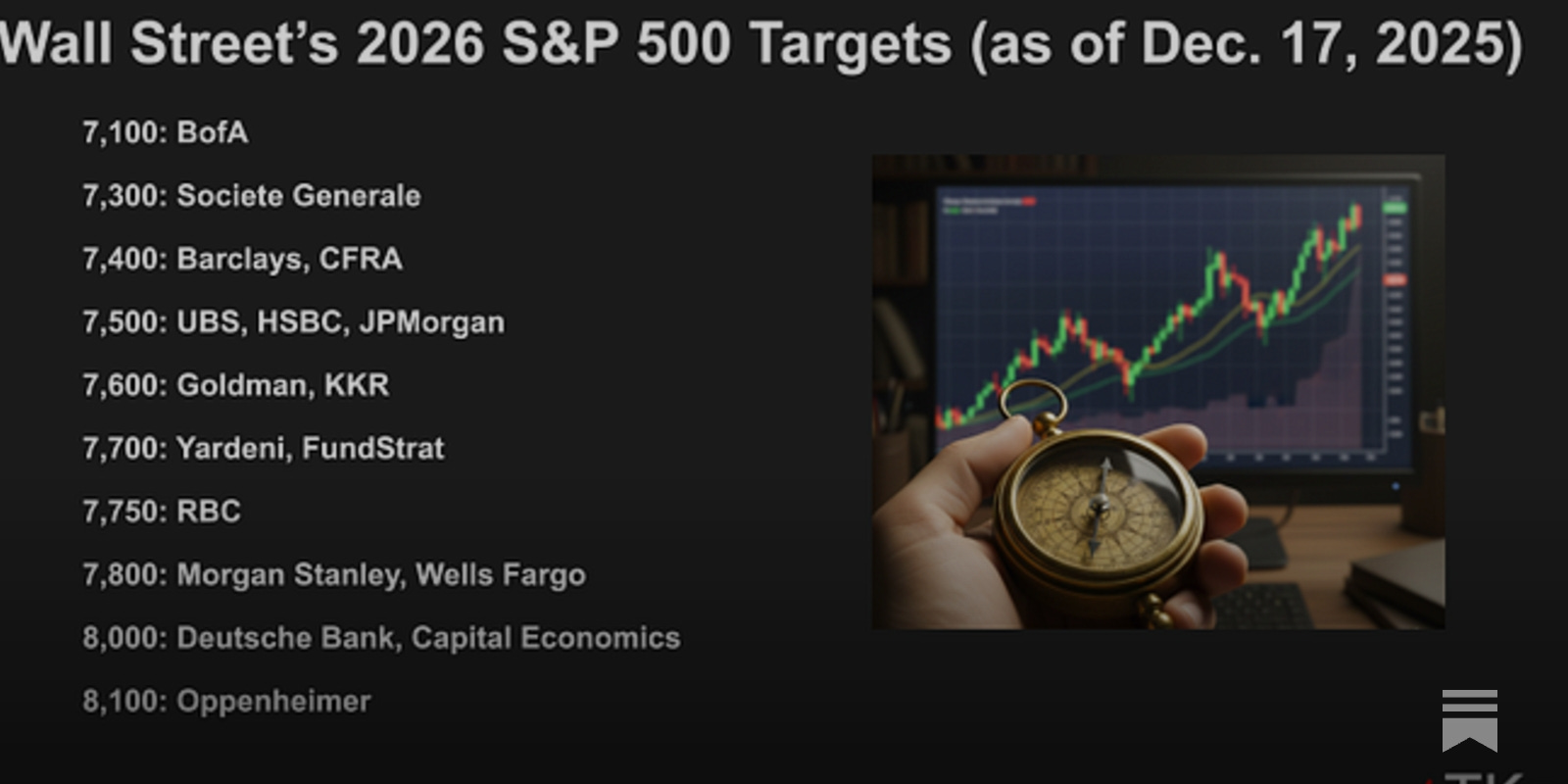
- Broadening Earnings: Wall Street consensus points to a solid 2026 for equities, driven by corporate profit growth expanding beyond mega-cap technology into cyclical and industrial sectors.
- The AI Inflection Point: Institutional scrutiny on artificial intelligence investments is intensifying, with enterprise buyers demanding demonstrable operational ROI and infrastructure scalability to justify sky-high capital expenditure.
- Fiscal and Regulatory Catalysts: Looming tax legislation and evolving regulatory compliance frameworks introduce both tailwinds and severe volatility risks for corporate balance sheets.
- Elevated Valuation Multiples: Price-to-earnings ratios remain near historical highs, leaving institutional portfolios vulnerable to sudden shifts in market liquidity and macroeconomic shocks.
NEW YORK — As trading desks wind down the final sessions of 2025, Wall Street’s premier strategists are locking in their baseline forecasts for the year ahead. The prevailing sentiment heading into 2026 is one of guarded optimism: corporate earnings are projected to remain robust, macroeconomic indicators point to a resilient (if slowing) expansion, and the breadth of the market rally is anticipated to widen. Yet, beneath the veneer of continued gains, a chorus of Chief Investment Officers, senior quantitative researchers, and risk management executives is sounding a persistent alarm. The risks are not merely growing; they are compounding.
For institutional asset managers, the primary challenge of 2026 will not be identifying growth, but navigating a complex web of structural vulnerabilities. From the amortizing costs of cloud compute architecture powering the artificial intelligence revolution to shifting fiscal policy in Washington, the margin for operational error among bellwether corporations has narrowed significantly. As equity markets price in a near-flawless economic transition, capital allocation strategies are undergoing a rigorous stress test.
The Macroeconomic Landscape: Profit Growth Meets Valuation Pressures
The foundational thesis supporting a positive 2026 equity outlook rests on sustained corporate profit expansion. Throughout 2024 and 2025, earnings growth was heavily concentrated within a handful of mega-cap technology titans. However, consensus estimates compiled by major financial institutions indicate that profit growth is broadening out. Industrial, financial, and healthcare sectors are projected to capture larger shares of aggregate earnings growth as interest rate cuts by central banks gradually lower corporate borrowing costs and stimulate capital expenditure.
Despite this fundamental strength, equity valuations present a formidable hurdle. Price-to-earnings (P/E) multiples for the S&P 500 sit comfortably above their 10-year historical averages. This valuation expansion implies that markets have already priced in much of the anticipated earnings recovery. Consequently, any macroeconomic disruption—whether driven by persistent core inflation, unexpected labor market tightening, or geopolitical friction—carries an outsized risk of multiple compression.
Institutional risk mitigation strategies are shifting accordingly. Portfolio managers are increasingly focused on quality factors: companies with pristine balance sheets, strong free cash flow generation, and manageable debt profiles. The era of speculative, high-beta momentum investing is ceding ground to a more disciplined focus on sustainable enterprise value.
Can the Generative AI Rally Sustain Its Momentum?
No variable holds more sway over the 2026 market trajectory than the longevity and economic return of the artificial intelligence boom. Over the past three years, hyperscalers and semiconductor manufacturers have poured hundreds of billions of dollars into data center expansion, advanced GPUs, and specialized cloud compute architecture. The critical question for 2026 is whether enterprise buyers can translate these multi-billion-dollar outlays into tangible, bottom-line enterprise ROI.
Senior analysts note that the market is moving past the initial phase of infrastructure build-out into a phase of rigorous financial accountability. Wall Street clients are demanding clarity on how generative AI implementations reduce operational expenditures and drive new revenue streams. If enterprise adoption stalls or if the efficiency gains fail to offset capital expenditure, the resulting correction in semiconductor and cloud computing valuations could exert severe downward pressure on major market indices.
Furthermore, supply chain bottlenecks for high-performance silicon and constraints on electrical grid capacity remain active operational risks. Energy availability, in particular, has emerged as a critical limiting factor for hyperscale data center operators, forcing tech conglomerates into long-term power purchase agreements with nuclear and renewable energy providers.
Fiscal Policy, Tax Legislation, and Regulatory Compliance
Beyond technological and macroeconomic factors, the domestic political and regulatory environment in 2026 introduces significant binary outcomes for corporate balance sheets. Legislative debates surrounding the extension or modification of landmark tax legislation remain at the forefront of institutional risk assessments. Corporate tax policy directly impacts net income margins, and any legislative shifts will force immediate re-evaluations of discounted cash flow models across Wall Street research departments.
Simultaneously, the regulatory compliance landscape is growing increasingly complex. Antitrust scrutiny targeting dominant digital platforms, evolving cross-border data sovereignty laws, and stricter oversight of financial technology infrastructure demand proactive legal and operational risk management. Corporations that lack nimble compliance frameworks face substantial legal liabilities and operational friction that could weigh heavily on their equity valuations throughout the year.
| Market Metric / Catalyst | Current Baseline (2025) | 2026 Outlook / Projection | Primary Market Implication |
|---|---|---|---|
| S&P 500 P/E Multiple | Elevated (~22x–24x forward) | Susceptible to multiple compression | Heightened vulnerability to earnings misses. |
| AI Infrastructure Capex | Exponential year-over-year growth | Shift toward ROI and monetization | Differentiation between winners and losers based on efficiency. |
| Earnings Breadth | Concentrated in Mega-Cap Tech | Expanding to Industrials & Financials | Supportive for equal-weight and cyclical portfolios. |
| Corporate Tax Policy | Stable status quo | Legislative review & potential adjustment | Direct impact on net profit margins and capital return plans. |
Industry and Market Implications: Winners and Losers
As market dynamics shift in 2026, the divergence in performance between distinct asset classes and corporate tiers will likely widen. Understanding these structural shifts is vital for institutional asset allocators and sophisticated private investors alike.
The Winners: Quality Cyclicals and Infrastructure Enablers
Companies that provide tangible solutions to operational bottlenecks are poised to outperform. This includes industrial automation firms, specialized energy providers servicing data center clusters, and financial institutions capable of capitalizing on robust corporate debt issuance and merger-and-acquisition (M&A) activity. Furthermore, companies demonstrating verifiable enterprise ROI from their technology investments will attract steady institutional inflows.
The Losers: Over-Leveraged Growth and Commodity Tech
Conversely, firms reliant on continuous, low-cost capital access without immediate pathways to profitability face severe headwinds. Speculative technology plays that fail to convert research and development spending into recurring cash flow will experience valuation contractions. Additionally, businesses unable to pass rising regulatory and labor costs onto end consumers will see margin compression squeeze their equity values.
Frequently Asked Questions (People Also Ask)
What are the primary drivers behind Wall Street’s positive expectations for 2026?
Wall Street’s constructive outlook for 2026 is anchored by anticipated corporate profit growth that is broadening out beyond mega-cap technology into cyclical, industrial, and financial sectors. Additionally, easing monetary policy, stabilizing inflation, and resilient consumer spending continue to provide a supportive macroeconomic foundation for equities.
Why are market risks considered to be growing despite positive earnings forecasts?
Risks are accumulating primarily due to stretched valuation multiples, intense scrutiny over the financial returns of massive artificial intelligence investments, and potential volatility stemming from upcoming legislative tax debates and complex regulatory compliance requirements. High P/E ratios leave markets with little room for operational error or macroeconomic shocks.
How is the artificial intelligence rally expected to evolve in 2026?
The AI market is transitioning from a phase of unchecked infrastructure accumulation to a phase of rigorous financial accountability. Institutional investors are increasingly demanding concrete proof of enterprise ROI, operational efficiency, and scalable monetization models from companies deploying generative AI technologies.
How should institutional investors position their portfolios for the 2026 market environment?
Sophisticated investors are emphasizing risk mitigation by rotating into high-quality companies with robust balance sheets, strong free cash flow generation, and pricing power. Diversification away from overly concentrated mega-cap tech into select cyclical and industrial equities is becoming a favored tactical strategy.
Future Outlook: Key Milestones to Watch in 2026
As the market navigates the complexities of 2026, several critical inflection points will dictate the ultimate direction of equity prices. First-quarter corporate earnings reports will provide the initial empirical test of whether profit broadening is materializing as projected. Simultaneously, announcements from federal legislators regarding tax policy adjustments will serve as major catalysts for sector-specific re-pricing.
For long-term investors, discipline and rigorous fundamental research remain paramount. While the structural growth narrative of modern capital markets remains intact, the compounding risks dictate a departure from passive optimism in favor of active, risk-adjusted portfolio management. The year 2026 will reward discernment, operational resilience, and an uncompromising focus on intrinsic value.