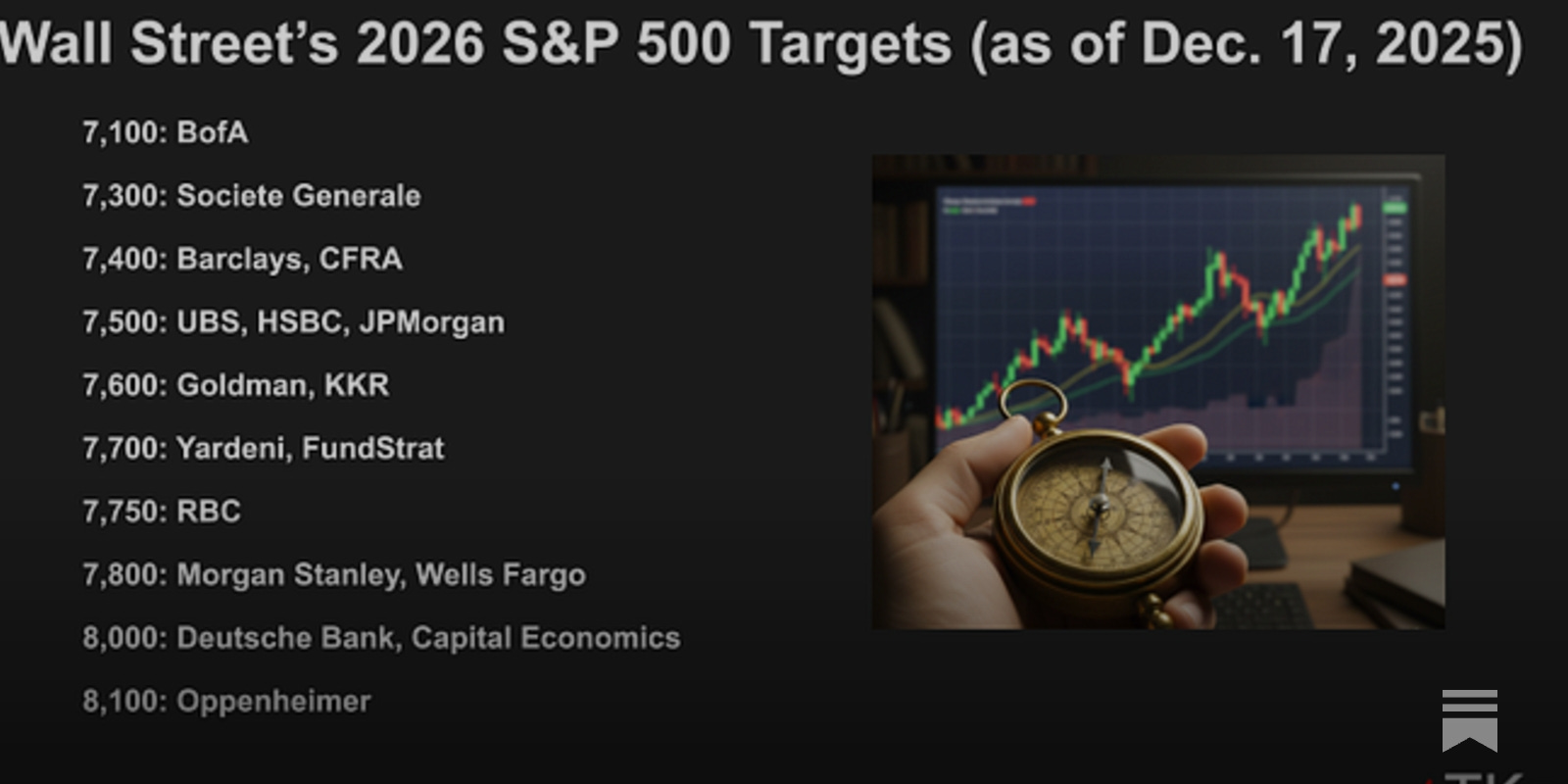
Executive Takeaways
- Broadening Earnings Expansion: Wall Street consensus points to a resilient 2026 for equities, driven by corporate profit growth migrating beyond mega-cap technology into cyclical and industrial sectors.
- The AI ROI Reckoning: Enterprise buyers and hyperscalers face mounting scrutiny over capital allocation, cloud compute architecture scalability, and tangible returns on massive generative AI investments.
- Fiscal and Regulatory Tailwinds/Headwinds: Anticipated corporate tax legislation and shifting monetary policy frameworks introduce both earnings upside and severe regulatory compliance hurdles.
- Elevated Valuation Multiples: With historical price-to-earnings (P/E) ratios stretched near multi-year highs, risk mitigation and portfolio rebalancing are becoming paramount for institutional asset managers.
As institutional trading desks finalize their capital allocation strategies heading into the new year, a familiar yet increasingly tense narrative dominates Wall Street boardrooms. According to primary market intelligence released in late December 2025, major investment banks and asset managers project a fundamentally solid, albeit more volatile, 2026 for global equities. Yet, behind the consensus forecasts of continued economic resilience and corporate expansion lies a growing chorus of caution. Beneath the surface of rising indices, structural vulnerabilities—ranging from artificial intelligence infrastructure fatigue to tightening fiscal margins and elevated valuation multiples—suggest that the margin for error in portfolio management is shrinking rapidly.
For financial editors tracking the intersection of macroeconomics, corporate finance, and enterprise technology, the setup for 2026 represents a critical inflection point. The runaway momentum that defined the post-pandemic recovery and the initial generative AI boom is transitioning into a mature, highly scrutinized phase. Investors can no longer rely on indiscriminate beta; instead, security selection will depend heavily on granular assessments of balance sheet strength, operational efficiency, and verifiable enterprise return on investment (ROI).
The 2026 Macroeconomic Setup: Profit Growth, Tax Policy, and Liquidity
The core thesis supporting a positive outlook for 2026 centers on corporate earnings. Equity strategists across major financial institutions anticipate that profit growth will not only remain robust but will also broaden significantly. While the past twenty-four months were characterized by extreme market concentration—where a handful of mega-cap technology titans drove the lion's share of index gains—current forecasts suggest a broadening out into sectors historically sensitive to economic cycles, such as industrials, financials, and mid-cap domestic enterprises.
This broadening earnings base is supported by stabilizing macroeconomic indicators, including resilient consumer balance sheets and a more predictable interest rate trajectory from central banks. However, fiscal policy remains a wild card. Debates surrounding upcoming legislative frameworks, specifically potential revisions to corporate tax rates and capital expenditure incentives, are already factoring into institutional financial models. A favorable tax bill could provide an immediate boost to net margins, yet fiscal expansion risks reigniting inflationary pressures, complicating the central bank's liquidity management and putting upward pressure on sovereign bond yields.
Furthermore, market liquidity is shifting. As quantitative tightening measures mature and global trade flows adapt to geopolitical realignments, corporate treasurers are prioritizing robust cash generation over aggressive debt financing. This environment favors cash-rich market leaders capable of funding internal research and development without relying on high-cost credit facilities.
Can the Generative AI Rally Sustain Its Momentum?

No discussion of equity market performance heading into 2026 can ignore the elephant in the room: the artificial intelligence super-cycle. The past few years have witnessed unprecedented capital expenditure cycles among hyperscale cloud providers, semiconductor designers, and enterprise software developers. Billions of dollars have been poured into cloud compute architecture, specialized graphics processing units (GPUs), and massive data center developments.
As we look toward 2026, Wall Street is pivoting from a phase of speculative expansion to one of hard economic accountability. Enterprise buyers are increasingly demanding proof of tangible productivity gains and clear enterprise ROI before committing to multi-year software licensing or infrastructure upgrade contracts. The central question for equity analysts is whether end-users can monetize these technologies rapidly enough to justify the astronomical capital expenditures undertaken by the hardware and infrastructure providers.
Any signs of decelerating enterprise adoption or margin compression among major cloud compute providers could trigger a sharp repricing across the technology sector. Conversely, if artificial intelligence integration successfully drives operational efficiencies across non-tech sectors—such as healthcare, logistics, and manufacturing—the secular bull market could find a powerful, sustainable second wind.
| Metric / Factor | 2024–2025 Market Dynamic | 2026 Projected Outlook | Implication for Investors |
|---|---|---|---|
| Earnings Leadership | Concentrated in Mega-Cap Tech ("Magnificent Seven") | Broadening into Industrials, Financials, and Cyclicals | Opportunities in overlooked mid-cap and cyclical equities. |
| AI Capital Expenditure | Aggressive, speculative infrastructure buildout | Scrutiny on enterprise ROI and infrastructure scalability | Higher volatility for hardware providers lagging in verified utility. |
| Valuation Multiples | Elevated P/E ratios driven by future growth expectations | Compressed room for execution error; sensitivity to yields | Heightened need for rigorous risk mitigation and hedging. |
| Regulatory & Fiscal Policy | Post-election transitions and tax credit adjustments | Impending tax bill debates and stricter antitrust oversight | Potential earnings tailwinds offset by compliance friction. |
Industry & Market Implications: Winners, Losers, and Economic Shifts
The evolving market dynamics of 2026 will create stark divergences between market winners and losers. Institutional portfolio managers are actively restructuring allocations to reflect these structural realignments.
The Winners: Corporations possessing robust pricing power, low leverage, and direct exposure to infrastructure modernization stand to gain. Industrial firms benefiting from supply chain reshoring, automated manufacturing, and energy grid upgrades are well-positioned. Additionally, enterprise software providers that successfully embed AI tools into mandatory business workflows without triggering exorbitant computing costs will capture durable recurring revenues.
The Losers: Companies heavily reliant on cheap debt financing to sustain operations, as well as consumer discretionary brands facing margin squeeze from persistent wage and input cost inflation, will likely underperform. Furthermore, technology hardware suppliers that fail to demonstrate clear infrastructure scalability and differentiated utility risk severe valuation multiple contraction as investors demand immediate financial returns.
Frequently Asked Questions (People Also Ask)
What are the primary catalysts driving Wall Street's positive outlook for 2026?
Wall Street’s constructive view on 2026 is anchored by expectations of resilient corporate profit growth that is gradually expanding beyond mega-cap technology stocks into cyclical, industrial, and financial sectors. Stabilizing macroeconomic conditions and anticipated supportive fiscal and tax legislation also underpin these solid earnings projections.
Why are risks considered to be growing for equity markets despite solid earnings forecasts?
While profit growth remains strong, equity valuations (P/E multiples) are elevated after years of sustained gains. This leaves little room for corporate missteps. Additionally, investors are growing increasingly impatient regarding the return on investment (ROI) for massive generative AI infrastructure spending, while potential shifts in monetary and fiscal policy introduce macroeconomic volatility.
How is the artificial intelligence rally changing as we approach 2026?
The AI market is transitioning from an initial speculative phase characterized by unchecked infrastructure buildout to a delivery-focused phase. Enterprises and financial markets are now prioritizing verified ROI, operational efficiency, and sustainable cloud compute architecture scalability over mere technological promise.
How should institutional investors approach risk mitigation in 2026?
Institutional managers are emphasizing active security selection, balance sheet strength, and portfolio diversification across sectors rather than relying on index-wide momentum. Emphasizing companies with strong free cash flow, low debt, and proven pricing power is viewed as the primary defense against potential market corrections.
Future Outlook and Key Milestones to Watch
As the market navigates 2026, several critical milestones will dictate the ultimate trajectory of global equity indices. First, quarterly corporate earnings reports will serve as the definitive test of whether margin expansion is truly broadening across non-tech sectors. Analysts will scrutinize management commentary regarding operating margins, input costs, and pricing power.
Second, legislative developments surrounding tax policy and regulatory compliance—particularly concerning antitrust enforcement and technology sector oversight—will significantly impact sector-specific valuations. Finally, macroeconomic data releases concerning inflation, employment, and central bank balance sheet policies will dictate bond market yields, directly influencing equity valuation models.
Ultimately, while 2026 promises solid underlying economic fundamentals, it will be a year that rewards disciplined fundamental analysis and stringent risk management over passive momentum trading. For sophisticated investors, navigating the intersection of expanding corporate earnings and rising structural risks will define outperformance in the modern financial landscape.