NEW YORK, LONDON, AND SAN FRANCISCO — The global technology sector has entered an unprecedented epoch of capital deployment. According to landmark research published by The Futurum Group on February 12, 2026, aggregate annual capital expenditure (capex) across the world’s leading cloud and artificial intelligence infrastructure providers is projected to surge to a staggering $690 billion in 2026. This infrastructure sprint—dominated by the "Big Five" hyperscalers: Microsoft, Alphabet, Amazon, Meta, and Apple, alongside accelerating contributions from Oracle and sovereign cloud entities—represents the largest coordinated industrial re-tooling in modern corporate history.
The standard macroeconomic playbook for technology cycles has been upended. Corroborating data from IEEE ComSoc indicates hyperscaler-specific capex will comfortably eclipse $600 billion, while credit rating agencies including CreditSights warn that corporate balance sheets are being radically restructured to accommodate sovereign-scale debt issuances. Driven by the transition from experimental generative models to production-grade agentic AI systems, enterprise reliance on hyper-dense compute architecture has converted capital allocation into the ultimate competitive moat.
Executive Takeaways
Test Our Free AI & Tech Utilities Suite
Calculate LLM API token costs, analyze article dwell-time, or simulate tech DCA returns.
- Sovereign-Scale Capital Deployment: Total AI infrastructure capex is forecasted to hit $690 billion in 2026 (per The Futurum Group), representing a compounding multi-year expansion that rivals major public infrastructure projects in total outlay.
- The Shift to High-Density Architecture: Capital is aggressively pivoting from general-purpose cloud facilities to specialized mega-campuses featuring direct-to-chip (D2C) liquid cooling, custom silicon (ASICs), and multi-gigawatt direct-to-grid power interconnections.
- Balance Sheet & Credit Pressure: Despite generating elevated free cash flows, hyperscalers are leveraging corporate bond markets at historic levels to lock in multi-gigawatt energy agreements, dragging down near-term Return on Invested Capital (ROIC) metrics to capture market share.
- Bottleneck Realignment: Compute capacity constraint has evolved from raw silicon availability to energy provisioning, high-density transformer equipment, and dark-fiber backhaul optics capable of 1.6 Terabits-per-second (Tbps) throughput.
The Anatomy of a $690 Billion Capital Allocation

To understand the sheer magnitude of the 2026 infrastructure sprint, one must look back at historical benchmarks. During the peak of the 1990s telecommunications buildout, transcontinental fiber laying cost adjusted tens of billions annually. The modern AI infrastructure cycle completely dwarfs those numbers. Driven by exponential demands in model parameter scales, real-time inference latency requirements, and multi-modal contextual processing, hyperscalers are spending more in a single quarter than most Fortune 500 companies do over a decade.
According to The Futurum Group’s analysis, the allocation of this $690 billion capital expenditure breaks down across four primary operational verticals:
1. Next-Generation Compute & Custom Silicon (42% / ~$290B)
While graphics processing units (GPUs) remain the backbone of deep learning training clusters, 2026 marks a dramatic tipping point toward custom Application-Specific Integrated Circuits (ASICs). Amazon’s Trainium and Inferentia series, Alphabet’s Sixth-Gen Tensor Processing Units (TPUs), Microsoft’s Maia chips, and Meta’s MTIA accelerator family now represent over 30% of new compute deployments. This diversification mitigates vendor lock-in, optimizes enterprise cost-per-token metrics, and preserves long-term valuation multiples by defending gross margin structures.
2. Energy Assets, Substation Architecture, and SMRs (28% / ~$193B)
Power has replaced silicon as the primary bottleneck for AI scalability. Hyperscalers are no longer merely leasing industrial real estate; they are acting as primary energy developers. The 2026 budget cycle reflects historic power purchase agreements (PPAs), funding for Small Modular Reactors (SMRs), off-grid geothermal installations, and proprietary high-voltage sub-stations designed to draw up to 2.5 gigawatts (GW) for single multi-cluster sites.
3. Direct-to-Chip Liquid Cooling and Facility Retrofits (18% / ~$124B)
Legacy air-cooled data centers are structurally incapable of handling thermal dissipation requirements exceeding 100 kilowatts (kW) per rack. As modern compute clusters push power densities past 120kW–150kW per rack, hyperscalers are directing over $120 billion toward direct-to-chip liquid cooling systems, rear-door heat exchangers, and immersion cooling retrofits. This phase of structural engineering is essential to maintain thermal safety margins and ensure operational uptime.
4. Terabit Networking & Optical Fabrics (12% / ~$83B)
Data transmission latency between distributed training nodes presents a constant operational barrier. Hyperscalers are deploying trillions of dollars worth of 800G and 1.6T optical transceivers, co-packaged optics (CPO), and ultra-low-loss fiber networks to link geographically disparate data centers into unified, virtualized compute fabrics.
Verified Data: 2026 Hyperscaler Capex & Technical Breakdown
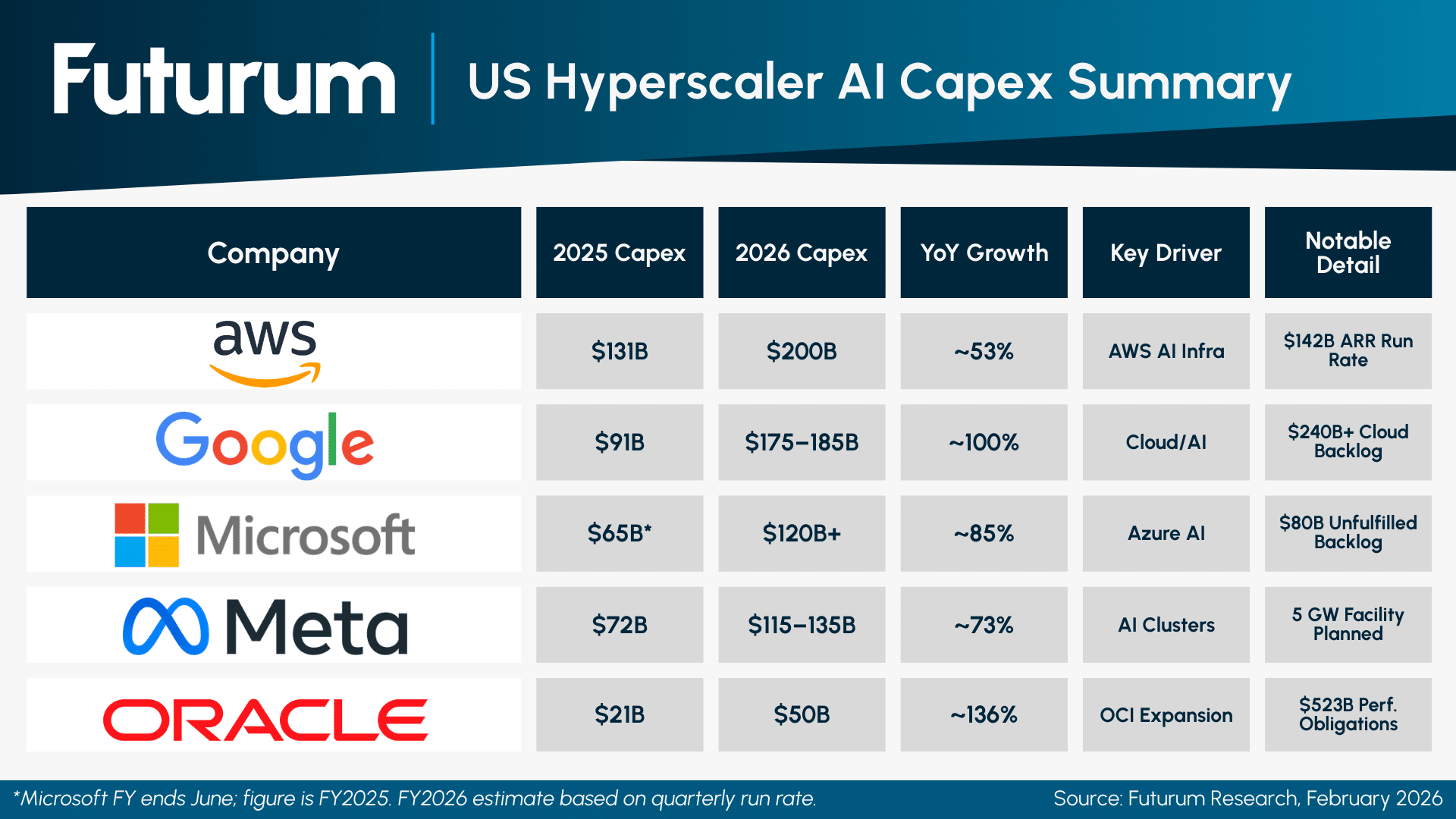
The following metrics highlight the operational strategies, projected capital outlays, and technical architectures deployed across the primary players driving the $690 billion benchmark in 2026.
| Provider / Entity | Est. 2026 Total Capex ($B) | Primary Silicon Strategy | Power Strategy & Grid Target | Dominant Infrastructure Focus |
|---|---|---|---|---|
| Amazon (AWS) | $175.0B | Mix: Commercial GPUs + AWS Trainium3/Inferentia3 | Nuclear PPAs, Utility-Scale Solar + Battery Storage (BESS) | Global Availability Zone Expansion, Custom ASIC Server Blades |
| Microsoft | $165.0B | Third-Party Accelerators + Maia 200 Custom ASICs | SMR Atomic Partnerships, Nuclear Restart Agreements | Multi-Gigawatt Super-Clusters, Direct-to-Chip Cooling |
| Alphabet (Google Cloud) | $135.0B | TPU v6e / TPU v7 Heavy Integration + Commercial GPUs | Geothermal, On-site Natural Gas with Carbon Capture | Trillium Pod Architecture, Optical Circuit Switching (OCS) |
| Meta Platforms | $115.0B | Open-Source Silicon Infrastructure + Commercial GPUs | Regional Utility Grid Buildouts, Renewable Energy Credits | Massive Scale Inference Clusters, Llama 4/5 Compute Training |
| Oracle & Sovereign Clouds | $100.0B | Heterogeneous Multi-Vendor GPU/NPU Clusters | Dedicated SMR Facilities, Grid Edge Co-location | Bare-Metal Infrastructure-as-a-Service, Sovereign Data Isolation |
Industry & Market Implications: Structural Winners and Risk Vectors
The cascading impacts of a $690 billion capital injection radiate far beyond Silicon Valley, establishing clear economic winners while creating structural liquidity pressures across broader capital markets.
The Structural Winners
- Electrical Equipment & Power Grid Suppliers: Enterprise demand for high-voltage transformers, switchgear, liquid cooling manifolds, and power distribution units (PDUs) has created multi-year backlogs for manufacturers like Eaton, Schneider Electric, and Siemens.
- Foundries and Memory Packaging Specialists: High-Bandwidth Memory (HBM4 and HBM3e) manufacturers alongside advanced packaging providers (such as TSMC's CoWoS) maintain maximum pricing power, locking in high operating margins.
- Specialized Real Estate & Energy Operators: Independent power producers (IPPs) with immediate grid interconnect capacity and nuclear utilities capable of supplying base-load energy are executing long-term, high-margin contracts.
Emerging Financial Risk Factors
Despite robust enterprise balance sheets, the sheer volume of capital allocation is introducing novel risk factors into equity and fixed-income valuation models:
- Margin Compression & Depreciation Schedules: As server hardware obsolescence cycles shorten to 3–4 years due to rapid silicon iteration, high depreciation expenses threaten near-term operating margins and Return on Invested Capital (ROIC).
- Credit Rating Scrutiny: CreditSights analysis emphasizes that while investment-grade status remains secure, debt-financed capex strategies are expanding enterprise balance sheets. High-yield and corporate bond markets must absorb historic supply levels to finance these multi-year commitments.
- Supply-Chain Squeezes on Non-AI Sectors: Industrial buyers, legacy telecom operators, and municipal utilities face prolonged lead times and cost inflation for electrical equipment and fiber hardware prioritized for high-density AI campuses.
Frequently Asked Questions (People Also Ask)
Why is projected AI capex reaching $690 billion in 2026?
The surge to $690 billion is driven by the structural pivot from small-scale AI model testing to world-scale, production-ready agentic workflows. Enterprise applications require exponentially greater compute density, memory bandwidth, and real-time inference capacity. Additionally, hyperscalers are forced to make massive upfront structural investments in land, direct energy access, and custom silicon development to secure operational longevity.
How are hyperscalers funding this unprecedented capital surge?
Funding is generated through a hybrid capital structure strategy: robust cash flows from core cloud and advertising operations, strategic corporate debt issuance, private equity partnerships for real estate buildouts, and asset-light power purchase agreements (PPAs). Off-balance-sheet joint ventures with energy providers are also increasingly utilized to de-risk balance sheets while securing grid priority.
What are the critical technical bottlenecks hindering this infrastructure buildout?
While initial bottlenecks were tied directly to GPU silicon supply, the primary constraints in 2026 are physical infrastructure assets: electrical transformer lead times (often exceeding 3 to 4 years), grid interconnection approvals, high-voltage transmission access, and technical supply constraints in High-Bandwidth Memory (HBM) and liquid-cooling manifold assemblies.
How does this capex expansion impact corporate Enterprise ROI?
Hyperscalers are taking a long-term strategic view: short-term compression in Return on Invested Capital (ROIC) and Free Cash Flow (FCF) yield is deemed an acceptable trade-off to capture foundational platform dominance. Enterprise ROI is expected to materialize as software monetization ramps up through autonomous agents, enterprise workflow automation, specialized healthcare systems, and sovereign compute hosting.
Future Outlook: Milestones to Watch Through 2028
As the $690 billion sprint accelerates through late 2026, market participants and institutional investors must track several critical indicators to evaluate the sustainability of this capital cycle:
- Energy Interconnection Approvals: Institutional scrutiny will shift toward local utility commissions and regional transmission organizations (RTOs) to verify whether promised multi-gigawatt connections actually come online on schedule.
- Commercialization Milestones of Custom Silicon: Track whether internal ASICs (Trainium, TPU, Maia, MTIA) successfully lower cost-per-token metrics for hyperscalers compared to commercial multi-vendor hardware alternatives.
- The Rise of Multi-Gigawatt Compute Nodes: Data center scale is transitioning from 100-megawatt campuses to single-site multi-gigawatt installations. The success of these installations relies heavily on the rollout of commercial SMR nuclear generation expected late in the decade.
- Enterprise Software Monetization Rates: Equity markets will increasingly demand clear evidence of end-user software revenue expansion to validate the continuous, multi-hundred-billion-dollar capex baseline.
The 2026 AI infrastructure sprint is far more than a routine technology refresh cycle—it represents a complete structural overhaul of world digital capital. As hyperscalers turn hundreds of billions of dollars into real-world energy networks, advanced silicon, and fluid thermal engineering, the boundaries of enterprise computing are being permanently redrawn.