By our Investigative Desk | Senior Bureau Chief & Chief Investigative Editor Report
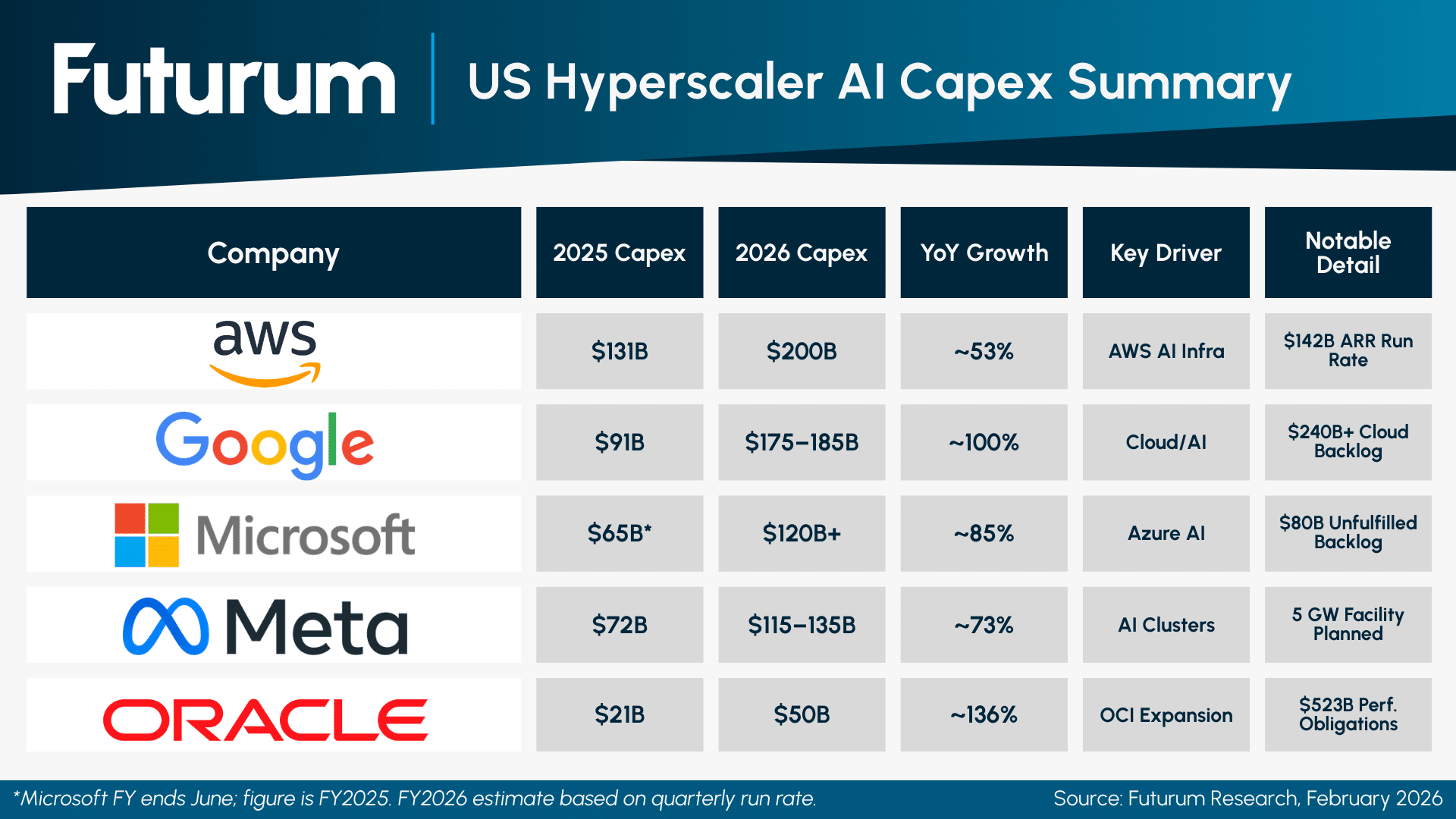
Dateline: February 2026. Primary Wire Analysis based on findings from The Futurum Group’s landmark telemetry brief, "AI Capex 2026: The $690B Infrastructure Sprint."
Executive Takeaways
- Unprecedented Capital Allocation: The five largest US cloud and AI infrastructure providers—Microsoft, Alphabet, Amazon, Meta, alongside key enterprise catalysts like Oracle—are spearheading a staggering $690 billion infrastructure sprint through 2026.
- The Compute Bottleneck: Global enterprise ROI hinges entirely on immediate access to hyper-scale cloud compute architecture. Organizations that fail to secure reserved capacity will face multi-quarter deployment delays, threatening their competitive standing.
- Geopolitical and Supply Chain Realignment: The race has expanded past traditional US hyperscalers, drawing aggressive capital expenditure from APAC markets and Chinese hyperscalers striving to bypass tightening export controls.
- Valuation Multiples Under Scrutiny: Wall Street is shifting its gaze from speculative top-line revenue metrics to rigorous capital expenditure efficiency, forcing tech giants to prove tangible enterprise monetization models.
Comprehensive Narrative: The Anatomy of a $690 Billion Bet

The global technology sector has crossed a historic financial Rubicon. According to landmark research published by The Futurum Group in February 2026, titled "AI Capex 2026: The $690B Infrastructure Sprint," the world's premier cloud and artificial intelligence infrastructure providers are committing an unprecedented $690 billion to capital expenditures. This capital injection is not merely a routine upgrade cycle; it is a high-stakes, generational arms race to secure global compute hegemony, power next-generation large language models (LLMs), and capture the burgeoning enterprise AI market.
For years, Wall Street analysts and institutional investors have debated the sustainability of runaway tech spending. Yet, as earnings calls from Microsoft, Alphabet, Amazon, and Meta underscore, the corporate strategy has shifted from cautious experimentation to aggressive, unyielding infrastructure scalability. Data center footprints are expanding across rural Virginia, northern Europe, and strategic APAC hubs, requiring gigawatt-scale power purchase agreements, advanced liquid-cooling systems, and next-generation silicon accelerators.
However, this monumental capital deployment introduces complex risk mitigation challenges. As debt and equity markets finance this massive hardware acquisition wave, corporate treasuries are under intense pressure. The central question dominating financial boardrooms is no longer whether generative AI can transform workflows, but whether the monetization velocity can match the sheer magnitude of the upfront capital expenditure. Enterprise ROI is under the microscope, and investors are demanding clear timelines for margin expansion.
Simultaneously, the competitive landscape has fractured beyond the traditional US tech titans. Oracle has emerged as a formidable force, capturing critical workloads through high-performance cloud architectures tailored specifically for frontier model training. Simultaneously, Chinese hyperscalers are engineering domestic workarounds to supply shortages, accelerating their own infrastructure sprints despite sweeping geopolitical and regulatory compliance barriers. The result is a multipolar race where access to power, silicon, and real estate dictates market winners and losers.
Verified Data & Metrics Breakdown
| Metric / Indicator | 2024–2025 Baseline | 2026 Projected Sprint | Strategic Implications |
|---|---|---|---|
| Combined Hyperscaler Capex | ~$380 Billion | $690 Billion | Massive acceleration in server, networking, and facility acquisition. |
| Primary Drivers | LLM Training & Early Pilots | Inference Scaling & Agentic AI | Shift from building models to continuous, high-volume real-time enterprise execution. |
| Key Market Participants | US Big Tech Oligopoly | US Giants + Oracle + APAC / Chinese Hyperscalers | Geographic decentralization and intensifying international competition. |
| Infrastructure Bottlenecks | GPU Allocation | Grid Capacity & Liquid Cooling | Power constraints now outweigh pure silicon availability in limiting deployment speed. |
Industry & Market Implications
The macroeconomic ramifications of the $690 billion infrastructure sprint extend far beyond Silicon Valley. Traditional utilities, electrical grid operators, and industrial real estate trusts are experiencing unprecedented demand shocks. Data centers requiring hundreds of megawatts of continuous power are forcing tech conglomerates to forge direct partnerships with nuclear and renewable energy producers, completely altering regional power markets.
In the financial sector, valuation multiples are undergoing a structural reassessment. Companies with disciplined cash flow generation and clear pathways to enterprise software monetization are commanding premium valuations, while hardware-dependent suppliers face volatile market liquidity cycles. Software vendors that successfully integrate proprietary enterprise data with hyperscale compute infrastructure are winning market share, while laggards risk terminal obsolescence.
For enterprise buyers, the market divide is stark: those who secure long-term cloud compute architecture agreements today will dominate their respective industries through automated efficiency. Everyone else will wait in line.
Frequently Asked Questions (People Also Ask)
What is driving the massive surge in AI capital expenditures to $690 billion in 2026?
The surge is driven by the transition from initial experimental model training to large-scale, production-grade inference and agentic AI deployments. As global enterprises demand real-time artificial intelligence integration at scale, hyperscalers must massively expand their data center footprints, secure power supplies, and procure advanced accelerators to meet demand.
Which companies are leading the $690 billion infrastructure sprint?
The primary architects of this spending wave are the major US cloud providers—Microsoft, Alphabet, Amazon, and Meta. Additionally, enterprise-focused cloud challengers like Oracle, alongside expanding APAC and Chinese hyperscalers, are contributing significantly to the global capital expenditure total.
How does this capital expenditure cycle impact enterprise software buyers?
Enterprise buyers face tightening cloud compute availability and potential cost fluctuations. Organizations must prioritize strategic vendor partnerships and secure reserved capacity early to avoid operational bottlenecks and deployment delays for their own AI initiatives.
What are the primary bottlenecks threatening the 2026 infrastructure rollout?
While silicon supply remains a consideration, the most critical bottlenecks facing the industry in 2026 are electrical grid capacity, power generation constraints, and the complex engineering required to deploy high-density liquid cooling across massive data center campuses.
Future Outlook & Key Milestones to Watch
As the industry navigates the remainder of 2026, stakeholders must monitor several critical inflection points. First, quarterly earnings reports will face intense scrutiny regarding monetization metrics; Wall Street will demand concrete evidence that $690 billion in capital expenditure is yielding sustainable operating margins. Second, regulatory developments surrounding energy consumption, grid access, and international trade controls will dictate how efficiently hyperscalers can scale their physical footprints.
Ultimately, the $690B Infrastructure Sprint is a high-stakes crucible. It will separate transient market hype from enduring technological utility, reshaping the global corporate hierarchy for decades to come.