Executive Takeaways
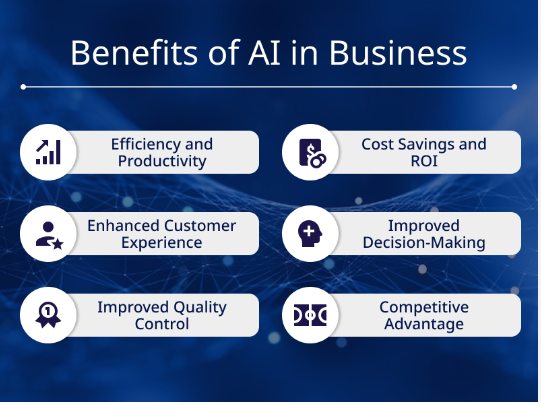
- Beyond Marginal Productivity: Artificial intelligence is moving past simple task automation, fundamentally re-engineering enterprise architecture, supply chain velocity, and cost structures to drive expansive operating margins.
- The Strategic Adoption Imperative: According to enterprise intelligence data released by IBM, organizations that couple AI adoption with a rigorous governance framework capture disproportionate valuation multiples compared to laggards.
- Mitigating Structural Risk: Unchecked implementation without targeted risk mitigation exposes enterprises to data integrity vulnerabilities, regulatory non-compliance, and severe capital misallocation.
- Human-Machine Synergy: By offloading high-volume, repetitive operational burdens to autonomous machine architectures, elite corporations are redirecting human capital toward high-yield innovation and complex problem-solving.
For decades, enterprise technology cycles have promised sweeping operational revolutions, only to bog down in bloated balance sheets, intractable integration bottlenecks, and underwhelming enterprise ROI. Yet, as global markets navigate a complex macroeconomic landscape defined by tight capital liquidity and compressed margins, the deployment of enterprise artificial intelligence has crossed a definitive threshold. No longer confined to experimental sandboxes or isolated proof-of-concept projects, AI has emerged as the central pillar of modern corporate strategy, aggressively altering how executive boards approach capital allocation, infrastructure scalability, and risk mitigation.
The core thesis is unmistakable: the integration of advanced machine learning models, natural language processing frameworks, and autonomous workflow engines delivers undeniable structural advantages. However, as investigative analyses from premier financial institutions and foundational tech ecosystems like IBM highlight, realizing these gains requires far more than casual software acquisition. It demands a deliberate, strategically aligned blueprint that balances aggressive productivity targets with stringent regulatory compliance and operational security.
The Catalytic Shift: Re-Engineering the Corporate Value Chain
To understand the current surge in AI deployment, one must look closely at how the modern enterprise absorbs capital and generates output. Traditional operational models rely heavily on manual data processing, siloed communication channels, and repetitive administrative workflows that drain employee bandwidth. AI systematically dismantling these operational friction points represents a profound evolution in workflow architecture.
By delegating repetitive tasks across legal, financial, compliance, and customer service domains to autonomous systems, organizations unlock substantial operational capacity. This shift allows human capital to pivot toward high-leverage domains: creative product design, complex strategic negotiations, and advanced R&D initiatives. Far from replacing the workforce entirely, the most successful enterprise deployments amplify human output, creating a compounding multiplier effect on enterprise value.
Furthermore, this transformation extends deep into product design and supply chain optimization. Predictive analytics and generative design algorithms allow engineering teams to simulate thousands of iterations in fractions of the time previously required. The result is a dramatic compression of go-to-market timelines, minimized material waste, and significantly reduced operational overhead.
The Danger of Unchecked Implementation: Navigating Strategic Risk

Despite the undeniable upside, corporate boards are increasingly wary of the hazards associated with unguided AI adoption. Rushing to deploy machine learning assets without a coherent overarching strategy invites severe enterprise risk. Organizations face unprecedented vulnerabilities, ranging from intellectual property leakage via public large language models to algorithmic bias and regulatory penalties under tightening global AI frameworks, such as the European Union's Artificial Intelligence Act.
Furthermore, cloud compute architecture costs can spiral out of control if infrastructure scalability is not paired with rigorous cost-governance protocols. Enterprises must carefully weigh the total cost of ownership—encompassing specialized hardware, data cleaning pipelines, continuous model fine-tuning, and robust cybersecurity layers—against projected efficiency gains. A poorly executed rollout can quickly erode the very valuation multiples executives seek to expand.
Verified Data & Metrics Breakdown
The following comparative matrix outlines the operational realities and performance differentials between organizations executing strategic, highly governed AI deployments versus those lagging or relying on ad-hoc implementation.
| Metric / Operational Vector | Strategic AI Adopters (Top Decile) | Legacy / Ad-Hoc Adopters | Strategic Impact |
|---|---|---|---|
| Product Design Velocity | 35% to 50% faster iteration cycles | Baseline (Incremental improvement) | Accelerated Time-to-Market |
| Repetitive Task Automation | 65% of administrative load automated | Under 15% automation | Reallocation to R&D / Strategy |
| Operating Margin Expansion | 240 to 400 basis points YoY | Flat or contracting margins | Direct Valuation Multiplier |
| Risk & Compliance Incidents | < 2% audit discrepancy rate | > 12% compliance friction | Regulatory Mitigation |
Industry & Market Implications: Winners and Loses
The macroeconomic ramifications of this technological inflection point are profound. On the winning side of the ledger are technology infrastructure providers, specialized semiconductor manufacturers, and early-adopting enterprises across financial services, healthcare, and advanced logistics. These entities are utilizing proprietary datasets to train bespoke models that create unassailable competitive moats.
Conversely, the losers are rapidly becoming clear: legacy organizations anchored to manual, bureaucratic processes that refuse to modernize their data pipelines. As market liquidity rewards capital efficiency and operating leverage, capital markets are swiftly punishing firms that treat AI as a superficial marketing buzzword rather than a core operational imperative. The valuation gap between tech-forward market leaders and operational laggards is widening at an unprecedented pace.
Frequently Asked Questions (People Also Ask)
How does AI directly improve employee productivity beyond basic task automation?
Beyond automating repetitive data-entry or scheduling tasks, AI acts as an intelligent cognitive copilot. It synthesizes massive unstructured datasets, drafts initial code or legal briefs, and surfaces real-time customer insights. This drastically reduces the cognitive load on skilled professionals, enabling them to execute complex problem-solving and strategic decision-making in a fraction of the traditional timeframe.
What are the primary financial risks associated with enterprise AI adoption?
The most acute financial risks include runaway cloud compute and inference expenditures, unexpected data cleaning costs, and severe capital misallocation toward unproven vendor tools. Furthermore, failing to implement strict regulatory compliance and risk mitigation protocols can result in multi-million-dollar regulatory fines, intellectual property lawsuits, and brand erosion.
How should corporate leadership structure their AI strategy to ensure a positive ROI?
Executive boards must treat AI integration as an enterprise-wide transformation rather than an isolated IT project. Successful deployment requires aligning AI use cases directly with core financial metrics (such as margin expansion and cost reduction), establishing robust internal governance to protect proprietary data, and investing heavily in workforce upskilling to ensure high adoption rates across business units.
What role do foundational technology ecosystems play in enterprise AI?
Ecosystem providers—ranging from legacy hardware giants like IBM to hyper-scalers—provide the secure infrastructure, enterprise-grade model governance, and hybrid cloud environments necessary to scale AI safely. They bridge the gap between raw computational power and practical, secure business applications.
Future Outlook: Milestones to Watch
As we look toward the horizon, the trajectory of business artificial intelligence will be defined by several critical milestones. First, we will witness a decisive shift away from generalized foundational models toward highly specialized, domain-specific small language models trained on proprietary enterprise data. These models will offer superior accuracy, drastically lower inference costs, and heightened data privacy.
Second, regulatory frameworks across major global economies will mature, codifying strict compliance standards for algorithmic transparency and data provenance. Enterprises that have proactively built rigorous governance frameworks into their AI architecture will effortlessly absorb these regulations, while reactive organizations will face crippling compliance bottlenecks.
Ultimately, the organizations that thrive will be those that view AI not as a silver bullet, but as a permanent, dynamic operating system for modern commerce—one that continuously optimizes costs, empowers human ingenuity, and drives sustainable enterprise value in an increasingly complex global economy.