Executive Takeaways
- Systemic Cross-Currents: The monetary policy paths of the "G4" central banks—the Federal Reserve, European Central Bank (ECB), Bank of Japan (BOJ), and Bank of England (BOE)—are diverging at an unprecedented velocity, creating a complex macroeconomic backdrop for the SPDR S&P 500 ETF Trust (
AMEX:SPY). - The BOJ Yen Carry Trade Reversal: As the Bank of Japan continues its structural policy normalization away from negative rates and Yield Curve Control (YCC), the unwinding of cross-border yen carry trades poses a primary tail-risk to global liquidity and US equity valuation multiples.
- Liquidity Arbitrage & Capital Inflows: Relative monetary easing by the ECB and BOE amid stagnant European growth is reinforcing foreign capital flows into US capital markets, providing a structural liquidity bid for high-margin
AMEX:SPYmega-cap technology constituents despite elevated domestic borrowing costs. - Valuation Multiples vs. Terminal Rates: The S&P 500’s forward Price-to-Earnings (P/E) multiple remains hyper-sensitive to global real yields. Equity risk premia (ERP) are operating at historical tights, leaving
AMEX:SPYvulnerable to any unexpected hawkish recalibration from the Federal Reserve or erratic sovereign debt auctions.
The G4 Monetary Nexus & The Mechanistic Transmission to AMEX:SPY
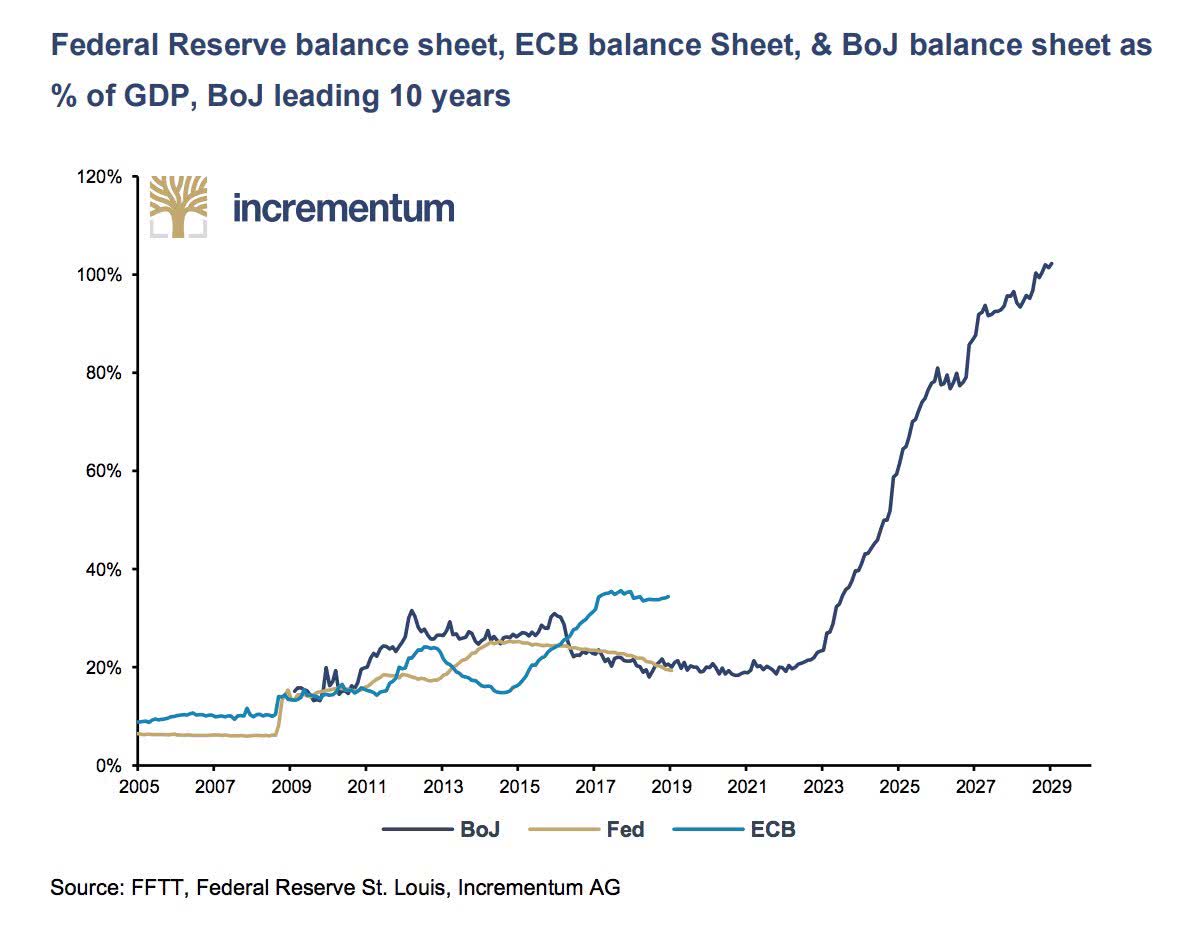
In global macroeconomics, no financial asset trades in isolation. The SPDR S&P 500 ETF Trust (AMEX:SPY), representing the core benchmark for global equity capital, is heavily governed by international capital flows, cross-currency yield differentials, and aggregate central bank balance sheet dynamics. According to macro-intelligence published via GlobalWolfStreet on TradingView, analyzing the interconnected framework of the Federal Reserve, ECB, BOJ, and BOE is essential for decoding equity market liquidity and risk-asset trajectories.
Central bank interest rate decisions serve as the gravitational force for global asset pricing. By determining the risk-free rate of return, these institutions govern corporate discount rates, enterprise capital allocation strategies, and global risk appetite. As central banks transition through asynchronous monetary cycles, the structural mechanisms transmitting global central bank decisions directly into AMEX:SPY valuation multiples demand rigorous institutional examination.
1. The Federal Reserve’s Equilibrium Search: Neutral Rates & Real Yields
The Federal Reserve remains the anchor of global financial condition indexes. Having engineered one of the most aggressive rate-hiking cycles in modern history to combat elevated inflation, the FOMC’s current focus centers on calibrating the long-run neutral rate (r*). For AMEX:SPY, the primary transmission mechanism is the real discount rate applied to corporate earnings projections.
When the Federal Reserve maintains nominal policy rates above expected inflation, real yields on US Treasuries expand. Elevated real yields compress equity valuation multiples, particularly for growth-oriented technology enterprises that dominate AMEX:SPY weighting. Conversely, as the Fed shifts toward monetary easing or halts quantitative tightening (QT), federal reserve net liquidity—defined as Fed total assets minus the Reverse Repo Facility (RRP) and Treasury General Account (TGA)—expands. This net liquidity expansion historically displays a strong positive correlation with AMEX:SPY upside, lowering corporate weighted average cost of capital (WACC) and incentivizing institutional share buyback programs.
2. The Bank of Japan Wildcard: Structural Normalization and Carry Trade Unwinding
While Western central banks navigate inflation cooling cycles, the Bank of Japan (BOJ) under Governor Kazuo Ueda represents the most critical asymmetrical threat to global market liquidity. For decades, Japan functioned as the world's primary creditor nation and yield anchor. Unprecedented monetary accommodation, zero-to-negative policy rates, and aggressive Yield Curve Control (YCC) incentivized institutional investors to borrow cheap Japanese Yen and deploy that capital into higher-yielding foreign assets—specifically US Treasuries and S&P 500 equities (AMEX:SPY).
As the BOJ normalizes monetary policy by raising benchmark borrowing rates and curtailing Japanese Government Bond (JGB) purchases, Japanese sovereign yields are rising. This structural transition alters cross-border capital incentives. The tightening yield spread between US Treasuries and JGBs, coupled with Japanese Yen appreciation, forces foreign institutional investors to unwind leverage and repatriate capital back to Tokyo. The liquidation of these massive FX carry trade positions requires selling US dollar-denominated assets, creating sudden volatility spikes in AMEX:SPY and pushing US term premia higher across the yield curve.
3. ECB and Bank of England: Managing Growth Stagnation & FX Spreads
Across the Atlantic, the European Central Bank (ECB) and the Bank of England (BOE) face distinct stagflationary pressures, characterized by sluggish GDP growth and persistent structural cost inputs. As European enterprise ROI contracts under stringent fiscal conditions, both central banks have been compelled to initiate rate-cutting cycles to prevent deep economic downturns.
This monetary easing in Europe directly impacts AMEX:SPY through cross-currency mechanics and corporate earnings translation:
- Currency Arbitrage: Rapid rate cuts by the ECB and BOE relative to the Federal Reserve weaken the Euro (EUR) and British Pound (GBP) against the US Dollar (USD). A stronger US Dollar Index (DXY) presents a double-edged sword for S&P 500 companies: while it signals strong international capital flight into US capital markets, it also creates foreign exchange headwinds for S&P 500 multi-national corporations generating foreign revenues.
- Relative Valuation Inflows: Because European capital markets exhibit lower benchmark earnings growth and structural tech deficits, global asset allocators increasingly use ECB and BOE rate cuts as liquidity events to reallocate global portfolio capital into US equity markets, sustaining elevated
AMEX:SPYmultiples.
Verified G4 Central Bank Policy & Asset Impact Matrix
The matrix below outlines the divergent operational mandates of the four major central banks, detailing their current macro stance, balance sheet trajectory, and structural mechanics affecting AMEX:SPY.
| Central Bank | Policy Rate Vector | Balance Sheet Strategy | Primary FX Vector | Direct Transmission Mechanism to AMEX:SPY |
|---|---|---|---|---|
| Federal Reserve (Fed) | Pivot to Neutral / Fine-Tuning | Tapered Quantitative Tightening (QT) | US Dollar Index (DXY) Anchor | Determines global risk-free discount rate, corporate WACC, and baseline valuation multiples for mega-cap tech equities. |
| Bank of Japan (BOJ) | Hawkish Normalization / Rate Hikes | Tapering JGB Purchases | USD/JPY Carry Trade Dynamic | Triggers global unwinding of Yen-denominated leverage, driving potential cross-border capital repatriation away from US equities. |
| European Central Bank (ECB) | Dovish Easing Cycle | Active Balance Sheet Reduction (APP/PEPP) | EUR/USD Rate Parity Pressures | Drives European capital flight into liquid US equity benchmarks; creates FX revenue conversion headwinds for US multinationals. |
| Bank of England (BOE) | Gradual Easing / Data Dependent | Active Gilt Reduction (QT) | GBP/USD Volatility | Influences European cross-asset liquidity and international corporate debt refinancing terms in London capital markets. |
Strategic Market Implications: Institutional Capital Winners and Losers
The macroeconomic cross-currents generated by G4 central bank divergence generate distinct sector-level winners and losers within the AMEX:SPY portfolio architecture. Institutional portfolio managers must continuously optimize capital allocation based on changing liquidity conditions and yield curve shifts.
Sector & Asset Classes Positioned to Outperform:
- Mega-Cap Technology & Secular Growth (Weighting ~30%+ of SPY): Enterprise tech giants equipped with fortress balance sheets, high net cash reserves, and pricing power thrive in a central bank environment characterized by moderate global liquidity growth. High enterprise ROI and cloud compute monetization buffer these firms against elevated base rates.
- US Financial Services & Money Center Banks: A steepening US yield curve resulting from Fed rate cuts combined with higher long-end Treasury yields expands Net Interest Margins (NIM) for large commercial institutions within
AMEX:SPY. - High-Quality Private Credit & Corporate Debt Instruments: Enterprise cash flows remain robust for top-tier balance sheets, providing strong risk mitigation against broader economic slowdowns.
Sector & Asset Classes Facing Structural Downside:
- Highly Leveraged Small-Caps & Non-Profitable Tech: Companies dependent on continuous short-term debt refinancing face elevated debt-servicing costs as global risk-free rates remain elevated far above post-2008 zero-bound levels.
- Capital-Intensive Rate-Sensitive Sectors (Real Estate & Utilities): High real yields lower the relative dividend attractiveness of traditional income sectors, forcing valuation multiple compression across utility and REIT components of the broader market.
- Export-Dependent Cyclicals: A resilient US Dollar driven by international rate differentials diminishes foreign sales competitiveness for US manufacturing and industrial exporters.
People Also Ask (Frequently Asked Questions)
How does Bank of Japan rate tightening directly affect the S&P 500 (AMEX:SPY)?
When the Bank of Japan raises interest rates, it narrows the yield differential between Japanese debt and US sovereign bonds. This reduces the profitability of the "Yen Carry Trade"—a strategy where global financial institutions borrow cheap yen to purchase US assets like Treasuries and AMEX:SPY. As carry trades are unwound, institutional investors sell US equities and convert proceeds back to Yen, creating downward price volatility and liquidity contraction across US equity indices.
What role does global central bank liquidity play in driving equity valuation multiples?
Global central bank liquidity—measured by aggregate G4 central bank balance sheets converted into USD—acts as a primary determinant of financial conditions. Expanded central bank balance sheets compress credit spreads, lower sovereign bond yields, and force yield-seeking capital into equities. This dynamic inflates forward Price-to-Earnings (P/E) multiples for AMEX:SPY, regardless of real economic growth velocity.
Why does monetary divergence between the Fed and ECB create arbitrage for US equity inflows?
When the ECB cuts rates faster than the Federal Reserve, European bond yields fall rapidly relative to US yields. International sovereign and institutional investors seeking higher inflation-adjusted returns reallocate capital out of European fixed income and into higher-yielding US corporate assets and blue-chip equities represented by AMEX:SPY. This structural inflow bolsters US asset prices while strengthening the US Dollar.
How does Federal Reserve Quantitative Tightening (QT) impact SPY market liquidity?
Quantitative Tightening reduces the Federal Reserve's balance sheet by allowing Treasury and agency mortgage-backed securities to mature without reinvestment. This process drains bank reserves from the domestic financial system. Lower bank reserves reduce primary dealer liquidity and capital market depth, amplifying day-to-day volatility swings for AMEX:SPY and making market infrastructure more susceptible to exogenous shock events.
Future Outlook: Critical Monetary Milestones and Volatility Catalysts
Navigating AMEX:SPY through the evolving G4 central bank landscape requires strict monitoring of critical macroeconomic triggers and central bank operational updates. Investors must focus on several key systemic milestones:
- Federal Reserve RRP Exhaustion and SOFR Dynamics: As the Fed's Reverse Repo Facility balances approach lower limits, quantitative tightening will directly drain bank reserves. Any spikes in the Secured Overnight Financing Rate (SOFR) will signal liquidity stress, forcing the Fed to halt balance sheet runoff to prevent equity volatility.
- BOJ Inflation Transmission and JGB Auction Demand: Sustained wage growth and inflation dynamics in Japan will dictate the speed of BOJ Governor Ueda’s rate normalization. Surges in 10-year JGB yields above multi-year highs will mark elevated tail-risk for foreign liquidations of S&P 500 holdings.
- Cross-Border Corporate Debt Refinancing Wall: Enterprise debt issued during the low-rate environment of 2020-2021 matures at higher refinancing rates over the coming quarters. Corporate capability to absorb higher interest expense without eroding gross profit margins will determine whether
AMEX:SPYearnings growth can sustain current forward multiples.
In summary, while domestic macroeconomic data drives short-term US headlines, global central bank liquidity dynamics serve as the fundamental engine behind long-term capital allocation. Investors holding AMEX:SPY must view the Federal Reserve, ECB, BOJ, and BOE not as isolated sovereign entities, but as an interconnected global monetary system where liquidity shifts in Tokyo or Frankfurt echo directly across the floor of the New York Stock Exchange.