Executive Takeaways
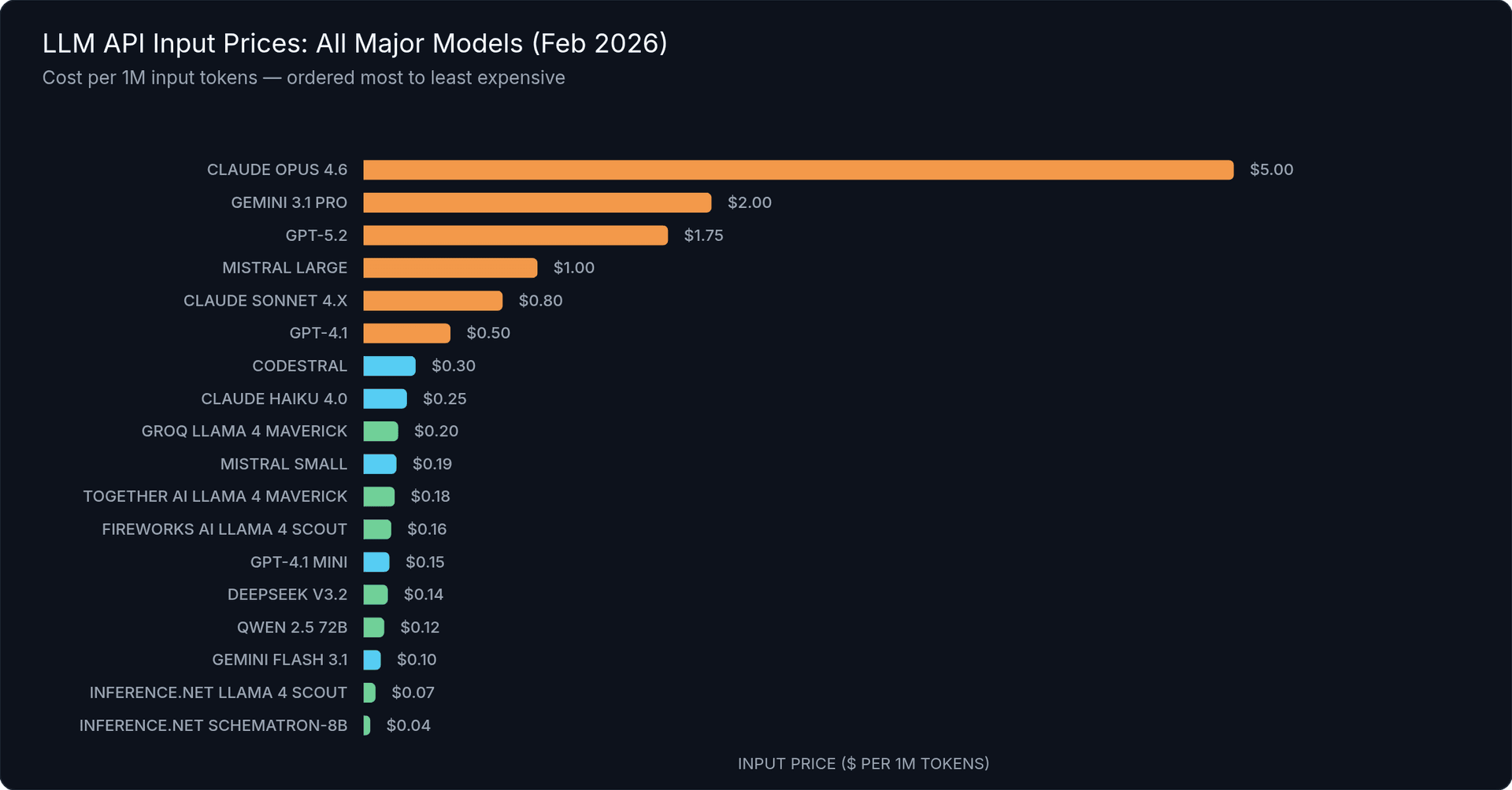
- Deflationary Pressures: Intensifying competition across more than 160 tracked large language model launches has driven token input and output costs down by orders of magnitude, threatening pure-play infrastructure margins.
- Enterprise ROI Realignment: Corporate technology buyers are shifting focus from raw model capability to total cost of ownership (TCO), inference latency, and fine-tuning overhead when allocating capital.
- The Compute Bottleneck: Capital allocation for specialized silicon (GPUs/TPUs) and cloud compute architecture remains the primary determinant of vendor pricing power and market liquidity.
- Strategic Differentiation: Tier-1 providers are successfully decoupling from pure commodity pricing by bundling proprietary retrieval-augmented generation (RAG) frameworks, data residency guarantees, and strict regulatory compliance.
NEW YORK — For nearly three years, the corporate landscape has been transfixed by an unprecedented technological gold rush. Generative artificial intelligence, anchored by the rapid maturation of large language models (LLMs), has transitioned from an exploratory research curiosity to a core operational pillar across Wall Street, Silicon Valley, and global manufacturing hubs. Yet, behind the polished keynote presentations and soaring valuation multiples of enterprise software providers lies a brutal, opaque economic battlefield: the race to the bottom in token pricing.
Recent comprehensive tracking data from enterprise research analysts at AIMultiple reveals a stark reality. An analysis of more than 15 tier-one and tier-two LLM providers—evaluated across historical launch prices encompassing upwards of 160 distinct model iterations—paints a picture of radical market volatility. While foundational intelligence capabilities scale upward at an exponential rate, per-token pricing models are experiencing severe downward pressure, challenging the capital expenditure (CapEx) models of both hyperscale cloud providers and venture-backed upstarts.
As enterprise procurement officers scrutinize software budgets for the upcoming fiscal cycle, understanding the granular cost structures, infrastructural bottlenecks, and hidden multipliers of LLM deployment has become a critical exercise in risk mitigation and financial governance.
The Catalytic Shift: From Monopoly Rents to Hyper-Commoditization
The initial wave of commercialized generative AI was characterized by acute scarcity. When early proprietary models debuted, pioneering vendors commanded near-monopoly rents. Early enterprise adopters absorbed steep compute fees without hesitation, viewing artificial intelligence as an existential strategic imperative rather than a cost-optimized line item.
However, the market structure has undergone a fundamental structural transformation. The entrance of open-weights models, aggressive pricing maneuvers by hyperscalers seeking to lock customers into proprietary cloud ecosystems, and the proliferation of distilled, highly efficient smaller models have radically compressed margins. Today, enterprise buyers are no longer simply asking, "How smart is the model?" Instead, they are deploying sophisticated financial modeling to calculate token economics down to the fraction of a cent, weighing inference latency against operational throughput.
This dynamic has forced providers into a precarious balancing act. To maintain market share, vendors must continuously subsidize or slash input/output pricing, even as the underlying capital costs required to train and run frontier models—driven by soaring electricity demands, specialized semiconductor procurement, and complex data center logistics—escalate.
Comparative Analysis: Pricing, Performance, and Token Economics

To evaluate the current state of the market, our investigative desk synthesized data tracking launch metrics, cost structures, and performance benchmarks across leading ecosystem players. The dataset highlights wide disparities in how vendors monetize computational intelligence.
| Provider / Ecosystem | Primary Model Class | Avg. Input Cost (per 1M tokens) | Avg. Output Cost (per 1M tokens) | Primary Enterprise Differentiator |
|---|---|---|---|---|
| OpenAI | Frontier / Flagship | $2.50 – $15.00 | $10.00 – $60.00 | Ecosystem maturity, advanced reasoning frameworks |
| Anthropic | Claude Sonnet / Opus | $3.00 – $15.00 | $15.00 – $75.00 | Extended context windows, nuanced coding safety |
| Google Cloud (Vertex AI) | Gemini Pro / Ultra | $1.25 – $7.00 | $5.00 – $21.00 | Native multimodal integration, massive context handling |
| Microsoft Azure OpenAI | Enterprise GPT Series | $2.50 – $10.00 | $10.00 – $30.00 | Enterprise compliance, data privacy guarantees, SLA backing |
| Meta (Open Weights) | Llama 3 / 3.1 / 3.2 Suites | $0.00 (Self-Hosted) / Varies via API | $0.00 (Self-Hosted) / Varies via API | Zero license cost for weights, full infrastructure control |
| Cohere / Mistral AI | Specialized Commercial | $1.00 – $2.00 | $3.00 – $6.00 | Multilingual specialization, enterprise search optimization |
As illustrated in the comparative breakdown above, pricing stratification is deeply tied to the underlying product architecture. While raw API calls for commoditized tasks (such as simple classification or text extraction) have plummeted toward negligible fractions of a cent, high-reasoning tasks utilizing frontier models continue to command premium pricing tiers. Notably, the emergence of high-performance open-weights alternatives has forced commercial API providers to constantly justify their fees through managed infrastructure stability, low latency SLAs, and integrated security guardrails.
Industry & Market Implications: Winners, Losers, and Economic Realities
The macroscopic financial fallout of this pricing evolution extends far beyond silicon valley boardrooms, reshaping capital expenditure cycles across multiple global sectors.
1. The Hyperscalers and Infrastructure Conglomerates
Cloud giants controlling proprietary data center architecture—specifically Microsoft, Amazon Web Services (AWS), and Google Cloud—occupy a commanding strategic position. Even if raw model pricing drops to near-zero, these firms capture monetization through underlying cloud compute consumption, storage, and egress fees. For these entities, LLMs function as high-velocity loss leaders designed to lock enterprises into sticky, multi-billion-dollar infrastructure contracts.
2. Pure-Play AI Vendors and the Margin Squeeze
Conversely, standalone model developers face a perilous economic landscape. Without a diversified cloud infrastructure business to absorb capital expenditures, pure-play AI labs are locked in a relentless race for capital. To survive, they must continually innovate at the frontier level to justify premium pricing while aggressively trimming operational overhead. This dynamic inevitably accelerates industry consolidation, as smaller independent labs struggle to fund the next generation of cluster training runs.
3. Enterprise Buyers: Navigating the TCO Maze
For corporate Chief Information Officers (CIOs) and Chief Financial Officers (CFOs), the collapse in token pricing is a welcome development, but it introduces operational complexity. Selecting a vendor based solely on headline API costs is an increasingly flawed strategy. True total cost of ownership (TCO) must account for fine-tuning overhead, token efficiency (how many tokens a model requires to solve a specific business problem), latency-induced productivity losses, and regulatory compliance risks.
Frequently Asked Questions (People Also Ask)
Frequently Asked Questions
How are LLM input and output costs calculated?
LLM pricing is universally measured per million tokens (where one token roughly equals 0.75 words in English). Input tokens represent the prompts, context documents, and system instructions sent to the model, while output tokens represent the generated response. Output tokens are consistently priced higher—often 3x to 5x more than input tokens—due to the intensive auto-regressive generation computational workload required during the inference phase.
What is the economic difference between proprietary APIs and open-weights models?
Proprietary API providers (such as OpenAI and Anthropic) manage all infrastructure, updates, and scaling behind a closed interface, charging strictly on a pay-as-you-go consumption model. Open-weights models (such as Meta’s Llama series) provide the raw model parameters free of licensing fees for most enterprise users, but require organizations to provision, secure, and maintain their own dedicated cloud GPU or TPU infrastructure, shifting the financial burden from variable API spend to fixed capital expenditure.
Why are smaller, specialized models disrupting enterprise pricing strategies?
Recent industry benchmarks demonstrate that "small language models" (SLMs) and highly distilled architectures can match or exceed the performance of massive frontier models on domain-specific enterprise tasks—such as financial document parsing or localized customer support—at a fraction of the inference cost and latency. This allows enterprises to bypass expensive flagship models for 80% of routine automated workflows.
How do security and data privacy impact enterprise LLM procurement?
Enterprise procurement is heavily gated by compliance frameworks such as SOC 2, HIPAA, GDPR, and industry-specific regulations. Vendors that offer isolated tenant architectures, zero-data-retention policies for training, and dedicated private instances command significant pricing power over consumer-grade or public-endpoint offerings, as legal liability mitigation often outweighs raw cost savings.
Future Outlook: Strategic Milestones to Watch
As the generative AI market matures past its initial hype cycle, the next 12 to 18 months will establish definitive boundaries for LLM pricing and economic viability. Key milestones executive leaders must monitor include:
- The Rise of Dynamic Inference Pricing: Moving away from static per-token rates toward real-time auctions or tier-based complexity pricing, where simple queries execute at near-zero marginal cost and complex multi-step reasoning commands dynamic premiums.
- -Silicon Diversification and Cost Unbundling: The aggressive deployment of proprietary enterprise ASICs (application-specific integrated circuits) by major cloud buyers designed to bypass traditional GPU monopolies, directly feeding downward pressure into downstream token pricing.
- Consolidation of Frontier Labs: Increased M&A activity and strategic joint ventures as second- and third-tier model providers face compressed operating margins and seek refuge within legacy enterprise software conglomerates.
- Mandatory ROI Benchmarking: The institutionalization of standardized enterprise auditing tools designed to measure exact productivity yields against AI token consumption, transforming generative AI from an experimental budget line into a strictly audited operational expense.
Ultimately, while the short-term economic landscape is defined by fierce deflationary pricing wars and hyper-competition among more than 160 tracked model variations, the long-term equilibrium will favor providers capable of combining ironclad data security, low-latency infrastructure, and unmistakable operational ROI.