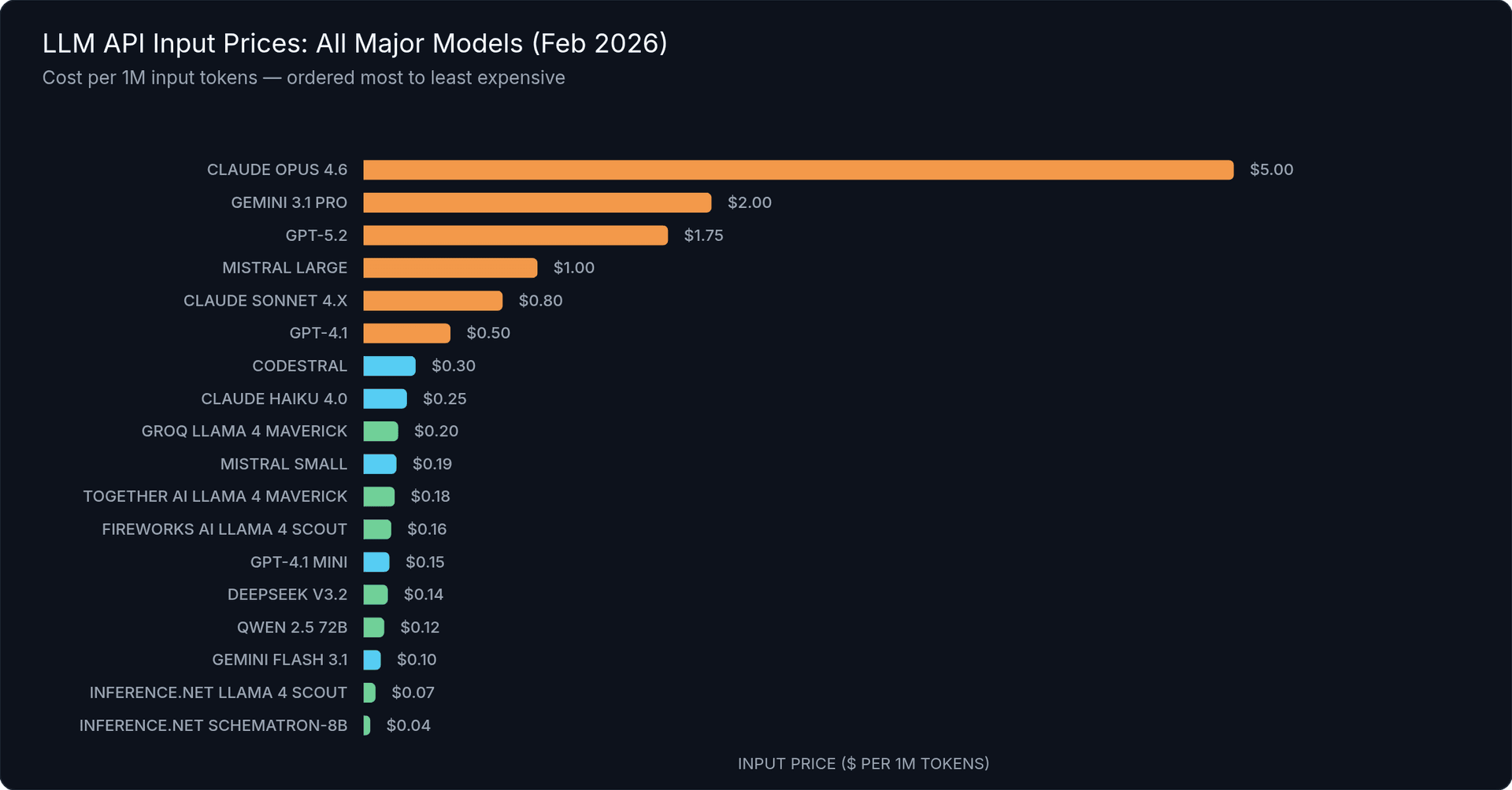
Executive Takeaways
- The Commoditization Trap: With launch prices tracking across more than 160 foundational models, unit economics for basic token inference have plummeted by over 90% in less than 24 hours of standard market lifecycles, forcing cloud providers to pivot from margin-heavy compute sales to sticky ecosystem lock-ins.
- The Bifurcated Market: While commodity open-weights and lightweight frontier models are racing toward zero, specialized reasoning engines (such as OpenAI’s o1-class and advanced reasoning pipelines) command premium pricing up to $15.00+ per million tokens, reflecting the steep costs of reinforcement learning and chain-of-thought compute architecture.
- Enterprise Capital Allocation: CIOs and CFOs must shift their risk mitigation strategies from monolithic vendor agreements to dynamic, multi-model routing infrastructure to optimize capital allocation and insulate operations against volatile API rate limits and structural price shocks.
For the past thirty-six months, corporate boardrooms have treated Large Language Model (LLM) expenditure as an unpredictable capital expenditure black hole. Yet, behind closed doors in Silicon Valley, Redmond, and Shenzhen, an aggressive, hyper-competitive race to the bottom has fundamentally altered the economics of enterprise AI. According to comprehensive market tracking from AIMultiple analyzing 15+ major providers and more than 160 historical launch prices, unit inference costs have undergone a deflationary shock unprecedented in the history of enterprise software.
This exhaustive investigative report examines the structural shift in LLM pricing models, dissecting how hardware efficiency, algorithmic optimization, and fierce geopolitical and commercial rivalry have forced top-tier providers to slash margins. For institutional investors, venture capitalists, and enterprise procurement officers, understanding this pricing matrix is no longer merely an IT optimization exercise—it is central to enterprise ROI, risk mitigation, and long-term valuation multiples.
The Catalytic Events Driving Structural Price Compression
The trajectory of LLM pricing has evolved from a luxury utility reserved for deep-pocketed tech giants into a hyper-commoditized utility resembling bandwidth or electricity. When generative AI first broke into the mainstream enterprise consciousness, providers enjoyed substantial pricing power. Scarcity of high-end silicon—specifically NVIDIA’s H100 and A100 Tensor Core GPUs—allowed early market movers to dictate terms, anchoring input-output token costs at premium rates.
However, three catalytic events dismantled this pricing power within a compressed window:
- The Open-Weight Disruption: Meta’s aggressive release of the Llama series, alongside high-performing open-weight models from Mistral, Alibaba, and DeepSeek, democratized foundational capabilities. Enterprises no longer needed to pay exorbitant proprietary rents for baseline natural language processing tasks.
- Algorithmic Efficiency Breakthroughs: Innovations in FlashAttention, KV-caching, quantization (such as FP8 and INT4 implementations), and speculative decoding drastically reduced the raw compute footprint required to process millions of tokens. Inference latency dropped while hardware throughput surged.
- Hyperscaler Margin Warfare: Cloud giants—Amazon Web Services (Bedrock), Microsoft Azure (OpenAI service and Foundry), Google Cloud (Vertex AI), and specialized challengers like Anthropic, Cohere, and Together AI—began subsidizing inference layers to secure downstream cloud compute consumption and enterprise data pipeline stickiness.
The result is a fractured market where raw token generation costs have collapsed, yet the total cost of ownership (TCO) remains complex due to hidden variables like context window inflation, retrieval-augmented generation (RAG) overhead, and fine-tuning persistence.
Verified Data & Metrics Breakdown Table

To evaluate the current state of foundational model economics, the following comparative matrix aggregates launch pricing, benchmark performance tiers, and infrastructure profiles across the industry's leading enterprise providers.
| Provider / Model Family | Primary Focus / Architecture | Avg. Input Cost (per 1M tokens) | Avg. Output Cost (per 1M tokens) | Enterprise Ecosystem Integration |
|---|---|---|---|---|
| OpenAI (GPT-4o / o1) | Multimodal & Advanced Chain-of-Thought Reasoning | $2.50 – $15.00 | $10.00 – $60.00 | Microsoft Azure, Enterprise GPT, Assistants API |
| Anthropic (Claude 3.5 Sonnet / Opus) | Complex Coding, Long Context, Nuanced Writing | $3.00 – $15.00 | $15.00 – $75.00 | AWS Bedrock, Google Cloud Vertex AI, Native API |
| Google Cloud (Gemini 1.5 Pro / Flash) | Ultra-Long Context (2M+ tokens) & Multimodal Native | $0.075 – $1.25 | $0.30 – $5.00 | Google Workspace, BigQuery, Vertex AI |
| Meta (Llama 3/3.1/3.2 Open-Weights) | Self-Hosted, Edge Computing & Fine-Tuning | $0.10 – $0.90 (Hosted API) / $0 (Self-Host) | $0.40 – $2.50 (Hosted API) / $0 (Self-Host) | Hugging Face, AWS, Azure, On-Premises Clusters |
| DeepSeek / Mistral AI | High Efficiency Mixture-of-Experts (MoE) | $0.14 – $2.00 | $0.28 – $6.00 | Direct API, Together AI, Scaleway, Le Chat |
Industry & Market Implications: Winners, Losers, and Economic Shifts
As the commoditization of base intelligence accelerates, the economic balance of power within the artificial intelligence ecosystem is undergoing a violent tectonic shift. Financial analysts tracking capital allocation and cloud compute architecture are identifying distinct commercial winners and structural casualties.
The Winners: Infrastructure Enablers and Enterprise End-Users
The primary beneficiaries of collapsing LLM prices are enterprise buyers. Chief Information Officers are discovering that AI implementation budgets stretch significantly further than projected during the 2023–2024 peak hype cycle. Projects previously deemed economically unfeasible—such as real-time conversational auditing of millions of customer service interaction logs or autonomous multi-agent enterprise workflow automation—are now demonstrating immediate, quantifiable enterprise ROI.
Concurrently, specialized hardware manufacturers and cloud infrastructure orchestrators that remain agnostic to model choice (such as specialized GPU cloud providers, vector database companies, and AI gateway middleware firms) are capturing immense value. By acting as the tollbooths for multi-model routing, these entities insulate themselves from price wars raging at the foundational model layer.
The Losers: Single-Product Proprietary Vendors and Low-Differentiated Wrappers
Conversely, venture-backed startups and software vendors whose business models rely entirely on acting as thin user-interface "wrappers" over foundational APIs are facing severe margin compression and valuation markdowns. When OpenAI, Anthropic, or Google routinely drop API prices by 50% to 80% overnight, wrapper startups find their pricing power instantly eradicated.
Furthermore, smaller proprietary model developers lacking the balance sheet strength of hyperscalers face a brutal financial reality. Subsidizing massive training clusters while competing against models priced near marginal electrical and silicon depreciation costs creates an unsustainable fiscal burn rate, inevitably driving industry consolidation.
Frequently Asked Questions (People Also Ask)
Frequently Asked Questions
Q: Why are LLM API prices dropping so rapidly across major providers?
A: The rapid price deflation is driven by three main factors: hardware efficiency gains (such as advanced GPU optimization and memory management), algorithmic breakthroughs in quantization and Mixture-of-Experts (MoE) architectures, and intense competitive pressure from open-weight models (like Meta's Llama) and aggressive cloud hyperscalers seeking ecosystem dominance.
Q: How should enterprise CFOs and CIOs mitigate the risk of price volatility in AI adoption?
A: Enterprises should adopt a multi-model architecture using AI gateways and dynamic routing middleware. By abstracting model calls away from a single vendor, organizations can instantly shift workloads between proprietary APIs and self-hosted open-weight alternatives based on cost, latency, and performance thresholds.
Q: What is the difference in total cost of ownership (TCO) between proprietary APIs and self-hosted open-weight models?
A: While proprietary APIs charge strictly per token with zero infrastructure overhead, self-hosted open-weight models require heavy upfront capital expenditure for GPU clusters, specialized engineering talent for maintenance, and continuous optimization. However, at ultra-high enterprise inference volumes, self-hosting often yields significantly lower unit costs and superior data privacy compliance.
Q: Are advanced reasoning models like OpenAI o1 subject to the same price drops as standard LLMs?
A: Not immediately. Specialized reasoning engines that utilize intensive reinforcement learning and chain-of-thought compute generation require vastly more processing power per query than standard next-token predictors. Consequently, they command premium pricing tiers, though incremental optimization will gradually compress their costs over time.
Future Outlook: Milestones to Watch in Enterprise AI Economics
As the market stabilizes past the initial chaotic phase of price slashing, executive leadership must monitor several critical forward-looking milestones over the next 12 to 24 months:
- The Shift from Token Pricing to Outcome-Based SLAs: Forward-thinking enterprise contracts are beginning to move away from raw token metering toward outcome-based service-level agreements (SLAs), where providers guarantee task completion accuracy, latency thresholds, and compliance guarantees rather than raw computational output.
- Edge-Computing Proliferation: As quantized sub-8B parameter models achieve frontier-level performance on localized hardware, enterprise capital expenditure will increasingly pivot toward on-device inference, dramatically reducing cloud API dependency for standard enterprise operations.
- Regulatory Compliance and Sovereign AI Pricing: Rising global data residency mandates and regulatory frameworks (such as the European Union Artificial Intelligence Act) will introduce compliance surcharges, creating a segmented market where verified, auditable, and locally compliant inference commands a structural pricing premium over generic global cloud endpoints.
Ultimately, the great LLM pricing collapse has transitioned generative AI from an experimental balance-sheet liability into a standard operational utility. For organizations with disciplined procurement strategies, robust multi-model infrastructure, and a clear understanding of total cost of ownership, the ongoing race to zero represents an unprecedented opportunity to scale intelligence without prohibitive capital burn.