Executive Takeaways
- Monetary Sovereignty at Risk: European Central Bank Executive Board member Piero Cipollone warns that unbacked private digital assets and fragmented stablecoins threaten the transmission of monetary policy and structural market liquidity.
- The Tokenisation Imperative: Central banks must embrace distributed ledger technology (DLT) and tokenised wholesale settlement to secure enterprise ROI and payment efficiency across global capital markets.
- Infrastructure Scalability Bottlenecks: Legacy financial architecture and fragmented cross-border payment networks incur billions in friction costs, driving urgent demand for institutional-grade public-private ledger interoperability.
- Regulatory Compliance and Risk Mitigation: The impending rollout of the digital euro serves as a foundational risk-mitigation anchor designed to safeguard macroeconomic stability against algorithmic volatility.
FRANKFURT — In a high-stakes address delivered at a premier central banking workshop in Frankfurt, European Central Bank (ECB) Executive Board member Piero Cipollone laid bare the existential crossroads facing global monetary authorities. As commercial lenders and institutional asset managers accelerate their exploration of distributed ledger technology, the ECB has drawn a sharp line in the sand: while tokenised assets hold immense potential to optimize payment efficiency, private, unbacked digital assets and fragmented stablecoin ecosystems pose a clear, systemic threat to monetary policy transmission and overall financial stability.
The speech, which has sent immediate ripples through European boardrooms and global foreign exchange desks, comes at a critical juncture in capital allocation. Financial institutions are aggressively modernizing their cloud compute architecture and upgrading internal settlement frameworks to capture valuation multiples in an increasingly digitized economy. However, as Cipollone underscored, the foundational architecture of money itself is undergoing a profound mutation. The central question facing regulators is no longer whether tokenisation will transform financial markets, but whether public central bank money or private, profit-driven digital tokens will dictate the terms of market liquidity.
The Mechanics of Modern Tokenisation: Efficiency Versus Systemic Risk
Test Our Free AI & Tech Utilities Suite
Calculate LLM API token costs, analyze article dwell-time, or simulate tech DCA returns.
To understand the urgency of the ECB's position, one must examine the operational inefficiencies plaguing traditional financial infrastructure. Legacy clearing and settlement systems rely on sequential batch processing, creating friction, trapped capital, and heightened counterparty risk. Tokenisation—the digital representation of real-world assets on programmable, shared ledgers—promises to eliminate these bottlenecks by enabling atomic settlement (the simultaneous exchange of assets and funds in real time).
Yet, Cipollone cautioned that private market participants rushing to capitalize on these operational efficiencies risk recreating the very systemic vulnerabilities that post-2008 regulatory frameworks were engineered to eradicate. When private entities issue digital tokens pegged to fiat currencies without adequate asset backing or robust regulatory compliance, they introduce maturity mismatch and liquidity risks reminiscent of historical shadow banking.
Furthermore, the fragmentation of payment networks creates severe headwinds for cross-border enterprise ROI. If multinational corporations and financial institutions are forced to navigate a fractured landscape of proprietary, closed-loop private tokens, market liquidity becomes siloed. This segmentation degrades the transmission mechanism of monetary policy, rendering central bank interest rate adjustments less predictable and harder to execute across the broader economy.
The Central Bank's Defensive Play: Institutionalizing DLT

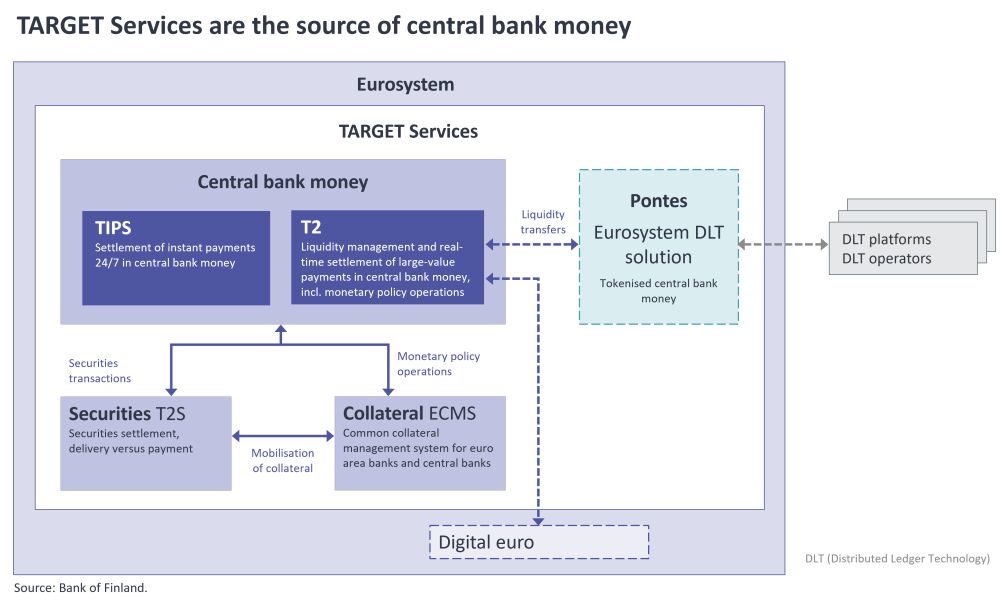
Rather than rejecting the technological underpinnings of digital assets, the ECB is proactively positioning itself as the ultimate architect of tokenised finance. Central banks recognize that tokenisation is irreversible; therefore, the strategy has shifted from resistance to integration. By spearheading initiatives like wholesale central bank digital currency (CBDC) settlement trials, the Eurosystem aims to provide a risk-free settlement asset that bridges legacy gross settlement systems with emerging DLT networks.
This approach addresses the core demands of institutional investors: infrastructure scalability, ironclad regulatory compliance, and absolute certainty of value. By anchoring tokenised commercial bank money and regulated stablecoins to a risk-free public ledger asset, the ECB seeks to preserve the single currency’s integrity while unlocking the productivity gains promised by blockchain technology.
| Asset Architecture | Settlement Speed | Systemic Risk Profile | Monetary Policy Impact |
|---|---|---|---|
| Traditional Legacy Rails (TARGET2) | Real-time (Business Hours) | Low (Central Bank Backed) | Fully Aligned & Predictable |
| Unbacked Private Cryptocurrencies | Variable (Network Dependent) | High (Extreme Volatility) | Disruptive / Detached |
| Commercial Stablecoins | Instant (24/7/365) | Moderate to High (Run Risk) | Fragmenting Liquidity Pools |
| Wholesale CBDC / Digital Euro | Instant / Atomic (24/7/365) | Minimal (Sovereign Guarantee) | Strengthens Transmission |
Industry & Market Implications: Winners, Losers, and Capital Allocation
The strategic pivot outlined by the ECB carries profound implications for global financial markets, reshaping competitive dynamics across banking, fintech, and enterprise technology sectors.
Who Wins
- Tier-1 Universal Banks: Institutions capable of successfully integrating legacy core banking systems with permissioned DLT networks will capture lucrative fee income from asset servicing and tokenisation mandates.
- Regulated Fintech Infrastructure Providers: Technology vendors specializing in enterprise-grade compliance, cryptographic security, and interoperability protocols will experience surging corporate demand.
- Institutional Asset Managers: Funds equipped to deploy capital into tokenised money market instruments and real-world assets will benefit from compressed operating costs and superior liquidity management.
Who Loses
- Unregulated Stablecoin Issuers: Entities operating in regulatory grey areas face severe compliance contraction, diminishing arbitrage opportunities, and restricted access to major banking corridors.
- Legacy Intermediaries: Correspondent banks and clearinghouses relying on slow, fee-heavy legacy messaging and manual reconciliation face existential revenue erosion.
- Speculative Altcoin Ecosystems: Tokens lacking fundamental utility or legal backing will struggle to retain institutional capital as risk mitigation mandates tighten globally.
Frequently Asked Questions (People Also Ask)
What is the primary concern raised by the ECB regarding private digital assets?
The European Central Bank argues that unbacked private cryptocurrencies and fragmented stablecoins undermine monetary policy transmission. Because private digital assets operate outside traditional central bank oversight and lack guaranteed liquidity backing, their widespread adoption risks fragmenting market liquidity and destabilizing the financial system during periods of macroeconomic stress.
How does tokenisation improve payment efficiency in capital markets?
Tokenisation converts traditional assets and currency into programmable digital tokens operating on shared, distributed ledgers. This enables atomic settlement—the instant, simultaneous exchange of assets and cash—which eliminates counterparty credit risk, reduces trapped collateral, and drastically cuts back-office reconciliation costs for institutional market participants.
What role does the digital euro play in the ECB's monetary strategy?
The digital euro acts as a public anchor for the European payment ecosystem. By providing a secure, universally accepted central bank digital currency for both retail and wholesale transactions, the ECB ensures that public money remains the foundational settlement asset, safeguarding monetary sovereignty against the encroachment of volatile private tokens.
How will these regulatory developments affect corporate capital allocation?
Firms are shifting capital away from speculative, high-risk digital assets and redirecting investments toward compliant DLT infrastructure, cloud compute architecture, and tokenised enterprise assets. Compliance, liquidity risk mitigation, and operational scalability have become the primary drivers of technology budgets in the financial sector.
Future Outlook: Milestones and Strategic Horizons
As the European Central Bank refines its operational roadmap, market participants must monitor several critical milestones over the next 24 to 36 months. The formal legislative framework governing crypto-assets in Europe (MiCA) is rapidly maturing, setting a global precedent for regulatory compliance and capital requirements. Concurrently, ongoing Eurosystem trials involving DLT-based wholesale settlement will test the technical boundaries of public-private ledger integration.
For executive leadership teams, corporate treasurers, and institutional investors, the mandate is clear. Navigating the tokenisation era requires a balanced strategy: embracing the undeniable efficiency gains of programmable ledgers while rigorously aligning with the evolving perimeter of central bank-backed monetary policy. Those who successfully adapt their infrastructure to this dual reality will dominate the next generation of global finance; those who ignore the ECB's warnings risk systemic obsolescence.