Executive Takeaways
- The 80% Autonomy Milestone: By 2025, enterprise AI agents powered by Ada achieved an 80% autonomous resolution rate across complex client tiers, systematically outpacing legacy human support teams in both speed and CSAT metrics.
- Token-Scale Infrastructure: Operating at a staggering velocity of 1.5 trillion tokens monthly, Ada's architecture represents one of the largest enterprise-grade transactional AI workflows in production today.
- Venture Backing & Valuation: Backed by blue-chip institutions including Bessemer Venture Partners, Accel, Spark Capital, FirstMark Capital, and Tiger Global, the company secured a $1.2 billion valuation, cementing its unicorn status in the Canadian and global tech ecosystems.
- The Fanatical CX Loop: Moving beyond static deflection, Ada’s recursive machine-learning loops ingest real-time consumer telemetry from massive digital properties like Amazon’s Twitch to dynamically rewrite dialogue trees without human developer intervention.
TORONTO & NEW YORK — In the high-stakes theater of enterprise software, the boundary between automated assistance and human substitution has officially collapsed. For years, Chief Information Officers and CFOs evaluated conversational AI through the lens of cost-containment: a blunt instrument designed to deflect low-tier support tickets, appease frustrated consumers with rigid decision trees, and protect human operational margins. That paradigm expired quietly over the course of 2025. Today, the vanguard of digital customer experience (CX) is defined not by deflection, but by autonomous mastery.
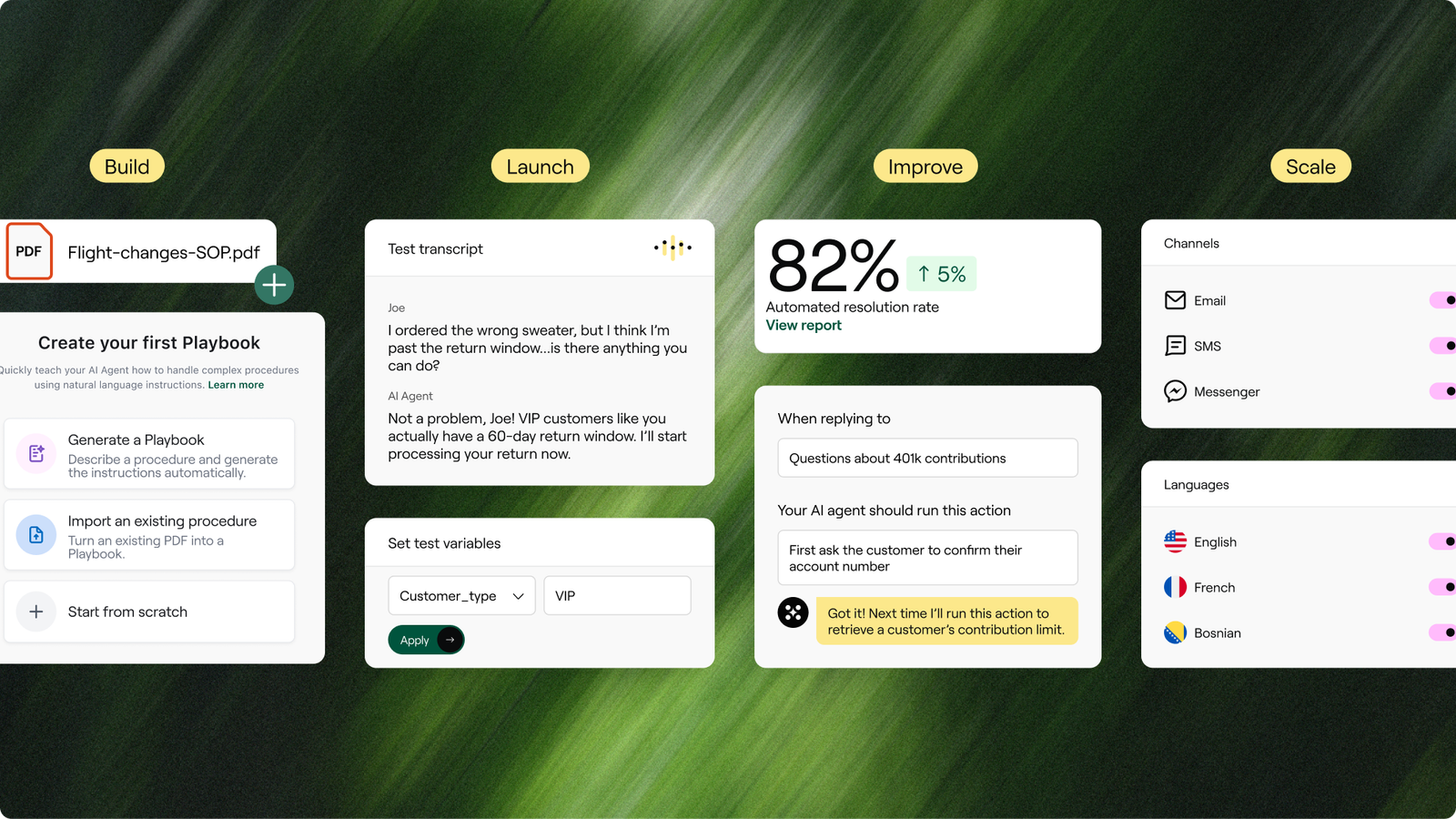
At the center of this paradigm shift is Ada, a platform that has transformed from a promising conversational tool into a foundational enterprise infrastructure. Processing a staggering 1.5 trillion tokens monthly, Ada's agents no longer assist support desks—they run them. Armed with fanatical, self-optimizing feedback loops, these agents achieved a historic inflection point in 2025, consistently outperforming human support teams by autonomously resolving 80% of inbound customer inquiries while simultaneously driving higher Customer Satisfaction (CSAT) scores than their human counterparts.
For enterprise buyers, venture capitalists, and market analysts tracking enterprise ROI and cloud compute architecture, Ada's trajectory offers an invaluable case study in capital allocation, product-market fit, and technical scalability. As global conglomerates race to optimize risk mitigation and trim bloated operational expenditures, the mechanics behind Ada’s architecture reveal how closed-loop machine learning is rewriting the economics of enterprise labor.
From Static Deflection to Autonomous Resolution: The Catalytic Shift of 2025
To understand the magnitude of Ada’s current market position, one must examine the evolutionary trajectory of enterprise conversational software. Founded on the premise that customer service workflows were fundamentally broken, early iterations of the platform focused on automating repetitive interactions. However, the generative AI wave of 2023 and 2024 exposed the limitations of off-the-shelf Large Language Models (LLMs). Unconstrained foundation models hallucinated, failed to integrate securely with legacy CRM databases, and lacked the domain-specific guardrails required by Fortune 500 brands.
Ada solved this by engineering what industry insiders term "fanatical CX loops." Rather than treating every customer interaction as an isolated event, Ada’s architecture ingests post-resolution telemetry, sentiment analysis, agent overrides, and downstream transactional data in real time. When an AI agent encounters an ambiguous query or a novel edge case, the system does not simply route the ticket to a human queue; it captures the human resolution path, generalizes the pattern across its vector database, and updates its operational parameters autonomously.
This recursive learning loop fundamentally altered unit economics for digital-first giants. Consider high-velocity streaming ecosystems like Twitch—an American video live-streaming service operated by Twitch Interactive, a subsidiary of Amazon Entertainment. In digital environments characterized by millions of concurrent users, sudden spikes in community engagement, and complex monetization mechanics, traditional support scaling required linear additions of human headcount. By deploying Ada's autonomous agents, enterprises operating at web-scale absorbed massive traffic surges without proportional increases in operational overhead, proving that enterprise-grade AI could deliver superior service quality at a fraction of human labor costs.
Capital Allocation, Valuation Multiples, and the Unicorn Blueprint

The market’s recognition of this technological moat is clearly reflected in Ada’s corporate finance ledger. Backed by a syndicate of premier institutional investors—including Accel, Spark Capital, Bessemer Venture Partners, FirstMark Capital, and Tiger Global—Ada achieved a watershed $1.2 billion valuation during its financing rounds, establishing itself as one of Canada's premier AI unicorns.
In a venture capital environment historically characterized by speculative excess followed by severe valuation corrections, Ada’s capital efficiency and revenue retention metrics stood out to tier-one underwriters. Investors evaluating software-as-a-service (SaaS) metrics look closely at Net Revenue Retention (NRR) and Gross Margin efficiency. Because Ada’s token-scale infrastructure processes multi-modal queries across complex enterprise APIs with minimal human intervention, its gross margins have scaled aggressively alongside its top-line growth.
Furthermore, the company's ability to attract cross-border institutional capital from firms like Bessemer and Tiger Global highlights the global appetite for enterprise automation platforms that demonstrate immediate payback periods. While many AI startups in 2023 and 2024 struggled to prove sustainable unit economics amid soaring cloud compute costs, Ada monetized its token volume effectively, passing infrastructure efficiencies down to enterprise clients while preserving healthy software margins.
| Metric / Milestone | Historical Benchmark (2021) | Current Enterprise Reality (2025/2026) |
|---|---|---|
| Valuation | $1.2 Billion USD (Unicorn Status) | Market leader commanding premium ARR multiples |
| Monthly Token Volume | Nascent transactional processing | 1.5 Trillion Tokens Monthly |
| Autonomous Resolution Rate | ~30% to 40% (Rule-based / Basic NLP) | 80% Autonomous Resolution across complex tiers |
| CSAT Performance | Parity or lagging behind human agents | Consistently outperforming human support teams |
| Key Institutional Backers | Accel, Spark Capital, Bessemer, FirstMark, Tiger Global | Expanded institutional syndicate & strategic partners |
Industry and Market Implications: Winners, Losers, and Economic Realignment
The maturation of Ada’s autonomous CX ecosystem triggers profound structural realignments across the broader technology and service economy. As enterprise boards mandate aggressive digital transformation strategies to offset macroeconomic pressures, the ripple effects are felt across multiple sectors:
- Enterprise Buyers (The Winners): Chief Customer Officers and CFOs gain unprecedented leverage. By offloading 80% of tier-one and tier-two inquiries to autonomous agents that maintain higher CSAT scores than human counterparts, corporations drastically reduce cost-per-resolution while insulating themselves against labor shortages and wage inflation in contact centers.
- Traditional Business Process Outsourcing (BPO) Providers (The Losers): The BPO industry faces an existential reckoning. Business models historically predicated on billing clients by the seat-hour are being systematically dismantled by outcome-based, token-driven AI architectures. BPOs that fail to pivot toward AI orchestration and proprietary data annotation risk rapid margin compression.
- Cloud Compute & Infrastructure Providers: Processing 1.5 trillion tokens monthly requires massive, specialized GPU infrastructure and low-latency vector database querying. Partnerships between AI platform architects and hyperscale cloud providers (such as Amazon Web Services, Microsoft Azure, and Google Cloud) are becoming tighter and more mission-critical than ever.
Frequently Asked Questions (People Also Ask)
1. How do Ada’s AI agents achieve an 80% autonomous resolution rate without sacrificing customer satisfaction?
Ada achieves this through deep integration with enterprise backend systems combined with proprietary "fanatical CX loops." Unlike rigid decision-tree bots, Ada’s agents execute transactional workflows—such as processing refunds, modifying subscriptions, and troubleshooting technical errors—directly within CRM and ERP databases. Furthermore, closed-loop machine learning continuously ingests resolution outcomes and customer feedback, allowing the models to self-optimize and maintain superior CSAT scores compared to fatigued human agents.
2. What role do institutional investors like Bessemer Venture Partners and Tiger Global play in Ada’s growth?
Beyond providing the capital necessary to reach its $1.2 billion valuation, premier institutional investors supply strategic guidance on global enterprise go-to-market strategies, cross-border regulatory compliance, and mergers-and-acquisitions opportunities. Their backing validates Ada’s enterprise readiness, giving risk-averse CIOs confidence in the platform's long-term financial stability and technological roadmap.
3. How does Ada handle data privacy, security, and regulatory compliance for Fortune 500 enterprises?
Enterprise data security is paramount for platforms processing sensitive customer telemetry at scale. Ada implements rigorous enterprise-grade security protocols, including end-to-end encryption, strict data isolation, role-based access controls, and compliance frameworks aligned with SOC 2 Type II, GDPR, and CCPA standards. Customer data is utilized exclusively within secured tenant boundaries to train localized models without compromising proprietary corporate information.
4. How does Ada's token-scale architecture differ from standard off-the-shelf Large Language Models?
While generic LLMs require extensive custom engineering and prompt tuning to integrate with enterprise software, Ada provides an out-of-the-box orchestration layer specifically engineered for customer experience workflows. Processing 1.5 trillion tokens monthly, the platform combines foundation model reasoning with deterministic guardrails, zero-hallucination verification checks, and native API connectors built explicitly for high-velocity customer service environments.
Future Outlook: The Road Ahead for Autonomous Enterprise Agents
As we navigate through 2026 and beyond, the competitive moat in enterprise AI will no longer belong to companies with the largest base models, but to those with the tightest, most responsive operational feedback loops. Ada’s dominance in processing 1.5 trillion tokens monthly demonstrates that autonomous agents have crossed the threshold from experimental novelty to mission-critical infrastructure.
Key milestones to watch in the coming quarters include the expansion of multi-modal autonomous agents capable of resolving complex visual and voice-based customer interactions, deeper integration with autonomous enterprise workflows (beyond customer service into sales and IT service management), and potential public market maneuvers as venture-backed AI unicorns mature into generational public tech enterprises. For the modern enterprise, the directive is unequivocal: adapt to the autonomous threshold, or cede market share to competitors already operating at token-scale velocity.