Executive Takeaways
- Paradigm Shift in Cyber Warfare: Google Cloud has deployed a next-generation AI-driven threat defense system designed to autonomously remediate enterprise infrastructure vulnerabilities in real time.
- Capital Expenditure & Market Positioning: The launch accelerates Alphabet’s aggressive monetization strategy within its cloud compute architecture, aiming to capture high-margin cybersecurity budgets amid tightening enterprise risk mitigation protocols.
- Competitive Pressure on Legacy Vendors: Traditional security information and event management (SIEM) operators face immediate margin compression as automated, LLM-backed threat detection redefines enterprise ROI expectations.
- Regulatory & Compliance Tailwinds: The architecture integrates native compliance-as-code frameworks, shielding multinational corporations from escalating global cybersecurity fines and regulatory liabilities.
NEW YORK & SAN FRANCISCO — In a move set to radically reprice risk across the global technology sector, Google Cloud has officially rolled out its comprehensive, AI-driven threat defense architecture for enterprise security. Announced against the backdrop of escalating state-sponsored cyber offensives and ballooning data breach costs, the deployment represents a decisive pivot from reactive security analytics to autonomous, predictive cyber defense. For institutional investors, chief information security officers (CISOs), and enterprise risk executives, the launch signals a structural transformation in how cloud compute infrastructure, capital allocation, and digital fortification intersect.
The announcement hits the market at a critical juncture for corporate IT spending. As enterprises grapple with widening talent shortages in cybersecurity and increasingly sophisticated, LLM-assisted cyberattacks, demand for automated risk mitigation has skyrocketed. By embedding advanced generative artificial intelligence and deep-learning neural networks directly into its core cloud fabric, Google Cloud is positioning its ecosystem not merely as a storage and compute utility, but as an indispensable digital immune system for the Fortune 500.
The Catalytic Shift: Moving Beyond Signature-Based Defense
For decades, enterprise security relied heavily on signature-based detection mechanisms—systems that identify known threats by matching them against historical databases of malicious code. However, the proliferation of zero-day exploits, polymorphic malware, and automated phishing campaigns has rendered legacy infrastructure obsolete. Modern enterprise networks, characterized by sprawling multi-cloud environments and decentralized workforces, generate millions of security telemetry events per second, overwhelming traditional security operations centers (SOCs).
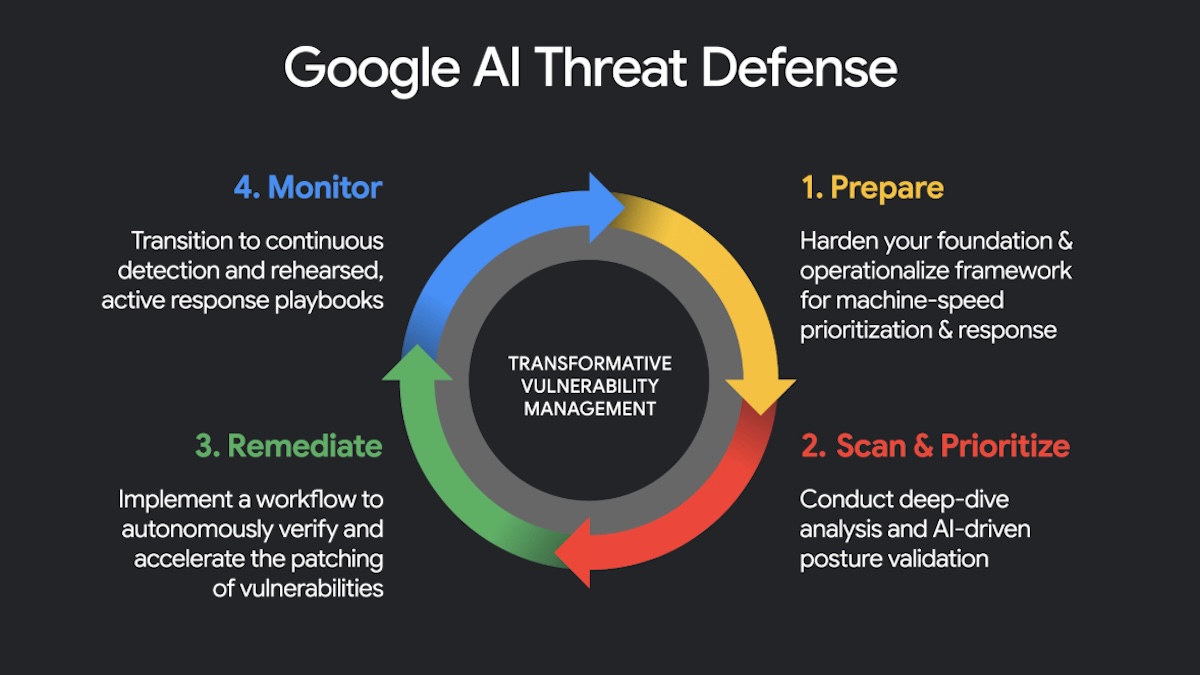
Google Cloud’s new AI-driven defense mechanism directly targets this operational bottleneck. By leveraging massive proprietary datasets harvested from global threat intelligence networks, the platform utilizes advanced pattern recognition to isolate anomalies microseconds after network intrusion attempts occur. Unlike older models that require human intervention to parse logs and deploy patches, this system closes the loop autonomously—detecting, isolating, and neutralizing vector threats without human latency.
Financial analysts tracking Alphabet’s valuation multiples note that this software-as-a-service (SaaS) layer significantly enhances the stickiness of Google Cloud’s enterprise contracts. High-margin security add-ons have historically served as primary drivers for software valuation expansion, and Google’s latest iteration is engineered to extract maximum recurring revenue from its existing enterprise base while poaching accounts from legacy incumbents.
Infrastructure Scalability and Financial Impact

Deploying real-time, compute-heavy artificial intelligence across global cloud infrastructure requires unprecedented computational efficiency. Industry insiders point out that Google’s proprietary Tensor Processing Units (TPUs) provide a structural cost advantage, allowing the tech giant to run resource-intensive threat analysis models without eroding cloud gross margins.
From a capital allocation perspective, enterprise buyers are increasingly evaluating cloud vendors through the lens of total cost of ownership (TCO) and risk-adjusted return on investment. Data breaches routinely inflict catastrophic damage on corporate valuations, regulatory compliance standings, and brand equity. By integrating proactive threat mitigation directly into the cloud substrate, Google aims to convince corporate treasuries that the platform pays for itself by averting catastrophic ransomware payouts and regulatory penalties.
| Metric / Dimension | Legacy SIEM & Security Models | Google Cloud AI Threat Defense |
|---|---|---|
| Threat Detection Latency | Hours to Days (Human analysis required) | Microseconds (Autonomous remediation) |
| Operational Expenditure (OpEx) | High (Large SOC staffing requirements) | Optimized (AI-driven workflow automation) |
| Infrastructure Integration | Siloed third-party point solutions | Native multi-cloud substrate integration |
| Regulatory Compliance Alignment | Manual audit preparation and reporting | Continuous, automated compliance-as-code |
Market Implications: Winners, Losers, and Competitive Dynamics
The introduction of Google’s AI defense system sends immediate shockwaves across the enterprise technology landscape. The competitive battle lines among the major hyperscalers—Google Cloud, Microsoft Azure, and Amazon Web Services (AWS)—are increasingly drawn around artificial intelligence capabilities and end-to-end security dominance.
- The Winners: Enterprise clients benefit from superior protection and streamlined vendor consolidation. Alphabet shareholders stand to capture expanded cloud market share, particularly among highly regulated sectors such as banking, healthcare, and defense.
- The Losers: Standalone legacy cybersecurity vendors that rely on manual triage and traditional endpoint detection face severe valuation pressure. As native cloud security tools become more sophisticated, corporations are questioning the economic viability of maintaining expensive, disjointed third-party security stacks.
- Broader Economic Impact: By raising the baseline security standard for cloud-hosted enterprise data, the initiative dampens the macro-economic drag of global cybercrime, which economic research groups estimate costs the global economy trillions of dollars annually.
Frequently Asked Questions (People Also Ask)
How does Google Cloud’s AI threat defense differ from traditional security software?
Traditional security software relies on predefined signatures and human-led analysis to identify breaches after they occur. Google Cloud’s new architecture utilizes autonomous machine learning models trained on global threat telemetry to predict, isolate, and neutralize cyber threats in real time without requiring manual intervention.
What is the impact on enterprise return on investment (ROI)?
Enterprises achieve positive ROI through reduced Security Operations Center (SOC) staffing overhead, lower incidence of catastrophic data breaches, and minimized downtime. Furthermore, automated compliance frameworks reduce the legal and financial costs associated with regulatory audits.
Does this tool integrate with multi-cloud and hybrid environments?
Yes. Designed with enterprise interoperability in mind, the defense architecture extends visibility and remediation protocols across hybrid IT infrastructure, allowing organizations running workloads on competing clouds or on-premise servers to centralize security management.
How does this impact regulatory compliance mandates?
The platform incorporates continuous compliance-as-code monitoring, automatically aligning enterprise data workloads with strict global regulatory standards such as GDPR, HIPAA, and regional financial governance frameworks.
Future Outlook: Strategic Milestones to Watch
As Google Cloud scales its AI-driven threat defense ecosystem, market watchers will be closely monitoring key performance indicators over the next four to eight quarters. Critical milestones include enterprise net retention rates, the speed of customer migration from legacy SIEM vendors, and potential regulatory scrutiny regarding data handling practices within automated AI security loops.
Ultimately, Google’s aggressive push underscores an immutable reality of the modern digital economy: security is no longer an ancillary IT checkbox—it is the foundational bedrock upon which enterprise valuation, operational continuity, and market leadership are built. As adversarial AI continues to evolve, the battleground for corporate data will be won or lost in the milliseconds where autonomous defense systems meet systemic enterprise risk.