WASHINGTON & NEW YORK — For decades, the structural bedrock of global finance has rested on a foundational assumption: the risk-free rate offered by United States long-term government debt would remain anchored within a predictable band, shielding corporate enterprise ROI and anchoring sovereign risk management. That foundational consensus is fracturing. In late August 2026, fresh market data channeled through premier wire services like Funds Society confirmed that rising long-term US Treasury yields are triggering severe alarms across institutional dealing desks, directly challenging the federal government's long-term debt financing architecture.
As the friction between massive deficit issuance and shifting market liquidity accelerates, institutional portfolio managers, corporate treasurers, and sovereign wealth funds are urgently recalibrating their risk mitigation frameworks. The implications extend far beyond Washington’s fiscal corridors, threatening equity valuation multiples, tightening corporate credit spreads, and raising systemic questions about how the world’s largest economy plans to service its ballooning liabilities without destabilizing global capital markets.
Executive Takeaways
- Escalating Debt Servicing Costs: Surging long-term Treasury yields are exponentially expanding the federal government's annual interest obligations, squeezing discretionary fiscal space and forcing difficult capital allocation choices in Washington.
- Valuation Compression Pressures: Higher risk-free rates are systematically rewriting corporate finance rules, forcing analysts to downwardly revise valuation multiples across capital-intensive sectors, tech infrastructure scalability, and leveraged balance sheets.
- Liquidity and Market Depth Strain: Primary dealers and institutional market makers report diminishing market liquidity in the long end of the curve, amplifying volatility during major Treasury auctions.
- Global Spillover Effects: As US yields trend upward, foreign exchange reserves, emerging market debt servicing, and cross-border capital flows face heightened downward pressures, complicating monetary policy coordination worldwide.
The Anatomy of the Yield Surge: Catalysts and Structural Pressures
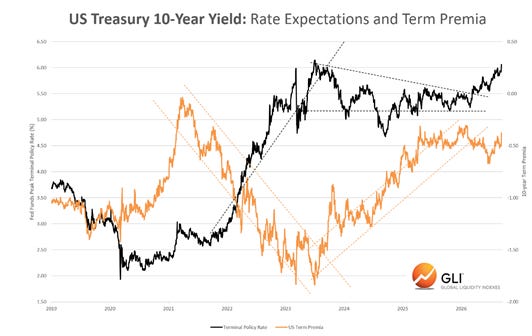
The current turbulence in the US Treasury market is not a sudden anomaly; it is the culmination of years of persistent fiscal deficits intersecting with a structural shift in monetary policy. Following the aggressive tightening cycles designed to curb post-pandemic inflation, the Federal Reserve transitioned into a "higher-for-longer" stance. However, while monetary policy stabilized short-term rates, the real battleground has shifted to the long end of the curve—the 10-year, 20-year, and 30-year sovereign bond maturities.
At the heart of the issue is supply-demand disequilibrium. The US Department of the Treasury has been forced to continuously ramp up auction sizes to finance an expanding national debt load that now exceeds historic peacetime ratios relative to Gross Domestic Product (GDP). Historically, robust international demand, anchored by foreign central banks and domestic institutional buyers, easily absorbed these issuances. Today, structural buyers—including foreign reserve managers diversifying away from dollar dominance and price-sensitive domestic pension funds—are demanding higher term premia to hold long-duration assets.
This dynamic has created a feedback loop. As yields rise to clear larger auction volumes, the market value of existing fixed-income portfolios declines, imposing unrealized losses on commercial banks and institutional balance sheets. This unrealized portfolio friction constrains lending capacity, dampens corporate investment, and introduces operational headwinds for CFOs seeking to optimize debt financing structures.
Data and Metrics Breakdown: Sovereign Debt and Yield Trajectory
To understand the mechanics of the current financing squeeze, we must examine the core quantitative indicators driving institutional sentiment:
| Metric / Indicator | Historical Baseline (Pre-2022) | Current Market Reality (2026) | Systemic Impact |
|---|---|---|---|
| 10-Year Treasury Yield | 1.50% – 2.50% | 4.35% – 4.75% (Elevated volatility) | Raises mortgage rates, corporate bond yields, and consumer borrowing costs. |
| Federal Net Interest Outlays | ~$400 Billion annually | Approaching $1 Trillion annually | Crowds out critical domestic spending and infrastructure investments. |
| Primary Dealer Inventory Risk | Low / High liquidity | Constrained by regulatory compliance (Basel III) | Amplifies auction tailing and intraday volatility spikes. |
| Corporate Debt Refinancing Wall | Low coupon refinancing | Peak maturity concentration | Forces companies to issue new debt at significantly higher interest expense. |
Industry & Market Implications: Winners, Losers, and Corporate Strategy
The ripple effects of surging long-term yields are deeply asymmetrical across the global economy. As capital becomes more expensive, corporate strategies must pivot swiftly to protect profit margins and maintain operational resilience.
Who Faces Pressures (The Vulnerable Segments)
- Capital-Intensive Tech and Infrastructure: Companies expanding cloud compute architecture and physical infrastructure scalability rely heavily on low-cost debt financing. Higher yields compress their discounted cash flow (DCF) models, leading to downward valuation re-ratings.
- Commercial Real Estate (CRE): Already grappling with structural shifts in hybrid work models, the CRE sector faces a brutal refinancing wall as maturing low-rate loans are replaced by debt carrying significantly higher coupon payments.
- Highly Leveraged Corporates: Firms that relied on cheap debt during the previous decade to fund aggressive M&A or share buybacks now face surging interest expense burdens, restricting free cash flow available for operational reinvestment.
Who Navigates Successfully (The Resilient Segments)
- Cash-Rich Balance Sheets: Technology conglomerates and industrial giants holding substantial short-term cash reserves are actually benefiting from higher interest income on their liquid assets.
- Asset Managers and Fixed-Income Funds: Institutional managers offering diversified private credit, high-yield structured products, and short-duration fixed-income strategies are seeing robust inflows from investors seeking attractive real returns.
Frequently Asked Questions (People Also Ask)
Why are long-term US Treasury yields rising despite stabilizing inflation data?
While headline inflation has moderated compared to its post-pandemic peak, long-term yields are being driven primarily by structural supply-demand imbalances. The sheer volume of federal debt issuance required to fund ongoing budget deficits has saturated the market. Additionally, investors are demanding a higher "term premium"—extra compensation for the risk of holding long-duration fixed-income assets in an environment of persistent fiscal expansion and geopolitical uncertainty.
How do rising Treasury yields impact corporate borrowing and enterprise ROI?
Treasury yields serve as the foundational benchmark for virtually all domestic and international credit markets. When sovereign yields rise, corporate bond yields, bank lending rates, and commercial loan costs rise in tandem. This increases the cost of capital, forcing corporations to raise their hurdle rates for new projects, which directly pressures enterprise Return on Investment (ROI) and limits aggressive capital expenditures.
What role do primary dealers and regulatory constraints play in Treasury market volatility?
Post-2008 regulatory frameworks, such as enhanced capital requirements and Basel III liquidity rules, constrain the balance sheet capacity of primary dealers—the major financial institutions that buy Treasuries at auctions and make markets for clients. Because these dealers cannot easily absorb massive influxes of new sovereign debt onto their books, market liquidity at times thinned out, leading to sharper price swings and auction "tails" (where securities sell at lower prices than anticipated).
Are foreign central banks still buying US government debt?
Overall foreign official holdings of US Treasuries have evolved significantly. While major traditional buyers have diversified their foreign exchange reserves or slowed their net accumulation pace, private international capital, hedge funds, and global asset managers have stepped in. However, because foreign demand is now more price-sensitive, the US Treasury must offer more attractive yields to clear its regular refunding auctions.
Future Outlook: Milestones and Strategic Risk Mitigation
As we look toward the remainder of 2026 and into 2027, the trajectory of US Treasury yields will remain the single most critical variable governing global asset prices. Market participants are closely monitoring upcoming Treasury quarterly refunding announcements, congressional fiscal negotiations regarding deficit reduction, and the Federal Reserve’s balance sheet normalization (quantitative tightening) pace.
For corporate leadership teams, the mandate is clear: strategic agility and rigorous risk mitigation are paramount. Organizations must prioritize liquidity preservation, optimize capital allocation toward high-conviction operational efficiencies, and actively manage refinancing schedules well in advance of maturity dates. In an era where the risk-free rate can no longer be taken for granted, financial discipline is no longer optional—it is the ultimate determinant of market survival and competitive dominance.