Executive Takeaways
- Unyielding Inflation Mandate: Federal Reserve Chair Kevin Warsh explicitly stated that structural inflation is not decelerating at an acceptable velocity, reaffirming the central bank's absolute commitment to the 2.0% target and signaling a "higher-for-longer" rate regime.
- Equity Market Contraction: Wall Street's benchmark indexes closed sharply lower on Friday as institutional money managers aggressively repriced terminal interest rate expectations, leading to a broad-based sell-off across high-valuation growth sectors.
- Valuation Multiples Under Pressure: The hawkish policy stance is forcing corporate treasurers and buy-side analysts to recalculate capital allocation models, directly impacting equity risk premiums and putting downward pressure on technology valuation multiples.
- Yield Curve Reshaping: Treasury yields surged across the curve, reflecting diminished market liquidity and a growing consensus that the neutral rate of interest (r-star) has structurally shifted upward.
The Catalytic Event: Inside Warsh’s Market-Moving Address
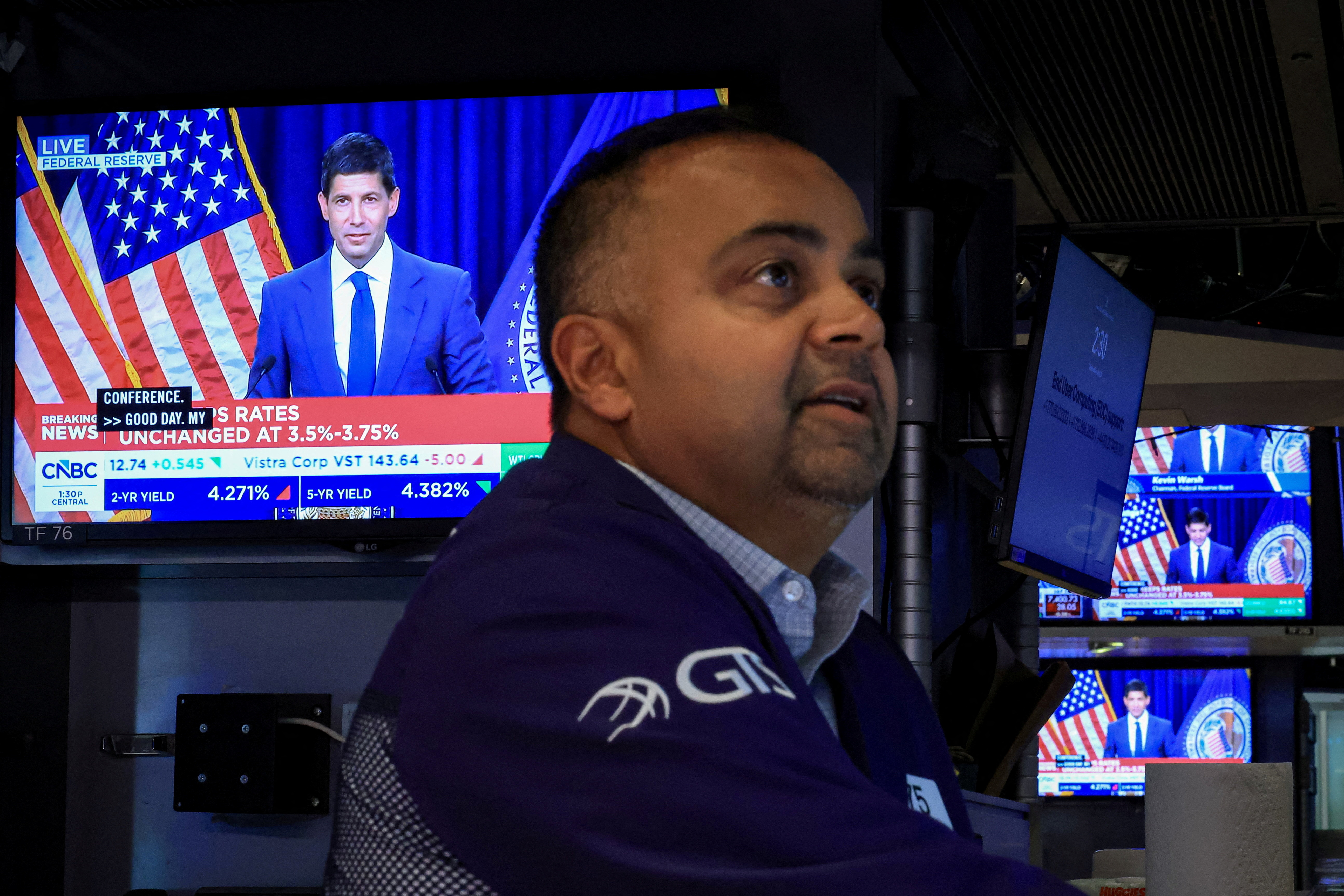
The delicate truce between Wall Street and the Federal Reserve shattered on Friday as Federal Reserve Chair Kevin Warsh delivered a stark, uncompromising assessment of the macroeconomic landscape. Speaking before an audience of institutional economists and asset managers, Warsh systematically dismantled any lingering market expectations of an imminent, aggressive monetary easing cycle. His message was clear: the underlying drivers of domestic inflation remain deeply entrenched, and the central bank is prepared to tolerate economic friction to achieve long-term price stability.
The market reaction was swift and unforgiving. The S&P 500 and the Nasdaq Composite, which had spent the previous week hovering near record highs on hopes of a dovish policy pivot, plunged into negative territory within minutes of the speech's broadcast. Programmatic trading algorithms and discretionary hedge funds alike executed rapid-fire risk mitigation protocols, unwinding leveraged long positions in interest-rate-sensitive assets. By the closing bell, the major indexes registered some of their sharpest single-session declines of the quarter, highlighting how sensitive modern market liquidity is to central bank rhetoric.
At the heart of the market’s anxiety is the realization that the "Fed put"—the historical expectation that the central bank will step in to support asset prices during periods of volatility—is effectively dormant. Chair Warsh’s remarks underscored a strategic pivot toward structural discipline. He noted that while headline Consumer Price Index (CPI) metrics have moderated from their cyclical peaks, core inflation components—particularly shelter, labor-intensive services, and supply-chain-reconstruction costs—are exhibiting stubborn persistence. "We will not be lulled into a false sense of security by transitory supply-side improvements," Warsh stated, in what market participants are now calling the "Warsh Doctrine."
Deconstructing the Structural Inflation Threat
To understand the depth of the Fed’s resolve, one must look beyond short-term data prints. Under Chair Warsh’s leadership, the Federal Reserve’s research staff has focused heavily on structural shift dynamics. Decades of globalization, cheap offshore labor, and highly optimized just-in-time supply chains—which previously acted as powerful deflationary forces—are actively reversing. The current geopolitical landscape requires significant investments in near-shoring, domestic manufacturing capacity, and redundant logistics infrastructure. While these initiatives bolster national resilience, they are fundamentally inflationary.
Furthermore, the energy transition and the explosive build-out of high-performance data centers designed for artificial intelligence have created unprecedented demand for raw materials and electrical grid capacity. This surge in industrial capital expenditure is occurring at a time when labor markets remain historically tight. Consequently, wage-price pressures in the services sector are not retreating at a pace consistent with a return to the 2% target. Chair Warsh’s speech highlighted these secular tailwinds, suggesting that the neutral rate of interest—the theoretical rate at which monetary policy is neither stimulative nor restrictive—has risen, rendering current policy less restrictive than historical models would imply.
For corporate leadership, this structural shift changes the arithmetic of business planning. For the past fifteen years, cheap debt functioned as a primary mechanism for boosting return on equity (ROE). In the new macroeconomic regime outlined by Warsh, enterprise ROI must be generated through genuine operational efficiency, pricing power, and technological innovation rather than financial engineering. Companies burdened with floating-rate debt or approaching major refinancing walls face a starkly different capital allocation environment.
Macroeconomic Indicators & Market Reaction Metrics
The following table illustrates the shift in key market indicators immediately preceding and following Chair Warsh’s policy address, highlighting the scale of the repricing event across asset classes:
| Financial Instrument / Indicator | Pre-Address Level | Post-Address Close | Basis Point / Percentage Change | Implication for Corporate Treasury |
|---|---|---|---|---|
| S&P 500 Index | 5,110.25 | 4,985.50 | -2.44% | Compression of broad equity valuation multiples. |
| 10-Year Treasury Yield | 4.12% | 4.31% | +19 bps | Increased cost of long-term corporate debt issuance. |
| 2-Year Treasury Yield | 4.45% | 4.68% | +23 bps | Yield curve inversion deepens; rising short-term financing costs. |
| Fed Funds Futures (Implied Year-End Rate) | 4.25% | 4.75% | +50 bps | Markets pricing out two scheduled 25 bps rate cuts. |
| CBOE Volatility Index (VIX) | 13.40 | 17.85 | +33.2% | Elevated cost of equity hedging and downside risk mitigation. |
The Impact on Enterprise Capital Allocation and Valuation Multiples
As the cost of capital remains elevated, enterprise executives face critical decisions regarding cash flow management and balance sheet optimization. During the era of quantitative easing, low discount rates inflated the present value of distant cash flows, allowing pre-revenue technology firms and speculative ventures to command astronomical valuation multiples. Under the Warsh Doctrine, the discount rate applied to future earnings is structurally higher. This shift disproportionately penalizes growth companies whose profitability is projected far into the future, while favoring cash-generative enterprises with strong current yields.
This valuation compression is forcing a rigorous reassessment of capital expenditure, particularly in high-cost sectors like cloud compute architecture and AI infrastructure. While enterprise demand for generative AI capabilities remains high, boards of directors are demanding clearer pathways to enterprise ROI before approving multi-billion-dollar infrastructure investments. "The era of unchecked capital deployment is over," noted a chief financial officer of a major Silicon Valley firm. "Every project must now clear a hurdle rate that is 300 to 400 basis points higher than it was three years ago."
Additionally, corporate treasury departments are prioritizing debt retirement and liability management over share buybacks. For years, executing stock repurchases using cheap debt was a standard play to bolster earnings per share (EPS). Today, with investment-grade corporate bond yields hovering well above historical averages, using cash reserves to pay down maturing liabilities or invest in high-yielding short-term cash equivalents represents a more prudent risk-mitigation strategy. This shift in capital allocation from equity support to balance sheet fortification removes a key pillar of support for the broader stock market.
Industry Implications: Winners, Losers, and the Regulatory Landscape
The continuation of a restrictive monetary policy creates distinct bifurcations across the corporate landscape:
The Disadvantaged Sectors (The "Losers")
- Commercial Real Estate (CRE): Already grappling with structural shifts in hybrid work patterns, the CRE sector faces a refinancing wall. Trillions of dollars of commercial mortgages are scheduled for reset over the next 24 months. At current interest rates, many properties will struggle to meet debt service coverage ratios, likely forcing distressed sales, write-downs, and increased loan-loss provisions for regional banking institutions.
- Highly Leveraged Growth & Small-Cap Firms: Companies within the Russell 2000 index, which rely heavily on floating-rate debt and bank credit lines, will see their interest expenses consume a larger portion of operating income, suppressing net profit margins and raising default probabilities.
- Consumer Discretionary: As high borrowing costs filter down to credit cards, auto loans, and mortgages, household discretionary income will contract. This poses a direct threat to high-end retail, travel, and leisure segments.
The Resilient Sectors (The "Winners")
- Net-Cash Corporate Giants: Mega-cap technology firms holding massive cash balances on their balance sheets are uniquely positioned. Instead of paying high interest, they are earning substantial yields on their cash reserves, effectively offsetting the impact of higher operational costs. This cash pile also allows them to fund R&D and strategic M&A internally, widening their competitive moats.
- Financial Institutions with Strong Deposit Franchises: Large money-center banks can maintain low deposit betas while reinvesting assets at higher yields, expanding their net interest margins (NIM). However, this benefit must be weighed against potential credit quality deterioration in their loan portfolios.
- Defensive Value & Essential Infrastructure: Utilities, healthcare providers, and consumer staples companies possess inelastic demand and robust pricing power, allowing them to pass rising input costs directly to consumers.
People Also Ask (PAA) / Frequently Asked Questions
Why did Fed Chair Warsh's speech trigger a sell-off on Wall Street?
Wall Street had priced in a benign economic scenario characterized by rapidly declining inflation and swift interest rate cuts. Fed Chair Warsh's speech directly challenged this optimistic narrative by highlighting persistent structural inflation and asserting that the central bank will keep rates elevated until inflation is convincingly on path to the 2% target. This hawkish clarification forced investors to rapidly adjust their economic models, leading to a broad-based repricing of equities and bonds.
How does a "higher-for-longer" rate environment affect corporate valuation multiples?
In financial theory, the valuation of an asset is the present value of its future cash flows, discounted by a rate tied to risk-free government bond yields. When the Fed keeps interest rates higher, the discount rate rises. A higher discount rate reduces the present value of those future earnings, particularly for growth stocks and technology companies whose primary profits are expected years down the road. This leads to a compression of price-to-earnings (P/E) and enterprise-value-to-EBITDA (EV/EBITDA) multiples.
What is the relationship between the neutral rate of interest (r-star) and monetary policy?
The neutral rate of interest, or r-star, is the real interest rate that supports the economy at full employment and stable inflation. If the actual interest rate is above the neutral rate, policy is restrictive; if it is below, policy is accommodative. Fed Chair Warsh’s commentary suggested that structural shifts in the global economy—such as supply chain re-shoring, the green energy transition, and persistent fiscal deficits—have pushed the neutral rate higher. This means current nominal interest rates are not as restrictive as they would have been in the previous decade, justifying a prolonged period of elevated policy rates.
What steps should institutional investors take for risk mitigation in this environment?
Institutional asset managers are actively shifting portfolios toward shorter-duration fixed-income instruments to minimize interest rate risk. In equities, there is an increased allocation to high-quality, cash-generative businesses with robust balance sheets and low leverage. Additionally, managers are utilizing derivatives and volatility indices (such as the VIX) to hedge against sudden capital market drawdowns, while increasing allocations to alternative assets like private credit and commodities that tend to perform well in persistent inflationary environments.
Future Outlook: Milestones and Key Indicators to Watch
As market participants adapt to the Warsh Doctrine, several key milestones will dictate the direction of global capital markets over the coming quarters. First and foremost are the monthly Core Personal Consumption Expenditures (PCE) prints, which the Federal Reserve favors as its primary inflation gauge. Any signs of acceleration in super-core inflation (services ex-housing) will likely solidify the Fed's hawkish bias, potentially pushing the terminal rate expectations even higher.
Second, the corporate earnings calendar will serve as an essential reality check. Investors will closely scrutinize forward guidance to assess how well companies are navigating compressed margins, elevated interest expenses, and slowing consumer demand. If corporate guidance begins to downgrade earnings expectations, we may see a secondary leg of market correction driven by earnings revisions rather than just multiple compression.
Finally, the plumbing of the financial system bears watching. The combination of quantitative tightening (QT)—the Fed’s ongoing reduction of its balance sheet—and massive Treasury issuance to fund the federal deficit could strain market liquidity. Signs of stress in the overnight repo market or a sharp widening of credit spreads would test the Fed's resolve, potentially forcing a choice between maintaining the inflation fight or intervening to ensure financial system stability. For now, Chair Warsh has made his priority clear: inflation remains public enemy number one, and Wall Street must learn to live without the safety net of easy money.